
Technical Production Partner vs. Event Planner: Busting the 5 Biggest Myths in 2026
If you believe your event planner is also your lead technical engineer, you might be unintentionally setting the stage for a silent keynote. It’s a common assumption that can lead to expensive misunderstandings and unnecessary stress. While a planner designs the guest experience, a technical production partner vs event planner comparison reveals that the latter engineers the physical reality of your vision. You’ve likely felt the pressure of a rising budget or the fear of a technical glitch during a high-stakes presentation. It’s a heavy burden to carry when your brand’s reputation is on the line.
We understand that you want a cohesive team where every detail is managed with precision. This article clarifies these distinct roles to ensure your next event is engineered for success, not just organized. You’ll gain clarity on who handles complex technical riders and how to prevent communication gaps between creative ideas and technical execution. We’re going to bust the five biggest myths that cause budget bloat and friction in 2026. By the end, you’ll have a clear roadmap for building a production team that lets you focus on your guests while the technical experts handle the behind-the-scenes mastery.
Key Takeaways
- Understand why modern event technology in 2026 demands specialized engineering to prevent technical bottlenecks and ensure seamless execution.
- Learn the critical differences between a technical production partner vs event planner, focusing on the balance between guest comfort and technical reliability.
- Discover how the four pillars of production-audio, video, lighting, and staging-act as the structural foundation for your brand’s message.
- Uncover the true ROI of a technical partnership, including how early collaboration prevents costly on-site change orders and equipment mismatches.
- Gain a clear set of criteria for selecting a production ally with the national reach and heritage-driven work ethic required for high-stakes environments.
The Myth of the All-in-One Event Professional
The landscape of Event management is more complex than ever. In 2026, the demand for immersive, broadcast-quality experiences means that the “one-stop-shop” model for event planning is often a recipe for technical bottlenecks. While your planner is an essential architect of the guest experience, expecting them to also lead your technical engineering can lead to critical points of failure. It’s a heavy burden to place on a professional whose primary focus should be the seamless flow of people and logistics.
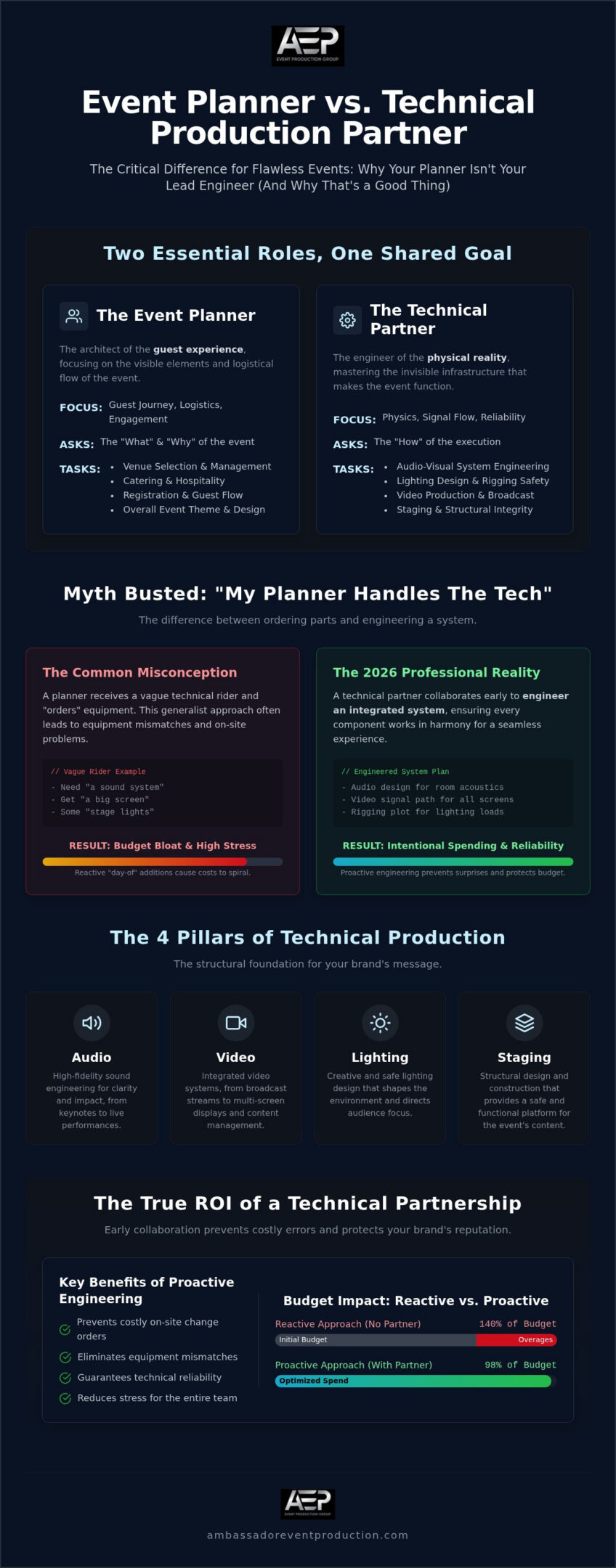
A planner’s expertise lies in the visible elements: the venue selection, the catering, and the logistical flow that keeps guests engaged. However, the invisible infrastructure, the audio-visual backbone, requires a different level of specialization. Relying on an “AV Guy” or a generalist often results in equipment being “ordered” rather than a system being “engineered.” This distinction is the core of the technical production partner vs event planner conversation. One designs the vision, while the other builds the reality that supports it.
Myth #1: My Planner Handles the Technology
There is a significant difference between a strategic vision and technical execution. Your planner is your partner for the “what” and the “why,” but a technical production partner is responsible for the “how.” In 2026, technical requirements have evolved. We’re seeing stricter national rigging safety standards and a move toward high-fidelity audio that generalists simply aren’t equipped to manage. When a planner oversees technical details without an engineering lead, the budget often suffers from oversight rather than intentional spending. It’s not a lack of effort; it’s a lack of specialized engineering depth.
The High Cost of Technical Misunderstandings
A dedicated production team prevents these surprises through early collaboration. By bringing in a technical lead during the initial design phase, you ensure that the lighting design, audio production, and staging are integrated from the start. This approach reduces stress and guarantees that the execution matches your brand’s high standards. It’s about moving away from reactive troubleshooting and toward proactive engineering that lets your planner focus on the guests.
What is a Technical Production Partner? (Definition & Scope)
A technical production partner acts as the engineering firm responsible for the physical and digital infrastructure of your event. They’re the professionals who ensure the invisible mechanics work perfectly behind the scenes. When looking at a technical production partner vs event planner, you’ll find that while the planner focuses on the guest journey, the production partner masters the “how” through a deep understanding of physics and signal flow. This behind-the-scenes mastery is what prevents a high-fidelity audio system from feeding back or a broadcast-grade video stream from lagging during a global keynote. When evaluating a technical production partner vs event planner, it’s essential to understand that they’re complementary allies, not competitors.
To bring these complex systems together, you need the live event technical direction that unifies the four pillars of production. These pillars-audio, video, lighting, and staging-must work as a single, cohesive unit. This level of coordination is what transforms a standard meeting into an immersive experience that aligns with your brand’s highest standards.
Integrated Video and Audio Production
Modern events have moved far beyond simple microphones and screens. We now manage sophisticated signal paths that require a unified management strategy to avoid technical bottlenecks. This is where a professional live event AV workflow becomes critical for high-stakes environments. Technical production is the bridge between creative concept and mechanical reality. By integrating video production services with high-fidelity audio production, we ensure that every piece of technology supports the speaker’s message without distraction.
Staging, Rigging, and Structural Safety
Staging is an engineering feat, not just a wooden platform. It requires precise calculations to ensure stability and safety for everyone on stage, especially when supporting heavy LED walls or complex sets. In 2026, staying compliant with national rigging safety standards is a non-negotiable requirement for any reputable venue. A production partner handles these structural complexities, from the initial load-bearing math to the final execution of staging and rigging. When paired with expert lighting design, these structural elements do more than just hold people up; they create a dynamic environment that drives audience engagement. If you need a partner who prioritizes these high standards, Ambassador Event Production offers the seasoned expertise required for national-scale success.
Technical Production vs. Event Planning: The Side-by-Side Comparison
Understanding the distinction between these roles is the first step toward a flawless execution. While the planner focuses on guest comfort and the overall atmosphere, the production partner prioritizes technical reliability. It’s a balance of hospitality and engineering. A planner ensures the registration is smooth and the catering is on time; the technical lead ensures the audio is crystal clear and the lighting cues are perfectly timed. Both are essential, but their primary objectives require different mindsets and training.
The timelines for these roles also diverge significantly. A planner often starts months or even years in advance, securing the venue and defining the creative theme. The technical production team typically engages during the technical design phase, translating that creative vision into a physical equipment list and a signal map. On show day, a clear hierarchy emerges to avoid confusion. The Event Director, usually the planner, manages the attendee flow and VIP needs, while the Stage Manager from the production team takes control of the technical crew, ensuring every transition happens exactly as planned.
Who Owns the Technical Rider?
One of the most common causes of budget bloat is a planner signing a technical rider without an engineering review. A technical partner should review these documents early to identify equipment redundancies that don’t add value to the show. For example, if you’re planning a complex broadcast, your partner ensures that hybrid event video production is properly specced for both the in-room and remote audiences. This proactive review prevents last-minute surprises that often lead to premium rush fees and equipment mismatches.
The Collaboration Framework
A successful event depends on a seamless hand-off between creative design and technical execution. We recommend a unified “Show Flow” document that combines logistical cues with technical triggers. This document serves as the single source of truth for both teams. When the technical production partner vs event planner roles are clearly defined, communication becomes methodical rather than frantic. It creates a supportive environment where the planner can focus on the client’s vision, knowing the technical team has the behind-the-scenes mastery handled. This collaborative approach is the hallmark of a team that prioritizes consistency and thoroughness over simple transactions.
Busting the ROI Myth: Is a Technical Partner “Extra” Expense?
Many organizations assume that using the venue’s in-house AV is the most cost-effective path. It’s a logical thought, but it often overlooks the hidden “change order” culture that plagues on-site execution. A dedicated technical production partner vs event planner dynamic works differently. While the planner focuses on the venue contract, the production partner focuses on the technical rider’s precision. By engineering the solution beforehand, you avoid the premium fees associated with last-minute equipment additions. This proactive approach protects your budget from the unexpected costs that occur when a generalist realizes the venue’s gear isn’t compatible with your keynote’s needs.
Quality control is another significant driver of ROI. When you work with a partner who owns and maintains their own equipment, you’re not at the mercy of a third-party rental warehouse. Every piece of high-fidelity audio gear and broadcast-grade video hardware is tested before it leaves the shop. This level of oversight ensures a flawless experience that protects your brand’s reputation. After all, the cost of a technical failure during a high-stakes moment is always higher than the investment in professional engineering. Choosing the right technical production partner vs event planner structure ensures that quality control is a priority, not an afterthought.
Preventing Technical Failures and Liability
The hidden costs of “good enough” audio and lighting often manifest as disengaged audiences or, worse, safety liabilities. Professional staging and rigging are engineering tasks that require strict adherence to national safety standards. In 2026, compliance with updated structural regulations is a non-negotiable part of risk mitigation. This is especially true for high-pressure environments like technical production for sales kick-off meetings, where zero-fail redundancy is mandatory. You can’t afford a single point of failure when your entire national sales force is watching.
The Value of a 70-Year Legacy
There’s a distinct advantage to working with a family-owned partner that has been operating since 1955. This legacy isn’t just about age; it’s about a proven history of stability in a volatile market. Heritage-driven firms approach problem-solving with a quiet confidence that comes from seven decades of experience. They don’t just react to issues; they anticipate them. This steady, reliable presence on the show floor reduces stress for everyone involved, including your event planning team. If you’re looking for a partner who prioritizes long-term consistency over quick transactions, explore our approach to technical production.
Choosing Your Technical Ally for 2026
Selecting the right partner for your next high-stakes event requires a look beyond simple equipment lists. As we look toward 2026, the criteria for a successful collaboration have shifted toward engineering depth, proven legacy, and the ability to provide national coverage. While your event planner focuses on the creative vision and attendee logistics, your technical partner must provide the structural and digital foundation that makes that vision possible. The distinction in a technical production partner vs event planner evaluation is often found in the level of personal attention and accountability a firm brings to the show floor. You need a steady ally that views your success as a shared journey, not just a series of equipment rentals.
Integrating a technical lead early in your 2026 planning cycle is the most effective way to ensure a seamless execution. By involving engineers during the initial site visits and concept meetings, you prevent the communication gaps that often lead to technical failure. This proactive integration allows for a methodical approach to signal flow and structural design, giving your planning team the confidence that the physical reality will match their brand standards. It’s about building a relationship based on trust and a heritage of reliability.
Questions to Ask Your Potential Partner
To ensure you’re working with a firm that prioritizes excellence and safety, consider asking these specific questions during your evaluation process:
- Do you own your equipment or do you sub-rent from a third party? Owning the inventory ensures better quality control and familiarity with the gear’s performance history.
- How do you handle rigging safety and national structural compliance? Your partner should have a deep understanding of current 2026 rigging standards to mitigate any risk to your guests or staff.
- Can you provide integrated audio, video, and lighting as a single workflow? A unified team reduces friction and ensures that all technical elements communicate perfectly with one another.
The Ambassador Advantage: Expertise Since 1955
Ambassador Event Production brings a unique blend of modern technical proficiency and old-school accountability to every project. Since 1955, our family-owned and operated firm has focused on being the expert that stays out of the spotlight so our clients can shine. This service-led culture means we prioritize your brand’s standards over flashy marketing, providing a quiet confidence that’s rare in a volatile event market. We don’t just offer services like lighting design and audio production; we offer a 70-year legacy of consistency and thoroughness. If you’re ready for a partner that handles complex logistics so you don’t have to, Partner with Ambassador for your next national event.
Engineering Your Event for 2026 and Beyond
Choosing between a technical production partner vs event planner isn’t about picking one over the other; it’s about building a balanced team where vision meets execution. You now know that while a planner crafts the guest experience, a technical partner provides the engineering depth required for high-fidelity audio and structural staging. Early collaboration is the most effective way to eliminate budget bloat and ensure your brand’s standards are met with precision.
By selecting a partner with a 70-year legacy, you gain the peace of mind that comes from seasoned expertise and national reach. We’re here to handle the complex signal flows and rigging safety so you can focus on your audience. Our family-owned approach prioritizes your long-term success through integrated audio, video, and lighting solutions that represent your brand with excellence.
Let Ambassador Event Production engineer your next success. We look forward to supporting your vision with the quiet confidence and personal attention your event deserves.
Frequently Asked Questions
What is the main difference between an event planner and a technical production partner?
An event planner focuses on the guest journey, managing logistics like venue selection and catering. In contrast, a technical production partner vs event planner comparison shows that the production partner is an engineering firm responsible for the physical and digital infrastructure. They handle the behind-the-scenes mastery of signal flow and structural safety to ensure your technical execution matches your brand’s standards.
Do I need a technical production partner if the hotel provides AV?
While hotel AV is convenient for simple meetings, high-stakes events require the specialized engineering of a dedicated partner. In-house services often use generalist staff and limited equipment pools. A production partner brings high-fidelity audio, broadcast-grade video, and a team that understands your specific brand requirements across multiple national venues, ensuring consistency that venue-specific vendors can’t match.
Can an event planner hire the technical team for me?
Yes, planners often facilitate these introductions, but you should maintain a direct line to your technical lead. This ensures that complex technical riders are reviewed by engineers rather than generalists. When the technical production partner vs event planner relationship is collaborative, the planner handles the creative vision while the production team engineers the mechanical reality of that vision.
What technical services are typically included in event production?
Professional event production includes a comprehensive suite of engineering services centered on four pillars. These include video production services for broadcast and live display, audio production for high-fidelity sound, custom lighting design, and structural staging and rigging. Each service is integrated into a single workflow to prevent technical bottlenecks and ensure a seamless show day.
How early should I involve a technical production partner in my event planning?
You should involve your technical partner during the site selection or initial design phase. Early engagement allows engineers to verify venue power requirements, ceiling heights for rigging, and acoustic properties before contracts are signed. This proactive approach identifies potential technical failures early and prevents the expensive on-site change orders that often occur when technical needs are an afterthought.
Is a technical production partner only for large-scale conferences?
No, any high-stakes environment where technical failure is not an option requires a professional production partner. Whether it’s an intimate VIP product launch or a national sales kick-off, the same principles of engineering and structural safety apply. If your brand’s reputation depends on a flawless presentation, having a dedicated technical team is a necessary investment in reliability and precision.
How does a technical partner help with event budget management?
A technical partner manages your budget by identifying equipment redundancies and engineering solutions that fit your financial goals. By reviewing riders and venue contracts early, they prevent the hidden costs associated with last-minute rentals or technical misunderstandings. This methodical approach ensures that every dollar spent contributes directly to a better attendee experience rather than fixing preventable errors on show day.
What are the risks of using a planner for technical oversight?
The primary risk is a lack of specialized engineering depth, which can lead to misunderstood technical riders and safety compliance issues. Planners are experts in logistics, not signal flow or structural load-bearing math. Without a dedicated technical lead, your event may suffer from audio feedback, video lag, or rigging hazards that a professional production team would have mitigated during the design phase.