
Corporate Event Live Streaming: 2026 Technical Guide
A professional live stream isn’t just a meeting with more people; it’s a high-stakes broadcast where every second of lag costs you credibility. When you’re searching for live streaming services for corporate events, you aren’t just looking for a digital platform. You’re looking for the absolute assurance that your message reaches every attendee with crystal-clear clarity. We understand the unique pressure that comes with the “Go Live” button, especially when a single audio glitch or a flickering stream can overshadow months of careful preparation. You’ve worked too hard on your content to let a technical oversight stand in the way of your impact.
You deserve a technical foundation that works as hard as you do. This guide will help you master the complex infrastructure required to deliver zero-latency, high-definition broadcasts that bridge the gap between your physical stage and your remote audience. We’ll walk through the essential integration of video, audio, and lighting systems that define the technical standards for 2026. By the end, you’ll have a clear roadmap for managing the technical logistics that ensure your next corporate event is a seamless and professional success.
Key Takeaways
- Learn how to transition from basic web conferencing to a sophisticated broadcast environment that elevates your brand’s strategic presence.
- Understand the necessity of professional live streaming services for corporate events to ensure zero-latency delivery and seamless technical integration.
- Identify the critical infrastructure needs, such as dedicated bandwidth and isolated power circuits, that prevent stream crashes during high-stakes moments.
- Discover how multi-camera arrays and high-fidelity audio production create an immersive experience for both remote and in-person audiences.
- Recognize the value of an integrated technical partner who handles the complex logistics, allowing your team to focus on the stage.
Beyond the Webinar: The Evolution of Corporate Live Streaming in 2026
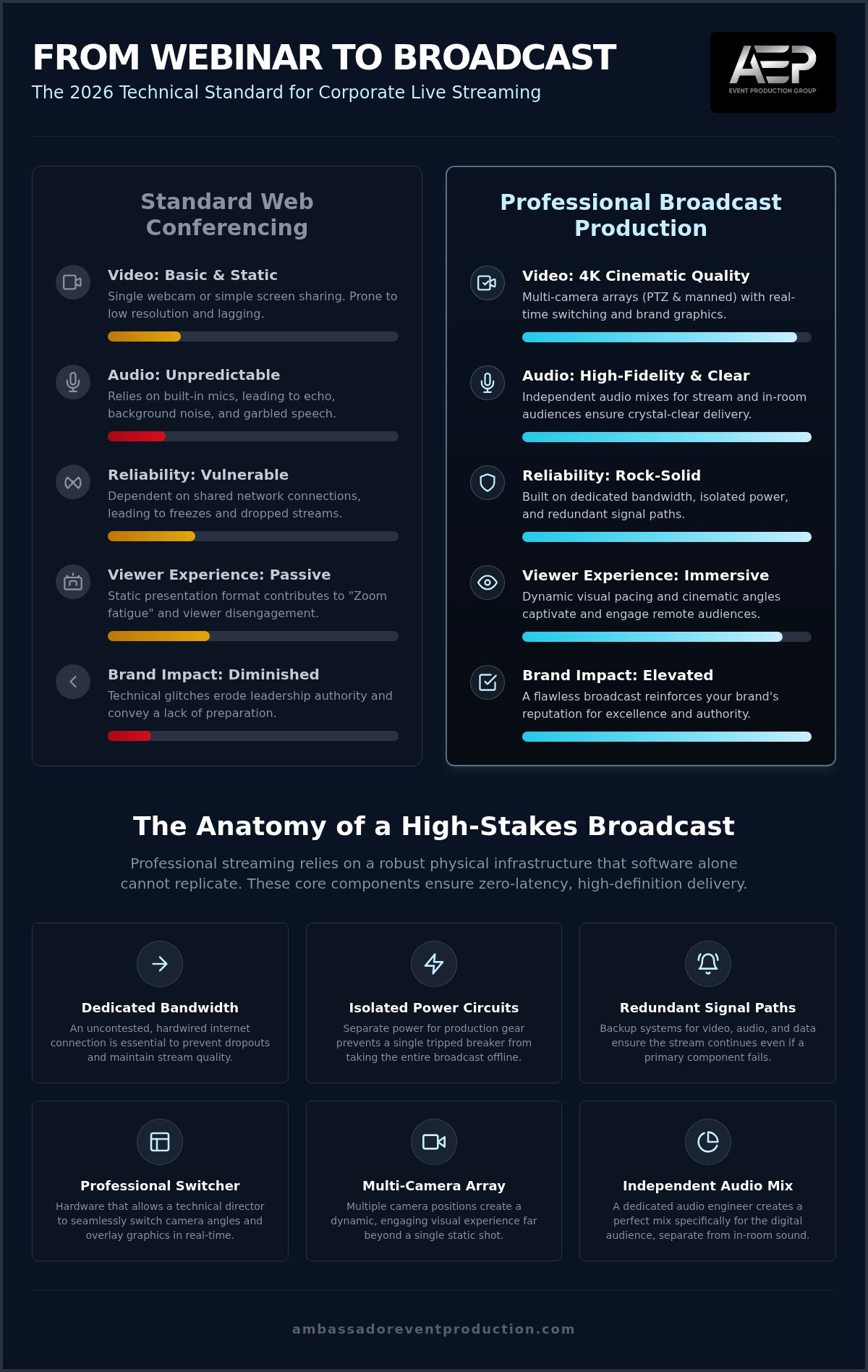
The era of the “survival stream” has passed. In 2026, live streaming services for corporate events have transitioned from a temporary fix to a central pillar of global brand strategy. A professional stream is no longer just a digital window into a conference room; it’s a fully realized broadcast environment designed to captivate a global audience. While a standard webinar focuses on basic information delivery, a high-stakes corporate broadcast prioritizes the viewer’s experience through cinematic quality and interactive depth. It’s the difference between a static presentation and a dynamic, strategic brand experience that commands attention.
Modern standards now demand a 4K signal path as the baseline for technical excellence. This isn’t merely about higher resolution; it’s about providing the visual fidelity that stakeholders expect in a professional setting. Moving beyond simple screen sharing requires the integration of corporate event video production services to manage complex switching, graphics overlays, and real-time interactive elements. These tools ensure that your remote participants don’t feel like passive observers, but rather active participants in a unified corporate narrative.
The Rise of the Hybrid Broadcast Model
The primary challenge in 2026 is creating a shared experience for two distinct audiences simultaneously. You must balance the energy of the in-person room with the technical requirements of the digital viewer. Multi-destination streaming is now a standard requirement for live streaming services for corporate events, ensuring your message reaches employees on internal portals and stakeholders on professional social platforms at the same time. High production value does more than look good. It validates the importance of the remote employee, boosting engagement by making them feel like a priority rather than a secondary thought.
Why ‘Good Enough’ is No Longer an Option
Technical failures in a high-stakes environment carry a heavy price. A dropped stream or garbled audio doesn’t just disrupt a meeting; it erodes the authority of your leadership and damages your brand’s reputation for excellence. Professional production counters the pervasive issue of “Zoom fatigue” by using dynamic visual pacing, multi-camera angles, and intentional lighting to maintain viewer focus. By treating the stream as a broadcast, you ensure the message is delivered with the weight it deserves. Broadcast-grade streaming is the integration of redundant signal paths and professional-grade acquisition.
The Technical Anatomy of a High-Stakes Corporate Broadcast
Professional live streaming services for corporate events rely on a robust physical layer that software alone cannot replicate. While web conferencing tools handle basic screen sharing, a broadcast-grade event requires an integrated ecosystem of hardware designed for stability and high-fidelity output. For organizations looking to optimize their internal collaboration spaces, averett.tech offers intelligent meeting room designs and specialized 360° camera solutions that serve as a benchmark for professional AV integration. This technical infrastructure serves as the backbone of your presentation, ensuring that every frame and every word reaches your audience without compromise. Understanding this anatomy is the first step toward moving from a simple video call to a cinematic corporate experience.
Video Acquisition and Switching
The visual quality of your stream begins with the lens. For dynamic keynotes, we utilize a combination of PTZ (Pan-Tilt-Zoom) cameras for efficiency and manned camera units for artistic, cinematic tracking shots. These multi-camera arrays allow for varied perspectives that keep the audience engaged. A technical director then manages these feeds through a professional switcher, layering in brand-accurate graphics and lower-thirds in real time. This level of control allows for a polished look that reinforces your brand’s authority throughout the broadcast.
Audio Engineering for Live Streams
Audio is frequently the most undervalued component of a stream, yet it’s the first thing to ruin a viewer’s experience if it fails. High-stakes events require high-fidelity event audio production that treats the stream as a separate entity from the physical room. Our engineers manage independent mixes; what sounds perfect through the house speakers often needs significant adjustment for a digital listener. By implementing digital signal processing and redundant microphone systems, we ensure vocal clarity remains consistent while eliminating the background noise floor that often plagues amateur streams.
The Encoder: The Heart of the Stream
The encoder is where your high-definition production becomes a digital stream. We prioritize dedicated hardware encoders over software solutions because they offer superior stability under heavy processing loads. To prevent dropouts, we employ bonded cellular technology and multi-ISP (Internet Service Provider) strategies, creating a “fail-safe” connection. By utilizing the SRT (Secure Reliable Transport) protocol, we can balance ultra-low latency with the global reach of traditional HLS streaming. This ensures your remote audience sees the action almost exactly as it happens on stage.
Lighting also plays a specialized role in this technical mix. Stage lighting designed for the human eye often appears flat or “washed out” on a digital sensor. We adjust color temperatures and intensities specifically for the camera lens, ensuring skin tones look natural and the stage depth remains visible to the viewer. If you’re ready to elevate your next broadcast, it’s helpful to partner with an experienced technical team that understands these nuances from the ground up.
Professional Production vs. Standard Web Conferencing
Choosing between a standard web meeting and professional live streaming services for corporate events is fundamentally a decision about risk and brand reputation. While consumer-grade conferencing tools serve a purpose for collaborative internal huddles, they lack the visual control and technical overhead required for high-stakes external messaging. Professional production removes the limitations of a standard platform’s interface, replacing it with a fully customizable environment. This shift ensures that your visual standards remain high, regardless of the scale of your audience or the complexity of your presentation.
Standard platforms often experience performance degradation when viewer counts move from hundreds to thousands. In contrast, professional infrastructure utilizes robust Content Delivery Networks and dedicated hardware to support 100,000 viewers with the same stability as 100. This technical scalability is paired with live event technical direction to drive engagement. By employing a director to manage visual pacing and transitions, you transform a passive viewing experience into an active, compelling narrative that maintains attention.
The reliability of managed technical production stems from the use of dedicated, hardwired connections rather than shared consumer internet. While a home or office Wi-Fi signal might fluctuate, professional event production relies on redundant, high-speed backbones. This ensures that your stream remains rock-solid even if one ISP experiences a failure. It’s this level of behind-the-scenes mastery that allows your leadership team to focus on their delivery rather than worrying about the technical logistics of the broadcast.
When to Use Web Conferencing vs. Professional Services
Evaluating the stakes of your event is the most effective way to determine your production needs. If a technical glitch occurs during a casual team update, it’s a minor inconvenience. However, if that same glitch happens during an Annual General Meeting or a national product launch, it becomes a significant liability. High-production services are an investment in the reliability of your communication. When you measure ROI through employee engagement and stakeholder confidence, the value of a broadcast-grade stream becomes evident.
Technical Feature Comparison
The technical gap between these approaches is found in the signal quality and the level of support provided. Professional live streaming services for corporate events provide the depth and clarity that consumer platforms often compress. This ensures a polished, high-definition result that looks professional on any screen.
- Signal Bitrates: Managed services offer significantly higher bitrates that prevent pixelation, even during high-motion segments or complex slide transitions.
- Dedicated Crews: You move from “self-service” troubleshooting to having a dedicated technical team monitoring every signal path and audio level in real time.
- UI Customization: Professional streams offer bespoke viewing environments rather than the standard, restrictive layouts of common meeting apps.
Venue Infrastructure and Technical Requirements for Flawless Streaming
The physical environment of your venue serves as the foundation for every digital interaction. While much of the focus often lands on the cameras and microphones, the success of live streaming services for corporate events is frequently decided by the hidden infrastructure within the walls. A professional technical audit identifies potential bottlenecks in power, connectivity, and structural support before they can impact your broadcast. By treating the venue as a controlled production studio, we ensure that the high-stakes message you’ve prepared isn’t undermined by local environmental limitations.
Network and Connectivity Standards
Reliable streaming requires more than just a fast connection; it requires a dedicated, hardwired network path that is completely isolated from the venue’s public Wi-Fi. For a broadcast-quality 4K stream, we calculate bandwidth requirements based on a primary and a redundant backup path. While a single 4K stream might only pull 25 Mbps, our standard is to secure a dedicated 100 Mbps upload circuit to provide a necessary buffer for signal fluctuations. The Point of Presence (PoP) is the physical interface where the venue’s internal network infrastructure connects to the external internet service provider’s backbone.
Power distribution is equally critical to stream stability. We don’t share circuits with high-draw equipment like HVAC systems or catering warmers, which can cause voltage drops or electrical noise. Your production suite and encoder rack require a dedicated power circuit to prevent accidental breakers from tripping during the keynote. This behind-the-scenes mastery of electrical logistics is what separates a professional broadcast from a standard office presentation.
Staging and Rigging for Broadcast
A camera-friendly stage layout differs significantly from a traditional event setup. We focus on creating clear sightlines for both the in-room audience and the remote viewer, which often involves elevated camera platforms and strategic placement of monitors. This is where custom stage design becomes essential, as it allows us to integrate digital backdrops that look sharp on camera without causing moiré patterns or glare. The goal is to create a three-dimensional space that translates effectively to a two-dimensional screen.
Structural rigging provides the necessary support for overhead production gear, including camera jibs and intelligent lighting systems. These lighting rigs are adjusted specifically for the camera’s sensor, ensuring skin tones look natural and the stage has a cinematic depth. Safety and structural integrity are our highest priorities during this phase, ensuring that all overhead gear is securely mounted and balanced. If you’re planning a high-stakes event, contact our technical team to schedule a comprehensive venue infrastructure audit.
Partnering for Success: Integrated Technical Production with Ambassador
Ambassador Event Production has been a steady presence in the industry since 1955. We aren’t just another vendor; we’re a family-owned partner that brings seventy years of technical heritage to every project we undertake. When you seek out live streaming services for corporate events, you’re trusting a team to protect your professional reputation. Our national reach allows us to provide consistent, high-standard support across the United States, blending time-tested values of accountability with the latest in digital innovation. We position ourselves as the expert that stays out of the spotlight to ensure your leadership team shines.
The Strategic Advantage of Integrated Services
One of the most significant risks in high-stakes production is the fragmented vendor model. If a stream lags or the audio distorts, the “blame game” often begins between separate video and audio teams. We eliminate this friction by providing technical event production that is fully integrated from the ground up. By managing video, audio, lighting, and staging under one unified technical direction, we ensure every component works in perfect harmony. This one-stop approach significantly reduces project risk and streamlines communication throughout the planning process.
Our “Experienced Guide” persona is more than just a title; it’s a commitment to a stress-free experience for our clients. We understand that you have enough to manage with speakers and content. By taking full ownership of the technical logistics, we act as a dependable ally that handles the heavy lifting behind the scenes. This collaborative spirit moves away from cold corporate detachment toward a supportive partnership, ensuring that the technical infrastructure is the last thing you have to worry about on event day.
Planning Your 2026 Event with Ambassador
Success in 2026 requires a methodical approach that begins long before the first camera is positioned. Our process starts with an initial technical consultation to align our capabilities with your specific event goals. We then conduct a detailed site survey to verify that the venue can support the bandwidth and power requirements necessary for a flawless broadcast. This thoroughness allows us to identify and solve potential issues before they ever become risks to your live streaming services for corporate events.
We wrap this preparation into a customized technical rider and a finalized broadcast workflow designed for national delivery. This includes verifying every redundant signal path and ensuring the lighting is optimized for the camera’s sensor. By the time we reach the execution phase, every detail has been accounted for, providing you with the quiet confidence that comes from working with a partner who values consistency and thoroughness as much as you do.
Elevating Your Corporate Broadcast Standards for 2026
Professional live streaming has evolved into a sophisticated broadcast environment that demands more than simple screen sharing. To achieve technical excellence, you must integrate multi-camera arrays, high-fidelity audio, and dedicated venue infrastructure. This technical foundation ensures your message arrives with the clarity and authority your brand deserves. By focusing on the physical layer, such as dedicated bandwidth and isolated power circuits, you protect your event from the common failures that often derail standard web conferencing. Success requires a steady hand and a comprehensive approach to every technical detail.
Selecting the right live streaming services for corporate events is ultimately a decision to prioritize reliability and seamless execution. Ambassador Event Production has provided expert technical execution since 1955, offering the integrated mastery of video, audio, and lighting required for high-stakes broadcasts. With our national service coverage and family-owned heritage, we act as your trusted partner to ensure every detail is managed behind the scenes. We invite you to Partner with Ambassador for Your Next Corporate Broadcast. Your vision deserves a flawless delivery, and we’re here to help you achieve it.
Frequently Asked Questions
What is the difference between live streaming and web conferencing for corporate events?
Live streaming is a professional broadcast designed for high-production value and large audiences, whereas web conferencing is built for two-way collaboration. While tools like Zoom are excellent for meetings, live streaming services for corporate events provide superior branding, cinematic camera angles, and professional switching. This approach ensures your message reaches thousands without the technical limitations or “meeting” interface of standard conferencing apps. It transforms a digital interaction into a polished brand experience.
How much bandwidth is required for a professional 4K live stream?
A professional 4K stream typically requires a dedicated upload speed of at least 25 Mbps, but we recommend a 100 Mbps circuit for a safe buffer. This bandwidth must be a hardwired, synchronous connection isolated from the venue’s public Wi-Fi. We prioritize a “clean” network path to prevent signal drops during high-motion segments. Having a primary and a redundant backup connection ensures the broadcast remains stable even if the local ISP fluctuates.
Can you live stream to multiple platforms simultaneously like YouTube and LinkedIn?
Yes, we utilize multi-destination streaming to broadcast your event to several platforms at once. This strategy allows you to reach employees on internal portals while simultaneously engaging stakeholders on public professional networks like LinkedIn or YouTube. Our technical team manages the encoding process to ensure each destination receives a signal optimized for its specific platform requirements. This approach maximizes your event’s visibility without requiring additional hardware on-site at the venue.
What kind of lighting is needed for a professional corporate live stream?
Professional broadcasts require lighting designed specifically for camera sensors rather than the human eye. We use a combination of key, fill, and backlighting to create depth and ensure skin tones look natural on screen. Our lighting design and execution services focus on matching color temperatures across all fixtures to prevent flickering or “washed-out” visuals. This specialized approach ensures that your leadership team looks as professional on a remote monitor as they do in person.
Why is audio often the most difficult part of a live stream to get right?
Audio is challenging because the mix required for a physical room is vastly different from the mix needed for a digital stream. Remote viewers are sensitive to background noise and echo, which requires precise noise floor management and digital signal processing. Our audio production services involve creating independent mixes for each audience. This ensures your message is heard with crystal clarity, avoiding the muffled or distorted sound that often plagues amateur corporate broadcasts.
Does Ambassador Event Production provide services across the entire United States?
Ambassador Event Production provides comprehensive technical services on a national scale across the United States. We bring our seventy years of industry experience to high-stakes corporate environments regardless of your venue’s location. Our national focus ensures that you receive a consistent, integrated mastery of video, audio, and lighting at every event. As a family-owned business, we prioritize personal accountability and thoroughness in every project we manage from concept to final execution.
How do you ensure the live stream doesn’t crash if the venue internet fails?
We prevent stream crashes by implementing redundant signal paths and bonded cellular technology. If the primary venue internet fails, our hardware encoders automatically switch to a secondary ISP or a cellular data array without interrupting the broadcast. This fail-safe strategy is a core part of our live streaming services for corporate events. We also utilize a dedicated power circuit to ensure that electrical fluctuations at the venue don’t affect our encoding and transmission racks.
What are the benefits of using a multi-camera setup for a corporate keynote?
A multi-camera setup keeps your digital audience engaged by providing dynamic visual pacing and varied perspectives. We use a mix of wide shots for context, medium shots for gestures, and tight shots for emotional impact. A technical director switches between these feeds in real time, mirroring the high-production style of a television broadcast. This approach reduces viewer fatigue and ensures that remote participants remain focused on your key messaging throughout the entire presentation.