
2026 Technical Rider Checklist for Corporate Events
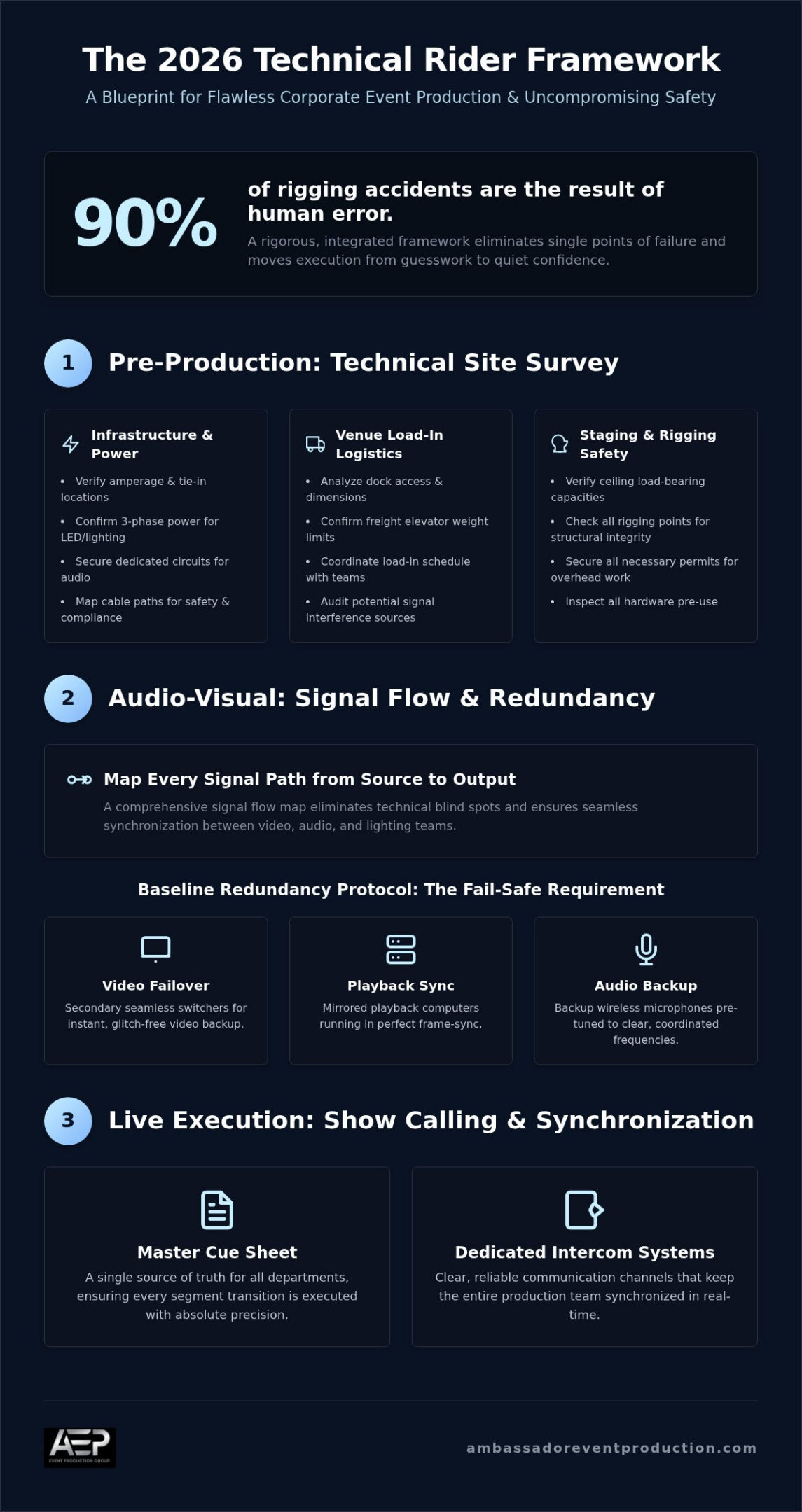
Approximately 90% of rigging accidents are the result of human error, often because equipment capabilities were pushed beyond their limits. In a high-stakes corporate environment, there’s no room for guesswork when it comes to safety or execution. You’ve likely felt that familiar tension during a keynote speech, worrying about a sudden audio drop or a video sync failure. It’s a valid concern because even one small oversight in your technical rider checklist for corporate events can disrupt a year’s worth of planning and investment.
We understand that managing complex rigging safety and synchronized production teams is a heavy lift. That’s why we’ve developed a rigorous, integrated framework designed to eliminate single points of failure. This article will guide you through the essential 2026 standards, from AI-driven meeting equity to the latest lighting power regulations. You’ll gain a trusted roadmap for managing your technical production partners, ensuring your next event moves from one segment to the next with absolute precision and quiet confidence.
Key Takeaways
- Conduct a comprehensive technical site survey to audit venue power distribution and signal paths, ensuring your infrastructure supports 2026 high-stakes requirements.
- Map every signal path from source to output to eliminate technical blind spots and ensure seamless synchronization between your video, audio, and lighting teams.
- Implement a rigorous staging and rigging safety protocol that includes structural integrity checks and pre-use inspections of all overhead hardware.
- Synchronize your live run-of-show using a master cue sheet and dedicated intercom systems to maintain professional precision during every segment.
- Use this technical rider checklist for corporate events to establish a trusted framework with your production partners, from the initial load-in to the final post-event strike.
Pre-Production and Technical Site Survey Checklist
A technical site survey is the bedrock of any successful production. It isn’t just a casual walkthrough of the ballroom; it’s a comprehensive audit of the venue’s physical and electrical limitations. By identifying power distribution points, structural rigging capacities, and signal path constraints early, you transform your technical rider checklist for corporate events from a simple wishlist into an actionable execution plan. This process ensures that the technical rider reflects the reality of the space, preventing last-minute scrambles that often lead to technical glitches. We also look for potential sources of signal interference, such as internal Wi-Fi networks or industrial machinery, that could disrupt wireless microphone frequencies or video transmissions.
Infrastructure and Power Requirements
Reliable power is the lifeblood of your event. We prioritize verifying amperage availability and identifying precise tie-in locations long before the first truck arrives. High-fidelity audio production requires dedicated circuits to prevent the distracting ground hum that can ruin a keynote recording. For large-scale lighting and high-resolution video arrays, we always confirm 3-phase power availability to handle the intense draw of modern LED walls. Mapping these cable paths early doesn’t just ensure safety; it keeps your event in compliance with venue regulations and local fire codes. For specialized fire safety assessments and physical site protection, you can visit Spycon Security Ltd. to ensure your venue remains fully compliant. We focus on creating a clean, integrated environment where power isn’t just available but strategically managed to support every technical layer.
Logistics can make or break a production schedule. We analyze dock access dimensions and freight elevator weight limits to ensure our gear moves efficiently. A well-coordinated load-in schedule aligns staging and rigging teams, allowing for a logical build sequence that respects the venue’s operational rules. This includes identifying venue-specific safety requirements or structural permits needed for overhead work. When rigging equipment, understanding the ceiling height and load-bearing capacities is non-negotiable. We verify that every point can support the intended weight of lighting trusses and speakers, ensuring a fail-safe environment for your audience. This methodical approach to the technical rider checklist for corporate events allows us to focus on the creative execution while the logistics remain invisible and secure.
The Audio-Visual Inventory and Signal Flow Checklist
Precision in technical execution depends on more than just high-end equipment; it requires a deep understanding of how each component interacts within the signal chain. Your technical rider checklist for corporate events must move beyond a simple list of gear to include a comprehensive inventory verification. This means matching every piece of hardware to the specific needs of the venue and the presentation. We document the path from every source to its final output, ensuring that signal flow is logical and efficient. This mapping process identifies potential bottlenecks before they manifest as delays or failures on show day.
Redundancy isn’t a luxury in a high-stakes environment; it’s a baseline requirement. We establish a strict redundancy protocol for all critical elements to ensure the show continues regardless of hardware hiccups. This includes:
- Secondary seamless switchers for instant video failover.
- Backup wireless microphones pre-tuned to clear frequencies.
- Mirrored playback computers running in frame-sync.
This level of integrated technical mastery ensures that audio, video, and lighting departments aren’t just working in the same room, but are synchronized via a shared master clock. This prevents the subtle digital drifting that can occur in digital systems over long event days.
Video Production and Playback Standards
We verify resolution and aspect ratio compatibility across all LED walls and projectors to maintain visual consistency. Checking primary and backup playback systems for corporate event video production services ensures that even a hardware failure won’t stop the show. We also test camera angles and signal strength for multi-camera video production setups, confirming that every shot is clear and properly framed. This is especially vital for 2026 AI-driven meeting setups that rely on precise tracking and automated framing to maintain equity between in-person and remote participants.
Audio Reinforcement and High-Fidelity Standards
High-fidelity audio begins with meticulous frequency coordination. We scan the local environment to identify and avoid interference for all wireless microphones, ensuring a clean signal throughout the venue. Our team tunes the sound system to provide consistent, intelligible coverage across the entire seating area, so every guest hears the same high-quality audio regardless of their position. Finally, we verify audio-video synchronization to eliminate distracting lip-sync issues on large screens. If you’re seeking a trusted partner to handle these intricate details, our specialized focus on technical execution provides the stability you need.
Staging, Rigging, and Lighting Safety Protocol
A flawless signal flow is only as reliable as the physical foundation supporting it. While many planners focus on the aesthetic “wow factor” of a stage, a professional technical rider checklist for corporate events prioritizes structural engineering and safety above all else. We begin every build with a rigorous structural integrity check, verifying that all stage decks are leveled and locked, and that every piece of rigging hardware meets modern load-bearing standards. This transition from digital planning to physical execution is where our decades of experience become your greatest asset, ensuring that your high-stakes environment is as secure as it is impressive.
Safety compliance isn’t just a best practice; it’s a regulatory necessity. As of 2026, OSHA can issue penalties of up to $16,131 per serious violation, making a comprehensive rigging safety audit a non-negotiable part of our workflow. We inspect every motor, truss section, and safety cable before any equipment is flown. This methodical approach ensures that we remain in full compliance with venue regulations and local fire codes, particularly regarding the use of flame-retardant materials and clear egress paths around the stage.
Expert Event Rigging Safety
Rigging safety requires a commitment to precision that goes far beyond equipment rental. We verify load calculations for all overhead components to ensure they maintain a 5:1 safety factor, meaning the hardware is rated for five times the actual weight it supports. Our team implements secondary safety attachments for every flown lighting fixture and audio cabinet, providing a fail-safe backup for every primary connection. Before the show begins, we conduct a final “bolt-check” on all truss connections and base plates. This quiet, behind-the-scenes thoroughness is what allows you to focus on your keynote speakers, such as those sourced through Speakers.com, while we handle the heavy lifting.
Once the structure is secure, we shift our focus to the technical synchronization of your lighting array. We test all intelligent lighting systems to ensure perfect DMX signal response across the entire network. Our technicians program lighting cues that complement the expert stage lighting design, creating a visual environment that enhances your brand without distracting from the message. We also coordinate a specific stage wash for video recording, adjusting color temperatures so your presenters look natural and professional on camera. This integrated approach ensures that your lighting works as a single unit with your video and audio teams, providing a seamless experience for both in-person and remote audiences.
The Live Run-of-Show and Show Calling Checklist
The transition from a static setup to a live environment requires a shift in focus from hardware to timing. A comprehensive technical rider checklist for corporate events culminates in the master cue sheet review. This is a final, collaborative walkthrough where audio, video, and lighting leads align on every transition. We verify that all crew members are on a dedicated, multi-channel intercom system. Clear communication is the only way to manage the complex logistics of a high-stakes keynote. Without it, even the best equipment remains a collection of silent parts. We ensure that the “PL” or private line is clear of chatter, reserved strictly for the show caller and department heads to maintain absolute focus.
Establishing a clear chain of command for live event technical direction ensures that emergency calls are handled with composure. We don’t just wait for the show to start; we rehearse the “what-ifs.” This includes practicing transitions for speaker entrances and high-impact video reveals. Our goal is to create a fail-safe environment where the technical crew operates as a single, intuitive unit. This methodical preparation reduces the stress on your presenters, allowing them to step onto the stage with the confidence that the technical foundation is unshakeable.
Technical Rehearsals and Sound Checks
Rehearsals are where we refine the rhythm of the event. We conduct full-speed runs for all video transitions and lighting changes to ensure timing is perfect. Sound checks for keynote speakers allow us to set precise gain and EQ levels, tailored to each individual’s voice and the room’s acoustics. In 2026, hybrid stability is paramount, so we test all remote presenter connections to guarantee seamless integration with the on-site audience. We also verify that all slide clickers and confidence monitors are responsive across the entire stage area, eliminating potential technical friction for the speaker.
Show Calling and Crew Coordination
Show calling is the heartbeat of the live event. We establish clear verbal cues for “standby” and “go” across every department to maintain professional precision. It’s vital that the technical crew for corporate events understands the contingency protocols for unexpected hardware issues, such as a primary projector lamp failure or a wireless microphone drop. By syncing the master show clock with the live event technical direction team, we ensure that every cue lands exactly when it should. This level of synchronization transforms a series of individual segments into a cohesive, professional narrative.
If you are preparing for a high-stakes presentation and need a team that prioritizes precision, partner with our expert production team to ensure your live execution is flawless.
Post-Event Strike and Technical Debrief
The success of a high-stakes gathering isn’t measured only by the applause during the closing session; it’s also defined by the precision of the exit. A comprehensive technical rider checklist for corporate events must account for the strike phase to ensure safety and accountability long after the guests have departed. We treat the load-out with the same level of detail as the initial setup. This stage requires a safe strike protocol where overhead equipment is de-rigged in a specific sequence to maintain structural balance. It’s a methodical process that prevents accidents and protects the integrity of the hardware. Asset management is equally vital. We inventory all gear during the pack-out to ensure no technical components are left behind, maintaining a clear chain of custody for every piece of equipment.
Systematic De-Rigging and Load-Out
Safety and efficiency drive our strike sequence. We coordinate the de-rigging of lighting trusses, audio arrays, and LED walls to ensure the venue’s structural limits are never compromised during the removal process. All technical event production gear is properly cased and labeled immediately to streamline the transition back to our warehouse. This disciplined approach allows us to return the venue to its original state quickly, meeting all load-out requirements and respecting the facility’s operational schedule. It’s our way of ensuring the partnership remains positive for both the client and the venue staff.
Technical Debrief and Future Planning
Once the trucks are loaded, our work shifts to analysis. We generate a technical performance report that documents any gear failures or signal issues encountered during the live event. This isn’t just about troubleshooting; it’s about continuous improvement. We analyze technical logs to identify recurring power draws or wireless interference patterns that might impact future planning. A formal client debrief follows, where we review the technical execution with event stakeholders to confirm all goals were met. We archive all event recordings and show files, providing you with a stable foundation for your next project. This feedback loop is a core component of our technical rider checklist for corporate events, ensuring that every production is better than the last while building a legacy of reliability and trust.
Elevating Your Event Execution with Technical Mastery
Mastering the technical details of a high-stakes environment requires more than just a list of equipment; it demands a rigorous framework of verification and synchronization. By implementing a comprehensive technical rider checklist for corporate events, you ensure that every signal path, rigging point, and live transition is handled with absolute precision. From the initial site survey to the final post-event strike, success is found in the methodical coordination of audio, video, and lighting as a single, integrated unit.
At Ambassador Event Production, we’ve served as a trusted technical partner since 1955, specializing in the complex logistics of audio, video, lighting, and staging. Our team combines a national reach with a boutique, service-first approach, ensuring that your vision is supported by a legacy of reliability and quiet confidence. We invite you to Partner with Ambassador for your next high-stakes technical production and experience a seamless execution that lets your message take center stage. You have the tools and the framework to succeed; now it’s time to bring your vision to life with total peace of mind.
Frequently Asked Questions
What is the most important item on a technical rider checklist for corporate events?
The most critical item on a technical rider checklist for corporate events is the technical site survey and power distribution plan. Without a verified understanding of venue power, structural limits, and signal paths, even the best equipment can fail. This foundation ensures that audio, video, and lighting teams have the dedicated circuits and infrastructure needed to operate without interference or ground hum, preventing glitches before they happen.
How early should the technical crew arrive for a corporate event load-in?
Load-in timing depends on the scale of the production, but for high-stakes corporate events, we typically begin 24 to 48 hours before the doors open. This window allows for a methodical build of staging and rigging, followed by thorough sound checks and lighting programming. Starting early provides the necessary buffer to troubleshoot signal flow issues and conduct full-speed rehearsals with presenters, ensuring a polished and stress-free execution on show day.
What are the most common technical failures in corporate event production?
The most common failures include wireless microphone interference, video sync issues, and power distribution overloads. Many of these problems stem from inadequate frequency coordination or failing to account for the venue’s existing electronic environment. We mitigate these risks by using integrated technical frameworks that include digital master clocks for synchronization and real-time frequency scanning to avoid local interference, ensuring that every segment of your event remains seamless and professional.
Why is a technical site survey necessary if the venue has in-house AV?
Even with in-house AV, a site survey is necessary to verify that the existing infrastructure meets your specific production standards. In-house systems are often designed for general use rather than high-stakes keynote environments. We audit the venue’s power draw, cable run lengths, and rigging point capacities to ensure they can support specialized video production and lighting arrays without compromising safety or performance. It’s about ensuring compatibility between our specialized gear and the venue’s limits.
What is the difference between event planning and technical production?
Event planning focuses on the logistical and hospitality elements like guest lists and venue booking. Technical production, on the other hand, is the physical execution of the event’s sensory environment. We specialize strictly in technical services, including audio, video, lighting, and staging. While a planner designs the “what” and “who,” we engineer the “how,” ensuring the technical infrastructure is robust enough to support your message without the distraction of equipment failures.
How do you ensure rigging safety for a large-scale corporate gala?
We ensure rigging safety by adhering to strict OSHA standards and calculating load-bearing capacities with a 5:1 safety factor. This involves using qualified riggers who inspect every motor, truss, and safety cable before any equipment is flown. Given that 90% of rigging accidents result from human error, our team follows a rigorous verification process that includes secondary safety attachments and final bolt-checks, providing a fail-safe environment for your audience and presenters.
What redundancy measures are standard for professional audio-visual support?
Standard redundancy measures for professional audio-visual support include mirrored playback computers, failover video switchers, and backup wireless microphones. We run primary and secondary systems in frame-sync, allowing for an instantaneous transition if a hardware failure occurs. This approach extends to our power plans, where we use dedicated circuits to prevent single points of failure from disrupting the entire production. These “Plan B” protocols are essential for maintaining continuity in high-stakes environments.
How does integrated technical production improve event quality?
Integrated technical production improves event quality by ensuring that audio, video, and lighting teams operate as a single unit rather than isolated departments. This synergy is achieved through a shared master clock for digital synchronization and a unified communication system for the crew. When these elements are integrated, transitions are sharper, signal paths are cleaner, and the overall narrative of the event feels cohesive and professional, reflecting the high standards of your brand.