
Multi-Location Event Production: 2026 Strategic Guide
What if the success of your national event series didn’t depend on which local venue crew showed up to work that morning? You’ve likely felt the frustration of walking into a ballroom in one city only to realize the audio-visual setup looks nothing like the high-standard execution you saw last week. Managing technical production for multi-location events often feels like an expensive gamble where your professional reputation is the stake. With the hybrid event market projected to reach $7.01 billion in 2026, the technical demands of maintaining brand consistency across different venues have never been higher.
We believe your focus should be on your message, not on whether the lighting rig in the next city will fail. This guide will help you master the complex logistics of executing high-quality events without the traditional headaches. You’ll learn how to build a standardized technical blueprint that protects your brand integrity and ensures every guest receives the same premium experience. We’ll explore how to consolidate your technical needs under a single, trusted partner to achieve flawless execution at every stop on your calendar. By the end of this guide, you’ll have the tools to replace logistical nightmares with a steady, reliable framework for national success.
Key Takeaways
- Learn how to eliminate technical fragmentation by creating a standardized technical blueprint that ensures brand consistency across every venue on your national tour.
- Discover the “Four Pillars” of integrated execution to maintain broadcast-quality video and high-fidelity audio regardless of local venue constraints.
- Identify the critical steps for building a master equipment manifest and conducting early technical audits to prevent costly logistical surprises.
- Understand the strategic advantages of centralizing technical production for multi-location events under a single, trusted partner to protect your professional reputation.
- Master the balance between replicating your core stage design and adapting to site-specific variables without compromising your event’s high standards.
Navigating the Complexity of Multi-Location Technical Logistics
Executing a successful event in one venue is a significant feat of coordination. Scaling that same experience across ten or twenty national locations introduces a level of complexity that can quickly overwhelm even the most seasoned marketing teams. The primary challenge isn’t just booking the space. It’s ensuring that the technical production for multi-location events remains identical from coast to coast. Managing technical production for multi-location events requires a shift in perspective from local fixes to national standards. When you rely on a “vendor-per-city” model, you inherit a patchwork of different equipment, varying crew expertise, and inconsistent standards. This approach often leads to a disjointed brand presence that confuses your audience and dilutes your message.
The True Cost of Technical Inconsistency
Inconsistent technical standards do more than just look messy. They actively undermine your professional reputation. If your keynote speaker has crystal-clear audio in the first ballroom but sounds muffled and distant at the next stop on your tour, their authority and impact are compromised. Similarly, lighting mismatches in brand-sensitive corporate environments can make your carefully designed stage look amateurish. Technical Fragmentation is the primary threat to multi-location event ROI, representing the breakdown of brand integrity when AV quality varies across different sites. Relying on “in-house” venue AV often means you’re at the mercy of whatever equipment happens to be available that day. While Event management involves many moving parts, the technical layer is what carries your content to the audience. We’ve seen how these small variances can add up to a significant loss in audience engagement.
Why National Scale Demands Centralized Technical Direction
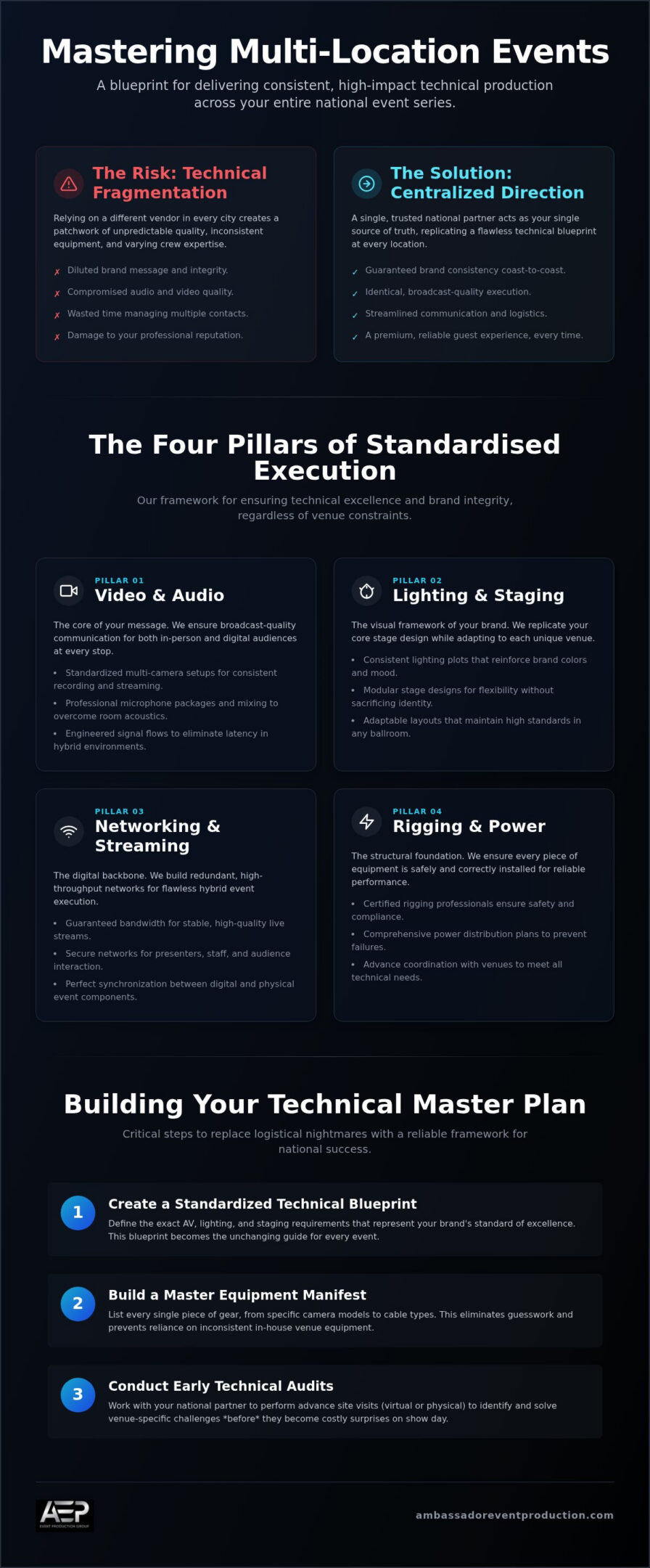
Moving away from local vendors toward a unified national production partner provides the stability needed for large-scale tours. A centralized technical director acts as your single source of truth. They ensure that every signal flow diagram and equipment manifest is replicated perfectly at every stop. This streamlined approach simplifies communication between your corporate marketing team and the technical crew. You only have one point of contact to manage, which reduces the risk of miscommunication. It ensures that your technical event production remains consistent regardless of venue architecture or local labor variables. Synchronizing crews across multiple time zones becomes a routine logistical task rather than a chaotic hurdle. By establishing a unified standard, you protect your vision and ensure that every attendee experiences the same high-caliber production.
The Four Pillars of Standardised Technical Execution
Achieving consistent technical production for multi-location events requires a focus on integrated hardware rather than just software-based scheduling. While coordination tools help with the calendar, the true challenge lies in the physical deployment of gear and talent across diverse venues. Industry leaders are noticing a new focus on multi-location events that prioritizes technical consistency over local convenience. To protect your brand, we rely on four technical pillars that serve as the foundation for every site on your tour.
Video and Audio: The Core of Communication
Broadcast quality shouldn’t fluctuate because you’ve changed venues. We use multi-camera setups at every location to ensure that recording and live-streaming quality remains identical for your digital audience. This consistency extends to your sound. By standardizing microphone packages and employing professional live event audio mixing techniques, we eliminate the variance caused by room acoustics. In hybrid environments, managing signal latency is critical. We engineer our signal flows to ensure that remote speakers and local audiences stay in perfect sync, regardless of the distance between them.
Lighting and Staging: The Visual Framework
Visual impact depends on how well your stage adapts to its environment. We design intelligent lighting systems for events that are flexible enough to work with varying ceiling heights while maintaining your brand’s specific color palette. Safety is our non-negotiable priority. Our teams ensure rigging safety compliance by adhering to the latest 2026 standards and navigating the specific regulations of each state. This structural integrity allows for a seamless experience when integrating stage design with AV and lighting. Your brand’s physical presence should feel intentional and permanent, not like a temporary setup.
Mastering the technical production for multi-location events means looking past the venue’s standard package. You need a setup that travels with your vision and a team that understands how to replicate it perfectly. If you’re ready to see how a unified technical approach can transform your next tour, we’re here to help you build that foundation.
Ensuring Technical Consistency Across National Event Series
Consistency in a national event series isn’t a happy accident. It’s the result of a rigorous “Blueprint” method that replaces guesswork with precision. While software can track your schedule, the physical execution requires a master technical rider that serves as the definitive guide for every venue. This document ensures that the technical production for multi-location events remains at a premium level, regardless of which city you’re in. By creating a standardized framework, you move away from reacting to venue limitations and toward a model of proactive control.
The discipline required for this level of coordination mirrors the advanced planning found in elite training environments like Yale’s Technical Production Program; where managing complex systems and production planning are core competencies. We apply this level of rigor to every tour stop. You must decide which elements are “mission-critical” to ship and which can be localized. Replicating the core control systems while adapting the heavy iron like staging or trussing allows you to maintain a consistent “Technical Master Plan” without unnecessary shipping costs.
Replicating the ‘Brand Feel’ Technically
Your brand has a specific visual signature that must be protected. We use color-matched lighting profiles, specifying exact Kelvin and RGB values, to ensure the “wash” on your stage is identical in every city. This level of detail is vital for your long-term marketing. It ensures that the “Stage Look” remains uniform, providing consistent photography for your annual reports and social media. Standardized corporate event video production services protect brand equity by ensuring that every frame of captured content looks like it belongs to the same cohesive story, no matter where it was filmed.
Managing Venue-Specific Variables
Every venue presents unique challenges, from power distribution limits in historic buildings to weight-load restrictions on modern ceilings. Mastering technical production for multi-location events means solving these puzzles behind the scenes so they don’t affect the show. We adapt rigging points and weight loads to fit the architecture without changing your visual design. If a room is acoustically “difficult,” we deploy specific audio processing tools to maintain clarity. Our teams use a multi-point technical checklist at every location to verify that these variables are managed before the first guest arrives. This steady, methodical approach ensures that your message is the only thing the audience remembers.
Building Your Multi-Location Technical Master Plan
While a methodical approach ensures your message is the only thing the audience remembers, ensuring the physical safety of your event is equally critical. For organizers expanding their tours into international or complex environments, you can discover Tactical Troop for specialized risk management and operational security.
A successful national tour isn’t built on a simple three-step checklist. It requires a rigorous, multi-layered framework that accounts for every technical variable before your equipment even leaves the warehouse. To truly master the technical production for multi-location events, you must transition from a reactive mindset to a proactive, strategic one. This begins with five essential steps designed to eliminate uncertainty and ensure that your high standards are met at every stop.
- Step 1: Conduct a comprehensive technical audit of every planned location early in your cycle to identify venue-specific power and rigging limits.
- Step 2: Develop a master equipment manifest and a detailed signal flow diagram that serves as the blueprint for every site.
- Step 3: Establish a unified technical crew structure with clear hierarchies, ensuring that your lead engineers maintain control over local labor.
- Step 4: Create a “Technical Bible” for the tour. This document acts as the definitive guide for rapid on-site setup and troubleshooting; for international series, Aabévé Vertaalbureau can help translate these critical technical guides to ensure consistency across global teams.
- Step 5: Define a post-event technical review process to capture lessons learned and improve the execution at the next location.
The Pre-Production Phase
Precision during pre-production is what prevents chaos on-site. We rely on 3D CAD modeling to visualize staging and lighting within the specific dimensions of each venue. This allows us to spot potential obstructions or rigging conflicts weeks before the event. Coordinating the logistics and shipping schedules for technical gear is equally vital, especially when moving sensitive electronics across the country. Managing live event technical direction during this window ensures that your creative vision is technically feasible and fully supported by the infrastructure we’ve designed.
On-Site Execution and Contingency
Once you’re on the ground, standardized protocols are your best defense against the unexpected. We implement strict “Load-In” and “Sound-Check” schedules to ensure that every system is tested and verified before the doors open. Building redundancy into the plan is a non-negotiable part of our process. We prepare a “Plan B” for every city, whether that means having backup signal processors on hand or alternative rigging paths. The role of the technical lead is to solve local venue bottlenecks quickly, keeping the production on schedule and protecting your professional reputation. If you’re ready to secure a partner who treats your tour with this level of thoroughness, reach out to our technical team to start building your master plan today.
Scaling Your Vision with Ambassador Event Production
Managing technical production for multi-location events across the United States requires more than just high-end gear. It demands a partner who understands the weight of your professional reputation. At Ambassador Event Production, we bring a legacy of reliability that dates back to our founding in 1955. With over 70 years of industry experience, we’ve navigated every major shift in technology, from the first analog sound systems to the complex digital integrations of 2026. This history isn’t just a number. It’s a proven track record of stability that ensures your national tour remains on solid ground from the first load-in to the final strike.
We provide a truly integrated approach to technical execution. Instead of managing four different vendors for video, audio, lighting, and staging, you work with a single, dedicated team. This consolidation eliminates the communication gaps that often lead to on-site errors and inconsistent brand experiences. Our national reach allows us to support your vision anywhere in the country, while our family-owned structure ensures a level of personal accountability you won’t find in a cold corporate entity. We operate as your trusted partner, staying behind the scenes to ensure you and your message take center stage.
A Multi-Generational Commitment to Excellence
Our business is built on the belief that relationships matter more than transactions. We blend seven decades of tradition with the cutting-edge technology of 2026 to provide a seamless production experience. This integrated technical mastery significantly reduces client stress by providing a “one-stop” solution for all technical needs. You won’t have to worry about whether the lighting team is communicating with the video crew; we are the same team, working from the same master plan. Working with a family-owned entity means you have direct access to experts who are personally invested in your success and your brand’s integrity.
Taking the Next Step in Your Multi-Location Strategy
The best time to secure your technical foundation is early in the planning cycle. We invite you to initiate a technical audit for your upcoming event series to identify potential venue challenges before they become costly problems. Our team provides custom quotes for integrated technical production tailored to the specific needs and scale of your national tour. Whether you’re launching a new product or hosting a high-stakes corporate summit, we have the expertise to make it flawless. Partner with Ambassador Event Production for your next national series and experience the quiet confidence that comes from 70 years of technical mastery.
Securing Your National Event Legacy
Mastering technical production for multi-location events is the difference between a fragmented brand experience and a cohesive national tour. By prioritizing a standardized blueprint and conducting early technical audits, you eliminate the variables that lead to on-site frustration. You’ve discovered that consistent audio, video, and lighting aren’t just about the hardware; they’re about a unified strategy that protects your professional reputation at every stop.
Ambassador Event Production is ready to help you execute this vision with precision. As a family-owned business founded in 1955, we bring over 70 years of integrated mastery in video, audio, lighting, and staging to your project. We provide the national reach you need with the personal accountability of a trusted partner who stays behind the scenes so you can shine. It’s time to move from managing multiple local crews to a single, dependable technical ally.
Request a Technical Production Consultation for Your National Event Series today. We look forward to helping you build a legacy of excellence across the country.
Frequently Asked Questions
What is the biggest technical challenge for multi-location events?
The primary challenge is maintaining technical uniformity across diverse venues. When equipment and crew standards vary by city, you risk “technical fragmentation,” where the audience experience differs at every stop. Technical production for multi-location events suffers when local variables like power limits or acoustic quirks aren’t audited in advance. Overcoming this requires a centralized technical director who oversees a single equipment manifest, ensuring that every venue meets the same high-performance benchmarks.
How do you ensure audio-visual consistency across different venue sizes?
Consistency is achieved through scalable technical blueprints. While a 500-seat ballroom and a 2,000-seat auditorium have different acoustic needs, the core signal flow remains the same. We use high-fidelity audio processing to tune the sound to each room’s specific dimensions while keeping the microphone packages identical. This integrated approach ensures that your keynote speaker sounds exactly the same in every location, regardless of the venue’s physical architecture or ceiling height.
Is it better to hire a national production company or local vendors?
Hiring a national production company is the most reliable choice for multi-city tours. Local vendors often use different brands of equipment and varying crew protocols, which leads to a disjointed brand experience. A national partner like Ambassador Event Production provides a single point of accountability and a legacy of reliability that spans the entire tour. You benefit from a unified team that understands your brand’s technical requirements and replicates them perfectly at every stop.
What technical equipment should be standardized for a national tour?
You should always standardize your “control core,” including video switchers, audio consoles, and primary microphone packages. Lighting profiles should also be locked in using specific Kelvin and RGB values to ensure brand colors remain identical. While heavy items like trussing or staging platforms can sometimes be localized to save on shipping, the technical production for multi-location events depends on having the same signal-processing hardware at every venue to guarantee a flawless broadcast.
How does technical production impact brand integrity in multi-site events?
Technical production is the physical delivery of your brand’s message. If the lighting is dim in one city or the video feed flickers in another, it suggests a lack of attention to detail that reflects poorly on your corporate identity. Flawless execution across multiple sites signals professional authority and stability. By maintaining high staging and AV standards, you protect your professional reputation and ensure that your brand integrity remains intact throughout the series.
What should be included in a technical master plan for multi-location events?
A comprehensive master plan must include detailed technical audits of every venue, a master equipment manifest, and a complete signal flow diagram. It should also define a clear crew hierarchy and a “Technical Bible” for on-site troubleshooting. Including a post-event review process is essential for identifying and solving logistical bottlenecks. This structured approach moves your tour away from reactive fixes and toward a methodical, integrated mastery of the entire production cycle.
How do you manage technical crew transitions between different cities?
Successful transitions rely on a core team of lead engineers who travel to every location. These leads act as the “technical memory” of the tour, ensuring that local labor follows your specific load-in and sound-check protocols. By maintaining a consistent leadership structure, you prevent the loss of information that usually happens when switching between different crews. This steady guidance ensures that the technical execution remains flawless, even when the local venue staff changes.
Can staging and rigging be standardized for venues with different layouts?
Staging and rigging can be standardized using modular designs that adapt to different room dimensions. We use 3D CAD modeling during the pre-production phase to visualize how your stage set fits into various venue layouts. While the physical rigging points may change based on the ceiling architecture, the visual “Stage Look” remains identical. This allows you to maintain design integrity while adhering to the specific safety and weight-load regulations of each individual site.