
Reliable Event Sound Systems: 2026 Technical Guide
Imagine the silence in a crowded ballroom when a keynote speaker’s microphone suddenly cuts out during the most pivotal moment of their address. It’s a nightmare scenario that every organizer fears, yet achieving truly reliable sound systems for events requires much more than just high-end hardware. You’ve worked hard to craft a message that matters, and it’s frustrating when technical jargon or equipment limitations stand in the way of that connection. We understand the unique pressure of high-stakes environments because our team has been navigating these technical complexities since 1955.
You deserve a partner who handles the technical stress so you can focus on your audience. This guide provides a clear roadmap for 2026, stripping away the confusion between line arrays and point source systems while explaining the latest standards in digital audio networking. We’ll show you how strategic engineering ensures crystal-clear sound for every seat in the house, regardless of venue size. By the end of this article, you’ll know exactly how professional audio production transforms potential failure into a flawless, integrated experience that lets your message shine.
Key Takeaways
- Learn how to secure reliable sound systems for events by prioritizing consistent audio delivery and eliminating the risks of “good enough” setups.
- Discover how acoustic modeling software and frequency coordination prevent microphone dropouts before your event even begins.
- Understand why integrated audio production provides more certainty than simple equipment rentals by including professional design and oversight.
- Master the “no single point of failure” philosophy through redundant signal paths that keep your audio running if a primary line fails.
- Find out how a dedicated technical partner handles complex logistics so you can focus entirely on your audience’s experience.
The Foundation of Reliable Sound Systems for Events
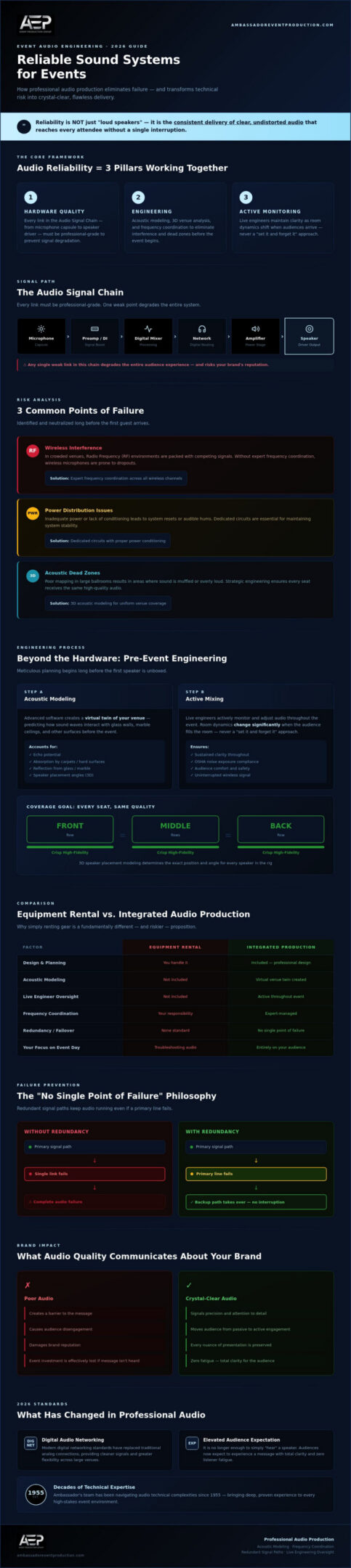
Reliability is often misunderstood as simply having “loud” speakers. In professional environments, true reliability is the consistent delivery of clear, undistorted audio that reaches every attendee without a single interruption. For high-stakes corporate communication, settling for “good enough” audio is a significant risk that can damage your brand’s reputation. If a message isn’t heard, the investment in the event is essentially lost. We view public address systems as complex ecosystems where every component must perform in harmony. Securing reliable sound systems for events involves more than just selecting high-end gear; it requires a holistic approach to the entire signal path. This performance relies on the “Audio Signal Chain,” a sequence where every link, from the microphone capsule to the speaker driver, must be professional-grade to prevent degradation. Audio reliability for events is a combination of hardware quality, engineering, and active monitoring.
Why Professional Audio Production Standards Matter in 2026
As we move through 2026, the standard for excellence has shifted. It’s no longer enough for an audience to simply hear a speaker. They need to experience the message with total clarity and zero fatigue. Modern digital networking standards have replaced traditional analog connections to provide cleaner signals and greater flexibility across large venues. This technical evolution directly impacts brand perception. Crystal-clear sound suggests a brand that values precision and detail. Conversely, poor audio creates a barrier that causes audience disengagement. Professional standards ensure that every nuance of a keynote or presentation is preserved, moving the audience from passive listening to active engagement.
Common Points of Failure in Event Sound
Even the most expensive equipment can fail without proper oversight and strategic planning. We focus on identifying and neutralizing these risks long before the first guest arrives. Common challenges include:
- Wireless Interference: In crowded venues, Radio Frequency (RF) environments are often packed with competing signals. Without expert frequency coordination, wireless microphones are prone to dropouts.
- Power Distribution Issues: Inadequate power or a lack of conditioning can lead to system resets or audible hums. Dedicated circuits are essential for maintaining system stability.
- Acoustic Dead Zones: Poor mapping in large ballrooms often results in areas where sound is muffled or overly loud. Strategic engineering ensures every seat in the house receives the same high-quality audio.
Addressing these failures requires a partner who treats audio as a science. By predicting how sound behaves in a specific environment, we eliminate the guesswork that often leads to technical stress. This proactive approach is what separates a basic rental from a truly integrated audio production service.
Engineering for High-Stakes Audio: Beyond the Hardware
Engineering excellence is what separates a standard setup from a world-class production. Reliable sound systems for events are the result of meticulous planning that begins long before the first speaker is unboxed. We use advanced acoustic modeling software to create a virtual twin of your venue. This allows our team to predict exactly how sound waves will interact with physical barriers like glass walls or high marble ceilings. By simulating these variables, we can address potential echo or clarity issues before they manifest during your event.
Active mixing is another critical component of technical success. A “set it and forget it” mentality often leads to disaster as room dynamics change when the audience arrives. Our engineers provide active monitoring to maintain clarity and adhere to OSHA noise exposure guidelines, ensuring the environment remains comfortable and safe for everyone. This level of oversight, combined with frequency coordination to manage wireless microphones in high-traffic areas, ensures that your audio remains uninterrupted by external interference or signal dropouts.
Acoustic Mapping and Venue Analysis
Precision matters in large-scale environments. By using 3D modeling, we can determine the exact placement and angle for every speaker in the rig. This ensures uniform coverage, so the person in the back row hears the same crisp high-fidelity audio as the person in the front. We account for the specific absorption and reflection properties of your venue materials. Whether it’s a heavily carpeted ballroom or a contemporary space with hard surfaces, the goal is to eliminate dead zones and deliver a consistent experience for every attendee.
Integrating Audio with Video and Lighting
Audio doesn’t exist in a vacuum; it must work in perfect harmony with other technical elements. Achieving seamless event video and audio synchronization is vital for live presentations where even a millisecond of lag can distract the audience. Lighting rigs and staging also impact sound diffraction, which is why an integrated technical crew is so valuable. When one team manages all AV elements, they can coordinate the physical layout to prevent interference and ensure the gear stays out of the spotlight.
This integrated approach allows us to act as your Audio-Visual Technical Support partner, handling the complex logistics so your message remains the central focus. We rely on digital audio networking like Dante or AVB to distribute lossless signals across large national venues, maintaining the highest possible quality from the source to the ear.
Comparing Equipment Rental vs. Integrated Audio Production
Choosing the right technical path often comes down to a choice between renting a commodity or investing in a service. While many providers treat speakers as a simple product, true reliability is the result of professional execution. When you opt for “Dry Hire” or gear-only rentals, the entire burden of performance falls on your shoulders. You aren’t just renting a box; you’re inheriting the responsibility for setup, configuration, and emergency troubleshooting. If a cable fails or a signal drops, the solution rests with you.
The hidden costs of these equipment-only solutions often surprise event planners. Shipping logistics, hours spent on assembly, and the stress of resolving unexpected technical glitches can quickly outweigh any initial savings. In contrast, integrated audio production is a turnkey service that includes strategic design, expert labor, and constant oversight. Our technical crew acts as the ultimate insurance policy for your event’s success. We ensure that reliable sound systems for events are not just a hope but a guaranteed outcome through meticulous behind-the-scenes mastery.
When is Equipment Rental Not Enough?
Renting a few speakers might work for a small internal meeting, but high-stakes environments demand more. If your event features multiple presenters, panel discussions, or live musical elements, the complexity of the signal chain increases exponentially. Venues with unconventional layouts or high ceilings require distributed audio systems that a standard rental package simply cannot address. In these settings, even a 30-second audio loss is unacceptable. It’s a failure that disrupts the flow of your program and distracts your audience from the message.
The Value of a Technical Production Partner
Partnering with a professional team gives you access to an experienced guide who understands the nuances of venue compliance and rigging safety. We manage the end-to-end support from the initial load-in to the final strike. This allows your team to focus entirely on content and attendee engagement while we handle the heavy lifting. We ensure every technical detail is aligned with your goals.
Our approach also ensures adherence to safety standards, including OSHA noise exposure guidelines, to protect both your audience and the staff. With a 70-year heritage of technical excellence since 1955, we provide the peace of mind that comes from proven performance. We handle the complex logistics so you don’t have to, ensuring every word is heard with crystal-clear precision across every seat in the house.
Critical Failure Prevention: Redundancy and Power Management
Reliability isn’t a happy accident; it’s the result of a “No Single Point of Failure” philosophy. In high-stakes environments, reliable sound systems for events must be designed so that if any one component fails, the show continues without interruption. This means thinking beyond just having a backup microphone in a drawer. It involves building redundant signal paths where a secondary analog line runs parallel to your primary digital network. If a network switch loses power or a fiber optic cable is damaged, the system can instantly switch to the backup without a single pop or drop in volume. Our team prioritizes this level of behind-the-scenes mastery to ensure your message is never lost to a technical glitch.
Before the doors open and the first guest arrives, our engineers follow a rigorous verification process. Use this checklist to ensure your system redundancy is actually functional:
- Verify Dual Network Paths: Confirm that primary and secondary digital lines (such as Dante or Milan) are communicating on separate switches.
- Test Microphone Switchover: Ensure the backup microphone is live and gain-matched to the primary unit for a seamless transition.
- Validate UPS Health: Check that Uninterruptible Power Supplies for mixers and processors are fully charged and capable of handling the load.
- Monitor Signal Integrity: Listen for interference or “hum” that might indicate a grounding issue between audio and lighting circuits.
Implementing System Redundancy
For high-profile keynote addresses, we often deploy dual-redundant mixing consoles. This setup allows two identical desks to process the same audio simultaneously. If the primary console experiences a software or hardware error, the secondary desk takes over the feed instantly. We also apply sophisticated live event audio mixing techniques to manage these fail-safes. This includes using a mix of wired and wireless microphone strategies for presenters to account for potential RF interference in crowded venues.
Power Stability and Grounding
Power is the lifeblood of any audio system, yet it’s often the most overlooked point of failure. We take steps to isolate audio power from lighting rigs and heavy machinery. Lighting dimmers and LED walls can introduce significant electrical noise, leading to audible hums or system resets. By ensuring consistent voltage and proper grounding, we maintain a clean electrical environment. Our technical crew monitors power health throughout the event, standing as a silent guard against the fluctuations often found in older venues. Our team provides the professional Audio Production Services required to keep your event stable, safe, and sounding perfect.
Partnering for Technical Certainty: The Ambassador Approach
Ambassador Event Production brings a unique perspective to the industry by blending a 1955-era work ethic with the most advanced 2026 technical standards. Our approach is built on a foundation of quiet confidence and seasoned authority. We don’t just provide equipment; we act as a dedicated ally in your event’s success. Our focus is strictly on technical execution. We don’t coordinate catering or manage guest lists. Instead, we dedicate ourselves entirely to the mastery of audio, video, lighting, and staging. This specialized focus is the primary reason we can deliver truly reliable sound systems for events across any venue in the country.
Our technical-only focus ensures that our engineers are never distracted by non-technical details. Every member of our team is an expert in their specific field, from RF coordination to digital signal processing. This allows us to maintain a level of precision that generalist firms often struggle to match. We provide national scalability, bringing consistent, high-level standards to every project regardless of the location. We help you move from the stress of managing gear to the peace of mind that comes with a trusted technical partnership. By handling the complex logistics behind the scenes, we ensure that you remain the central focus of the event.
A Legacy of Reliability Since 1955
As a family-owned business with a 70-year history, we operate with a level of accountability that’s rare in today’s corporate landscape. Our multi-generational team has encountered and solved every possible audio challenge over the decades. This deep institutional knowledge allows us to anticipate issues before they arise, providing a layer of stability that only comes from long-term experience. We blend this heritage of personal service with modern technical event production mastery. It’s a combination that ensures your message is heard perfectly, backed by a team that treats your success as their own legacy.
Your Next Steps Toward a Flawless Event
Starting a collaboration with us is a straightforward, logical process designed to reduce your technical stress. We recommend initiating a technical discovery session early in your planning phase. To help us build a comprehensive audio and staging quote, it’s helpful to provide venue dimensions, expected attendance, and a rough schedule of presenters. This information allows our engineers to begin the modeling and coordination discussed earlier in this guide. We invite you to contact Ambassador Event Production for your national technical needs. Let’s work together to ensure your next event is defined by technical certainty and crystal-clear sound for every seat in the house.
Mastering the Sound of Your Success
Achieving absolute technical certainty in 2026 requires a shift from simply renting gear to embracing strategic engineering. We’ve explored how acoustic modeling and redundant signal paths create a safety net for your most critical moments. By prioritizing integrated audio, video, and lighting mastery, you eliminate the variables that lead to failure. True success isn’t just about avoiding silence; it’s about ensuring your message resonates through reliable sound systems for events that are built for consistency.
With 70+ years of technical excellence, Ambassador Event Production provides the comprehensive national support you need to scale your vision across any venue. Our team handles the complex logistics and power management behind the scenes, allowing you to focus on your audience with complete confidence. You don’t have to navigate these technical complexities alone when you have a partner dedicated to your success. Secure your event’s success with Ambassador Event Production and let our heritage of reliability work for you. Your message deserves to be heard perfectly, and we’re here to make sure it is.
Frequently Asked Questions
What makes a sound system truly ‘reliable’ for a large corporate event?
Reliability is the consistent delivery of clear audio through strategic redundancy and professional engineering. It’s not just about the gear; it’s about having a “No Single Point of Failure” architecture. This includes redundant signal paths and active monitoring by a technical crew. Unlike simple rentals, reliable sound systems for events integrate hardware with a team that can troubleshoot in real-time, ensuring the keynote remains uninterrupted regardless of technical hiccups.
How do you prevent wireless microphone dropouts in busy venues?
Dropouts are prevented through proactive frequency coordination and high-quality RF management. We use scanning tools to identify available spectrum in crowded environments, avoiding interference from local signals or mobile devices. Strategic antenna placement and the use of digital wireless systems also enhance signal stability. By mapping the venue’s radio frequency landscape before the doors open, our team ensures that every presenter’s voice remains clear and connected throughout the program.
Is it better to use the venue’s built-in sound system or bring in a production team?
Built-in systems are often designed for background music or general paging rather than high-stakes corporate communication. Bringing in a dedicated production team ensures that the audio is tailored specifically to your event’s layout and content requirements. We provide professional-grade components and expert oversight that venue-provided systems typically lack. This approach offers superior clarity, uniform coverage, and the technical support necessary to handle complex presentations that standard house systems can’t support.
What is audio redundancy and why do I need it?
Audio redundancy is the practice of running secondary, backup signal paths alongside your primary lines. You need it because even the best hardware can experience unexpected failures. If a primary digital cable is damaged, a redundant analog line can take over instantly without the audience noticing. This “fail-safe” philosophy protects your event from total silence, ensuring that critical messages are delivered without delay or technical embarrassment during high-profile moments.
How does integrated lighting and video impact the sound system’s reliability?
Integrated systems prevent technical conflicts that occur when different crews work in isolation. Lighting rigs and LED walls generate significant electrical noise and heat, which can interfere with audio signals if not managed correctly. By coordinating these elements, our technical team isolates power circuits and manages physical placement to avoid signal hums or diffraction. This holistic approach ensures that your video production and lighting enhance the event rather than compromising audio quality.
Can a professional sound system handle both indoor and outdoor event segments?
Yes, professional systems are highly adaptable, but they require specific engineering for different environments. Outdoor segments face challenges like wind noise and a lack of reflective surfaces, requiring more power and strategic speaker placement for clear coverage. Our team designs integrated solutions that transition seamlessly between these spaces. We use weather-resistant equipment and specialized tuning to maintain consistent high-fidelity audio, whether your audience is in a ballroom or an open-air courtyard.
What should I look for in a technical production partner’s history?
Look for a legacy of stability and a proven track record in high-stakes environments. A partner with a multi-generational history, like our 70-year heritage since 1955, demonstrates a deep commitment to accountability and relationship-building. You want a team that specializes strictly in technical execution rather than general event planning. This focus ensures they have the specialized knowledge and national scalability required to handle complex logistics and maintain consistent standards across various venues.
How much power does a professional event sound system actually require?
Power requirements vary based on venue size and system complexity, but professional setups typically require dedicated circuits. A standard system for a large ballroom might need several 20-amp circuits to separate audio from lighting and video loads. We calculate these needs during the technical discovery phase to prevent system resets or interference. Ensuring consistent voltage is critical, especially in older venues, which is why our crew monitors power health throughout the entire production.