
Large Corporate Town Halls: 2026 Technical Buyer’s Guide
In a high-stakes town hall, a technical failure isn’t a minor distraction. It can undermine the message an executive came to deliver. Event production for large scale corporate town halls demands more than dependable screens and microphones. Audio must stay in sync, remote participants need to feel included, and technical teams must work from a coordinated plan.
If you’re concerned about lag during executive remarks, disconnected teams, or juggling multiple production partners, that concern is well-founded. A polished broadcast depends on how video, audio, lighting, staging, and the people operating them work together. When these elements are coordinated, leaders can focus on the room and the message instead of the technology.
This guide explains how to evaluate production partners and manage the technical demands behind a professional town hall. It covers hybrid broadcast planning, vendor coordination, proposal reviews, rehearsals, and questions to ask before show day, so you can make informed decisions and reduce avoidable stress.
Key Takeaways
- Assess event production for large scale corporate town halls as an integrated system, not a collection of separate technical vendors.
- Set clear requirements before comparing proposals, including video approach, audio-visual support, staffing, and responsibility for coordinating technical work.
- Ask how staging and rigging plans account for venue requirements, structural limits, and applicable safety rules.
- Look for a partner whose technical capabilities match your town hall’s needs across video, audio, lighting, staging, and rigging.
- Assess a production partner’s relevant experience and working approach, so executives can focus on delivering the message.
The High-Stakes Nature of Corporate Town Hall Production
A corporate town hall carries more weight than a routine video call. Executives may be delivering business updates, explaining change, or answering questions for employees in multiple locations. If speech and sound fall out of sync, slides disappear, or remote attendees can’t follow the conversation, the disruption can distract from the message and weaken confidence in its delivery.
That’s why event production for large scale corporate town halls should be treated as a coordinated broadcast, not simply a meeting with more people. Event management applies project management principles to creating and developing events. For a town hall, coordination also needs to account for the technical systems: video, audio, lighting, staging, and the venue’s capabilities.
Start by defining the scope. How many people will attend in person, and how many will join remotely? Do teams need to participate live, or will some watch a recording? What does the venue provide, and what limits apply to staging, rigging, power, and equipment placement? Clear answers help shape a production plan around the actual event rather than assumptions.
Broadcast Quality vs. Basic Connectivity
A meeting platform connects speakers and viewers; a production plan coordinates what those viewers see and hear. Multiple camera views, prepared visual content, clear speaker audio, and deliberate transitions can make an executive address easier to follow. Technical direction also helps coordinate cues and transitions, keeping attention on the message instead of avoidable pauses.
Plan for interruptions before they happen. Ask prospective partners how they’ll identify critical signal paths, which backup options suit the event, and who responds if a feed or component fails. Discuss redundancy as part of the design rather than waiting for a technical problem. The right approach depends on the venue, platform, and production scope.
Identifying Your Core Technical Needs
Set technical requirements to suit the audience and viewing conditions. Confirm which video formats the streaming platform supports and whether remote viewers will watch on large displays or personal devices. Prioritize intelligible speech, consistent audio levels, and a microphone approach suited to each speaker. For the room, assess sightlines, stage size, and existing light before deciding what staging and lighting will support clear visibility in person and on camera.
Bring these details together before comparing proposals. A partner who understands the full picture can help identify gaps between systems or responsibilities. Ambassador Event Production provides video, audio, lighting, staging, and rigging services, bringing an integrated technical perspective to a high-stakes broadcast.
Event Production for Large Scale Corporate Town Halls: Essential Technical Criteria
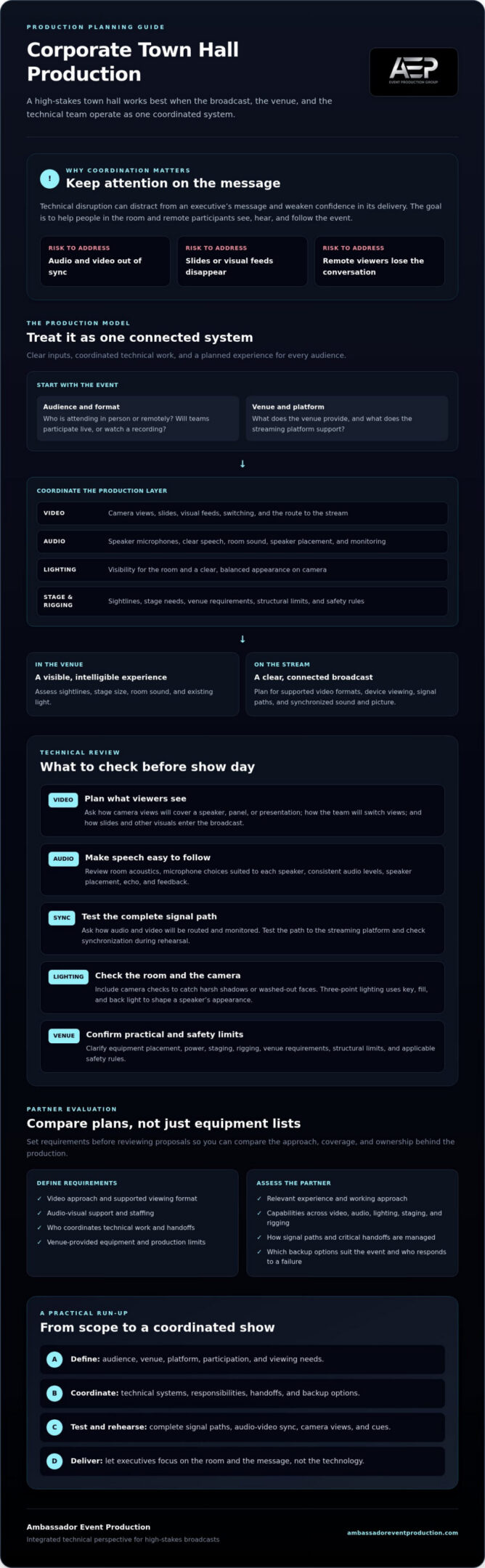
A polished town hall depends on systems that work together, not just equipment that works individually. When video, audio, lighting, and streaming are handled separately, signal paths and responsibilities can become unclear. A coordinated technical team can plan how each element connects, identify handoff risks, and establish who monitors each part of the show.
For event production for large scale corporate town halls, ask how the production will move from the stage to the audience’s screens. Multiple cameras can provide different views of a speaker, panel, or presentation, while real-time switching selects the appropriate view as the program unfolds. The production plan should also explain how slides, camera feeds, and other visual elements enter the broadcast.
Mastering Video and Audio Synchronization
Latency is the delay between a live event and its audio or video reaching a remote viewer. Lip-sync problems can occur when audio and video signals take different paths or are processed at different speeds. Ask how the team will route and monitor these signals, test the complete path to the streaming platform, and check synchronization during rehearsal. Clear, consistent speech helps remote audiences follow the message and supports the speaker’s delivery.
Audio deserves its own technical review. Large halls can create echoes and uneven sound, while poorly positioned microphones or speakers can contribute to feedback. Discuss room acoustics, microphone choices, speaker placement, and monitoring with the audio team. For more on the standards and decisions involved, see high-fidelity event audio production.
Lighting Design for the Camera and the Room
Lighting must work for people in the venue and viewers watching on camera. A stage that looks bright in person may produce harsh shadows or washed-out faces on screen, so include camera checks in the design process. Three-point lighting uses key, fill, and back light to shape a speaker’s appearance. Adapt the setup to the room, camera positions, and stage layout rather than applying it as a fixed formula.
Lighting cues can distinguish a keynote from a transition or panel discussion, while reinforcing brand colors where appropriate. Confirm how changes will look both in the room and through the cameras. To assess how a partner’s technical capabilities fit your requirements, you can review technical production capabilities.
Evaluating Production Partners: A Buyer’s Framework
For event production for large scale corporate town halls, compare more than equipment lists. Assess whether a partner can connect the technical requirements into one coherent plan, explain who is responsible for each part, and respond to the specific demands of your event. A useful proposal makes the scope clear instead of leaving critical details for show day.
An integrated technical partner can coordinate staging, rigging, video, audio, and lighting so decisions in one area account for the others. Camera positions, for example, affect stage layout, while rigging plans and lighting choices need to suit both the venue and the broadcast. Ask how the partner identifies these dependencies and manages handoffs between technical disciplines.
Experience matters most when a provider can explain how its knowledge applies to your event. Ask about comparable production challenges, the experience of the proposed crew, and the team’s approach to troubleshooting on site. Ambassador Event Production is family-owned and has worked in technical production since 1955, with services covering video, audio, lighting, staging, and rigging.
In-House AV vs. External Production Specialists
Venue AV may suit a straightforward meeting, but its standard setup might not cover your town hall’s camera plan, broadcast needs, stage design, or technical staffing requirements. Compare the venue’s capabilities with the show’s actual needs before deciding. If you bring in an external production partner, clarify how that team will coordinate equipment access, setup, technical responsibilities, and communication with venue staff. Venue systems may still be suitable if roles and connections are agreed in advance.
The Value of an Integrated Technical Team
A central technical lead can help keep decisions, cues, and responsibilities aligned across disciplines. Ask who will coordinate technical communication, who can make operational decisions on site, and whether a dedicated project manager or equivalent point of contact is included in the proposed scope. The right structure reduces the risk of conflicting instructions, though staffing models vary by provider. For a closer look at coordinated execution, read this technical event production guide.
Review quotes line by line. Confirm whether each item includes equipment, technical labor, setup, operation, and venue coordination, or whether those responsibilities sit elsewhere. Clarify exclusions and distinguish a complete production service from an equipment-only rental. A lower headline total may not represent the same scope, so compare deliverables and accountability before choosing. For an overview of technical capabilities, visit Ambassador Event Production.
Safety, Rigging, and Structural Integrity
Large screens, lighting fixtures, and scenic elements add more than visual impact. Their weight must be supported by a suitable structure and installed according to venue requirements. Structural rigging transfers overhead loads through planned attachment points and supporting structures, so the design and installation need careful coordination.
For event production for large scale corporate town halls, safety planning should begin before equipment arrives. Confirm the venue’s rigging rules, approved points, load limits, access restrictions, and required approvals with venue representatives and the production partner. Applicable requirements can depend on the equipment, structure, jurisdiction, and venue. Ask which current standards and local requirements apply to your event rather than relying on a generic checklist.
Expert Event Rigging Safety Standards
Use riggers with experience appropriate to the planned work, and verify any credentials or qualifications required by the venue or applicable rules. In ballrooms and convention centers, potential complications include limited ceiling height, restricted attachment points, obstructed sightlines, and loads concentrated in areas not designed to support them. Ask your production partner what documentation the venue requires, such as rigging plans, equipment and load details, inspection records, and evidence of required approvals.
Pre-event checks help confirm that the approved plan matches the installed setup. Establish who will supervise rigging on site, how changes will be reviewed, and who has authority to pause work if conditions differ from the plan. An inspection does not replace accurate load planning or venue approval.
Custom Staging and Rigging Integration
A stage must support the intended screen and scenic arrangement while giving speakers safe, clear paths to move. Consider how screen placement affects sightlines, where equipment and cables will sit, and whether the stage configuration fits the venue’s structural limits. For further guidance on balancing these requirements, see the custom stage design guide.
Before approving a proposal, ask how staging, overhead rigging, and technical equipment will be coordinated, what assumptions the design depends on, and how revisions will be handled if the venue raises a concern. These questions help you assess both the production approach and its safety planning. To discuss staging and rigging alongside your technical requirements, contact Ambassador Event Production.
Partnering for Performance: The Ambassador Approach
Strong production partnerships give leaders room to focus on the message while technical professionals manage the systems behind it. Ambassador Event Production has been family-owned and operated since 1955, providing video, audio, lighting, staging, and rigging services. Its work focuses on the technical execution that helps corporate broadcasts come together.
For event production for large scale corporate town halls, an integrated partner can consider related technical disciplines together rather than leaving you to coordinate a collection of separate providers. A change to stage layout, for example, can affect lighting positions and camera views. Bringing those needs into one technical conversation can clarify responsibilities and help reduce communication gaps.
Why Stability Matters in Production
A long-established partner can bring continuity and institutional knowledge to a complex production, but history alone isn’t proof of fit. Ask how the team’s experience applies to your town hall, who will be responsible for each technical area, and how decisions will be communicated as requirements evolve. Ambassador Event Production serves customers nationally and is family-owned and operated.
Request examples of work in comparable corporate environments, then look beyond polished footage. Ask what technical challenges the production involved, which services the provider handled, and how the team coordinated its work. This gives you a more useful picture of experience without relying on general claims or assuming every event has the same needs.
Getting Started with Your 2026 Town Hall
Bring a technical partner into the conversation early enough to review the event format, audience, venue information, broadcast needs, and executive requirements. Early discussion can surface dependencies before decisions become difficult to change. To request a technical production proposal, prepare the details you have and identify what still needs to be confirmed. Ask the provider to outline its proposed services, responsibilities, assumptions, and exclusions clearly.
Ambassador Event Production focuses on technical planning and execution, helping bring production requirements into alignment so your leadership team can stay focused on what it needs to communicate. To discuss the technical needs of your next town hall, contact Ambassador Event Production.
Bring Your Town Hall Message to the Fore
A confident corporate broadcast starts with clear technical ownership. Define the needs of in-person and remote audiences, assess how video, audio, lighting, staging, and rigging work together, and choose a production partner who can explain the plan and its responsibilities. That preparation helps executives stay focused on what they need to say.
Ambassador Event Production brings more than seven decades of technical production experience and offers video and audio production, lighting design and execution, staging, and rigging. Its integrated technical capabilities support town halls from initial technical coordination through on-site execution.
For event production for large scale corporate town halls, share your technical requirements and broadcast goals with Ambassador Event Production. Contact Ambassador Event Production to discuss your next town hall.
Frequently Asked Questions
What is the difference between event planning and technical event production?
Event planning coordinates the broader event, while technical production designs and operates the systems that deliver its sound, visuals, lighting, and staging. For a town hall, technical work may include video production, audio production, AV support, lighting design, and rigging. These are distinct scopes, so confirm who handles each responsibility. Ambassador Event Production focuses on technical production and does not provide event planning or catering.
How do I choose the right video resolution for a global town hall broadcast?
Choose a resolution that your streaming platform, production system, and intended audience devices can reliably support. Check platform specifications, available upload bandwidth, expected viewing conditions, and whether slides or fine visual details need to remain legible. A higher resolution isn’t automatically better if it causes buffering for remote viewers. Test the complete video path under realistic conditions before the broadcast, and confirm the final settings with your production team.
What are the essential rigging safety requirements for corporate events in 2026?
Requirements depend on the venue, jurisdiction, structure, and equipment, so confirm current applicable rules with venue representatives and qualified rigging professionals. Before approving overhead lighting or video walls, request a rigging plan that identifies loads, attachment points, and required approvals. Clarify who will inspect and supervise the installation, how changes will be handled, and what documentation the venue requires. Don’t assume one generic checklist applies to every event.
Why should I hire a national production partner instead of local venue AV?
A national production partner may be useful when your town hall needs technical capabilities beyond the venue’s standard AV setup, such as a coordinated video, audio, lighting, staging, and rigging approach. Venue AV can still be suitable, and the teams may be able to collaborate. Compare the venue’s equipment and responsibilities with your show requirements, then clarify system access, crew roles, communication, and accountability before making a decision.
How can I ensure audio-visual synchronization for a hybrid audience?
Have the production team test audio and video together through the full route to the streaming platform, not just at the stage. Delays can occur when signals travel through different equipment or processing paths. Rehearse with the microphones, cameras, presentation content, and stream settings planned for show day, then monitor the remote feed for lip-sync drift. Confirm who will watch the broadcast and who can address a problem during the program.
What kind of lighting is best for executives speaking on a large stage?
Use a lighting design that makes the speaker clear to the room and to cameras without creating harsh shadows or washed-out faces. A three-point setup, using key, fill, and back light, can help shape a speaker’s appearance, but placement and intensity should suit the stage, camera angles, and venue. Check the look on camera during rehearsal, and plan cues for transitions between speakers, panels, and presentations.
How does a technical project manager improve the success of a town hall?
A technical project manager can help coordinate the production scope, timelines, technical teams, venue requirements, and decisions that affect multiple systems. For example, a change to stage layout may also affect camera positions, lighting, and rigging. Ask whether your proposed partner provides a dedicated coordination role, what that person is responsible for, and how updates and on-site decisions will be communicated. Confirm the role in the proposal rather than assuming it’s included.
What should be included in a technical production RFP for a corporate event?
Include the event format, audience size, venue details, hybrid or streaming needs, program outline, and any known technical constraints. Specify requested video, audio, lighting, staging, and rigging capabilities, plus rehearsal expectations and venue requirements. Ask bidders to describe deliverables, staffing, responsibilities, assumptions, exclusions, and how they’ll coordinate with venue teams. Clear scope makes proposals easier to compare and helps reveal gaps before technical decisions are finalized.