
Expert Event Rigging Safety: A Practical Guide for 2026
What if a rigging plan that looks sound on paper becomes unsafe when the venue, equipment, or event conditions change? Expert event rigging safety is more than checking hardware before doors open. It depends on informed decisions, qualified review, and clear coordination throughout the production process.
If you’re unsure who owns safety decisions, how proposed loads are reviewed, or what to ask a rigging provider, a simple checklist won’t answer everything. Responsible rigging brings people, equipment, venue requirements, and ongoing communication together.
This guide explains how teams plan, review, install, and manage rigging, and how responsibilities connect across producers, venues, and technical partners. You’ll find practical questions to ask and ways to involve technical production professionals early, so your team can identify gaps and make informed decisions.
Key Takeaways
- Treat expert event rigging safety as a process that continues from early planning through show call, not as a hardware checklist.
- Ask how venue information, proposed loads, and the complete production setup will inform the rigging plan.
- Clarify who reviews the plan, who controls access beneath overhead work, and how the team will communicate changes.
- Use practical questions to assess a partner’s planning, site-specific review, and coordination with staging, lighting, audio, and video.
- Bring technical production professionals into the conversation early to identify constraints and reduce handoff gaps before event-day decisions.
What Expert Event Rigging Safety Means Before the Event Begins
Expert event rigging safety starts before equipment reaches the venue. It combines planning, competent work, clear communication, and ongoing verification, so decisions account for the actual space, production design, and people working around suspended equipment. It is not just an equipment inspection or a last-minute venue check.
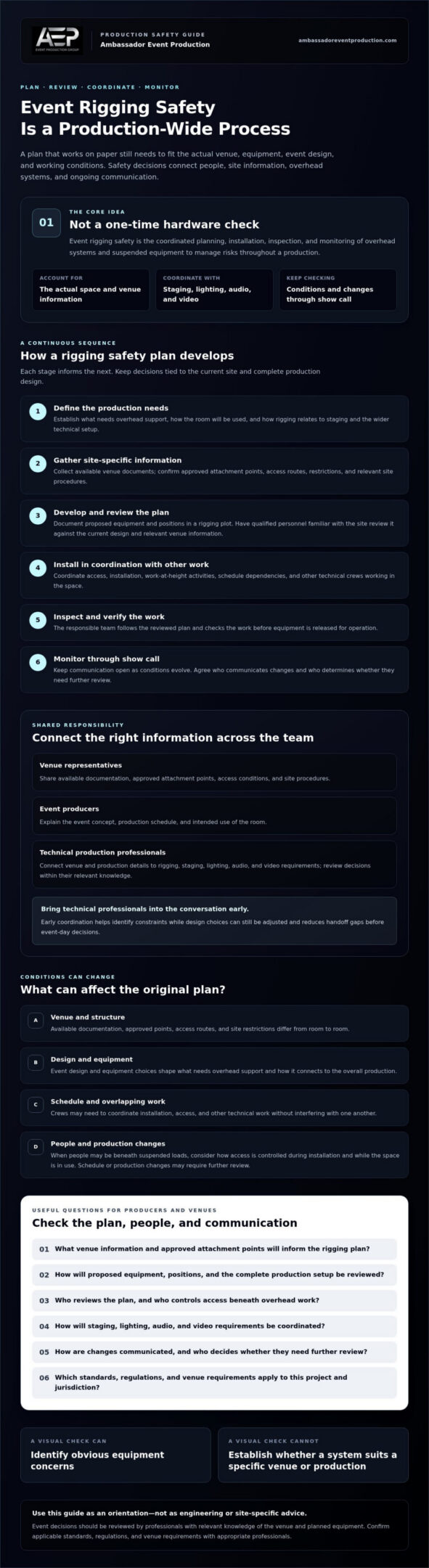
Event rigging safety is the coordinated planning, installation, inspection, and monitoring of overhead systems and suspended equipment to manage risks throughout a production.
That process connects rigging with staging and the wider technical setup. Lighting and video requirements may affect what needs overhead support, while stage layouts and work areas influence where crews can install equipment. A venue review is important, but it does not replace a site-specific plan or the judgment of qualified professionals familiar with the structure and equipment.
What does event rigging safety cover?
It covers the overhead support system, the equipment suspended from it, its relationship to staging, and the areas where installation or adjustment takes place. An entertainment rigger works in a field that supports theatre, film, and live productions, but every event has its own conditions. This guide provides an orientation, not engineering or site-specific advice. Event decisions should be reviewed by professionals with relevant knowledge of the venue and planned equipment.
Why do rigging risks change from event to event?
A plan that suits one room may not suit another. The venue structure and available documentation, event design, equipment choices, and schedule all affect what needs review. So do overlapping tasks: crews may need to coordinate access, installation, and other technical work without interfering with one another.
Audience activity matters, too. If people will be beneath suspended loads, the team needs to consider how access will be controlled during installation and while the space is in use. Schedule or production changes can also affect the original plan. Agree on how changes will be communicated and who will determine whether they need further review.
These factors make rigging safety an ongoing process, not a one-time sign-off. A visual check can identify obvious equipment concerns, but it cannot establish whether a particular system is appropriate for a venue or production. Share the event concept and site information with technical production professionals early, and keep rigging coordinated with staging, lighting, audio, and video as the plan develops.
How a Rigging Safety Plan Develops from Design to Show Call
A useful rigging plan develops in stages, with decisions checked against the venue and the complete production design. First, define what needs support and how the event will use the space. Then gather site information, develop and review the plan, install the system, inspect it, and continue monitoring through show call. This sequence helps the team spot conflicts before they become day-of-show problems.
Venue representatives, event producers, and technical specialists each contribute information the others may not have. The venue can explain what documentation is available, which attachment points are approved, and what access conditions or site procedures apply. Producers can describe the schedule and intended use of the room. Technical professionals can connect those details to rigging, staging, lighting, audio, and video requirements. Bring them into the discussion early, while design choices can still be adjusted.
What information should the team establish during planning?
Gather available venue documents, confirm which attachment points are approved for use, and identify access routes and restrictions. The production team should document proposed equipment and positions in a rigging plot for review by qualified personnel familiar with the site. The plot is useful only if it reflects the current design and relevant venue information, rather than assumptions carried over from another event.
Planning should also identify schedule dependencies, work-at-height activities, areas that need controlled access, and the people to contact with questions or changes. Confirm which technical decisions need review before installation proceeds. Check which standards, regulations, and venue requirements apply to the specific project and jurisdiction. For example, the OSHA rigging equipment standards may be relevant, but their applicability should be verified with appropriate professionals rather than assumed from a general guide.
What changes between installation and show time?
During installation, the responsible team follows the reviewed plan and checks the work before equipment is released for operation. The handoff should establish what was installed, what was checked, and who is responsible for communicating operational concerns. Show call is not the time to discover that the installed setup differs from the plan.
Rehearsals may reveal sightline or performance needs that prompt a request to move or add equipment. A schedule shift can also change access or create overlap between crews. Before proceeding, communicate the proposed change and reassess it with the responsible technical team.
Any documented change to the rigging plan must reach the responsible technical team before the affected work continues.
That steady coordination is central to expert event rigging safety. If you’re developing a production plan, consider involving a technical partner that can coordinate staging and rigging with event lighting, audio, and video from the outset.
Rigging Safety Misconceptions: Loads, Inspections, and Shared Responsibility
Two shortcuts can create false confidence: assuming a visual equipment check proves the entire installation is safe, and relying on a familiar load estimate without checking the specific site and setup. Inspections matter, but they address only part of the question. A sound review also considers how components work together, how they are configured, and what they connect to.
That distinction is central to expert event rigging safety. A component’s rating describes that component under specified conditions. By itself, it does not confirm the condition or capacity of the complete system, the suitability of an attachment point, or whether the proposed configuration is appropriate. Those questions call for qualified, site-specific review. Avoid substituting rules of thumb or informal load calculations for professional assessment.
Does rated equipment automatically make a rigging plan safe?
No. A rated item may still be unsuitable if it is damaged, incompatible with other components, or used in a configuration that has not been reviewed. A visual check can identify visible issues, but it cannot establish that the complete system and venue connection are appropriate. Equipment should be inspected before each lift, and defective items should be removed from service. The responsible technical professionals must determine what further review the installation requires.
Who coordinates rigging safety at an event?
There is no single assignment of responsibility that applies to every event. Roles and decision-making depend on the contract, venue rules, applicable requirements, and how the project is organized. Before installation begins, the event producer, venue representative, and technical team should agree on who reviews the plan, who can authorize changes, and how concerns will be escalated. Put those handoffs in clear terms.
For example, a requested lighting adjustment might change an overhead position. The person requesting the change may not be qualified to assess its effect on the rigging plan. A clear approval process helps route the request to the appropriate technical decision-maker before work proceeds. It also helps prevent different teams from acting on different versions of the plan.
For broader production coordination, see this guide to live event technical direction. It can help producers think through communication across technical teams, while site-specific rigging decisions remain with qualified professionals and relevant authorities.
Keep the practical questions direct: Who is the named decision-maker? Who must be notified if site conditions or equipment change? What approval is needed before the revised setup proceeds? Clear answers help the producer, venue, and technical team work from the same plan without assuming that one inspection or person covers every decision.
A Practical Event Rigging Safety Checklist for Producers and Venues
A checklist can help producers and venue representatives confirm that essential conversations have happened before work begins. Use these prompts to clarify information, approvals, and communication. They support planning, but do not replace professional inspection or site-specific advice from qualified technical personnel.
Questions to ask before rigging begins
- Site information: What venue documentation and access details are available, and who will review them for this event?
- Plan approval: Who prepares and reviews the event-specific rigging plan, and who has authority to approve it before installation?
- Equipment and changes: How will proposed equipment and positions be documented? Who needs to know if equipment, positions, or the production schedule changes?
- Work sequence and access: Which activities need to happen in sequence, and how will crews know which areas are restricted during installation?
- Handoffs: What documentation does the venue expect, what information will the production team pass on, and who are the named contacts for questions or concerns?
Clear answers make it easier to spot gaps before the schedule is locked. If stage layout or technical interfaces affect overhead positions, review those dependencies as part of the production plan. This custom stage design guide offers additional context on coordinating stage requirements with technical production.
What should the team confirm before doors open?
Before the space is released for audience access, confirm the planned checks and approval points with the responsible technical professionals. Make sure relevant crew members know which areas are restricted, how to report a concern, and who can assess an unexpected condition. Keep the agreed contacts easy to find.
If the installed setup differs from the reviewed plan, or new work is requested during rehearsal, pause the affected activity and alert the responsible technical team. Do not assume a change is minor because it appears simple. The professionals qualified to assess the setup can determine whether it needs review before work continues.
Use the checklist to support a clear, shared briefing. It cannot establish that an installation is safe on its own, but it can help the team identify unanswered questions and direct them to the right people. That is a practical part of expert event rigging safety: getting information to decision-makers in time for them to act.
Planning an event with overhead equipment or stage interfaces? Discuss staging and rigging requirements with a technical production team while the production plan is taking shape.
Choosing an Expert Event Rigging Safety Partner for Integrated Production
A capable partner should be able to explain how rigging decisions will be developed, reviewed, and communicated for your specific event. Look beyond broad claims of expertise. Ask how the team will learn about the venue, coordinate with venue representatives, document the proposed work, and handle questions or changes. Clear answers let you assess the process without having to make technical judgments yourself.
What signals a thorough technical production approach?
Listen for a practical sequence: gathering event and venue information, reviewing the design, identifying decision-makers, and agreeing on communication points before installation. Ask who will review the site details and how updates will reach the relevant technical professionals. A provider should be able to describe its coordination process in terms you can follow.
Also ask how rigging requirements connect with staging, lighting, audio, and video. A change to stage layout or equipment positions, for example, may affect other technical plans. Coordination helps teams identify those connections early rather than leaving each group to resolve them separately on site.
Keep credentials and process claims distinct. A confident presentation is not proof of a particular certification or regulatory compliance. Ask what qualifications and project-specific reviews are relevant, and verify requirements with appropriate professionals and authorities.
How can integrated production support rigging coordination?
When technical disciplines plan together, they can work from a shared understanding of equipment positions, stage design, and show cues. That can help identify dependencies, clarify handoffs, and communicate proposed changes to the people who need to assess them. Integrated coordination does not remove the need for qualified rigging review; it connects that review to the wider production plan.
Ambassador Event Production provides technical event production that includes staging and rigging, lighting, audio, and video support. The company is a production partner, not an event planner or equipment-only dry-hire supplier. If you’re comparing providers, ask how their services fit together and who will coordinate communication across the technical work. For broader context, explore this integrated technical event production guide.
Expert event rigging safety depends on project-specific review as well as clear coordination. Bring technical professionals into the conversation while your production requirements are taking shape, so they can help identify questions that need resolving. To discuss your event’s technical production needs, connect with Ambassador Event Production.
Build Safety Into Your Next Production
Expert event rigging safety comes from a process that starts early and stays active: site-specific planning, qualified review, clear handoffs, and communication when conditions change. A checklist can help the team ask better questions, but it cannot replace professional assessment of the venue, equipment, and proposed setup.
Choosing a technical production partner that coordinates rigging with staging, lighting, audio, and video can help keep those requirements connected. Ambassador Event Production is family-owned and operated, with a company history dating to 1955. Its integrated technical services support a coordinated approach to production needs.
Bring your technical team into the conversation while the event plan is taking shape. Discuss your event’s technical production needs with Ambassador Event Production. With clear communication and the right professionals involved, your team can move forward with greater confidence.
Frequently Asked Questions
What does expert event rigging safety include?
Expert event rigging safety includes planning the suspended equipment and support system, reviewing available venue information, coordinating qualified personnel, controlling access during work, and communicating changes. The process depends on the event, venue, equipment, and applicable requirements. For example, the team needs to know which venue documents and attachment points relate to the proposed setup. A general article or checklist can frame useful questions, but it cannot replace a site-specific review by competent technical professionals.
Who is responsible for rigging safety at an event?
Responsibility depends on the project, contracts, venue procedures, and applicable requirements. Producers, venue representatives, and technical providers should clarify their roles, approval points, and communication routes before work begins. Do not assume one party automatically covers every decision. Ask who reviews the rigging plan, who can authorize changes, and who receives safety concerns during installation and the event. Clear answers help the team understand where decisions belong and how to bring questions to the right person.
How do event riggers assess whether a venue can support a rig?
Qualified professionals assess relevant venue information, proposed attachment points, equipment configuration, and project-specific loads. If information is incomplete, they may need additional documentation or a specialist assessment before confirming the plan. Do not infer capacity from appearance or reuse another event’s plan without review. The appropriate process depends on the venue and system, so involve the responsible venue representatives and technical specialists early. They can determine what information and review the installation requires.
Can event rigging plans change after installation begins?
Yes, but changes should not be treated as informal adjustments. Equipment substitutions, position changes, schedule shifts, or changed venue conditions may affect the system and should be communicated to the appropriate technical decision-makers. They can determine whether the plan needs further review before the affected work continues. Agree on an escalation and approval process before installation, so crew members know whom to notify instead of making an unreviewed change.
What should an event producer ask a rigging provider?
Ask who reviews venue information, how the plan is documented, and which professionals make technical decisions. Confirm how proposed changes are approved and how the provider coordinates with venue staff and other production teams. Ask what checks and handoffs happen before equipment is used, and who should receive concerns during the event. These questions help you understand the provider’s process without requiring you to make engineering judgments or interpret technical limits yourself.
Does a rigging safety checklist replace a professional inspection?
No. A checklist helps the event team organize questions, confirm communication, and track agreed process steps. It does not establish whether a particular rigging system is suitable or safe. That determination requires appropriate, project-specific review by qualified professionals familiar with the venue, equipment, and configuration. Use a checklist as a coordination aid, not as engineering approval, certification, or a substitute for inspection. If an item raises concern, direct it to the responsible technical professional.
When should event rigging safety planning begin?
Begin event rigging safety planning during technical design, before production decisions become difficult to change. Early coordination gives the venue and technical team time to review available site information, proposed equipment, access, schedules, and interfaces with staging and lighting. The lead time varies by project. If the venue or design is not confirmed, identify what remains unknown and agree on who will resolve it before installation. This helps keep planning and technical review connected as details develop.