
Questions to Ask a Potential Event Production Company Before You Hire
What if the biggest event-day risk isn’t the equipment, but an assumption no one thought to clarify? The questions to ask a potential event production company can reveal whether its technical capabilities, crew, and proposed scope fit your event before key details are locked in.
Proposals can be difficult to compare. One may coordinate audio, video, lighting, staging, and rigging in a single plan, while another leaves responsibilities or costs unclear. A confident conversation is a good start, but clear answers about who handles what matter just as much.
This guide gives you practical questions for discovery calls and proposals, plus criteria for assessing technical capability, communication, and accountability. Learn how to clarify production requirements, check what’s included, and surface assumptions about equipment, crew, and event-day responsibilities. You’ll also see how an integrated technical partner can simplify coordination across production disciplines. With focused questions, you can compare proposals more fairly, agree on a clear scope, and move forward with greater confidence in the team behind your event.
Key Takeaways
- Match the production team’s capabilities to your event format, audience, venue, and program.
- Use questions to ask a potential event production company to assess how it coordinates video, audio, and lighting.
- Confirm who owns each planning step, deliverable, decision, and approval deadline.
- Ask for clear explanations of safety reviews, contingency planning, and responsibility boundaries.
- Compare proposals using specific answers and supporting evidence, not broad assurances alone.
Questions to Ask a Potential Event Production Company About Fit and Scope
A polished event depends on technical planning guests may never notice: presenters need to be heard, content must be visible, and lighting and staging should support the program. The right production scope follows from the event, not a preset equipment list. Your goals, format, audience, venue conditions, and schedule all help determine the technical support required.
Start discovery with questions that show how a potential event production company understands your needs before recommending a solution:
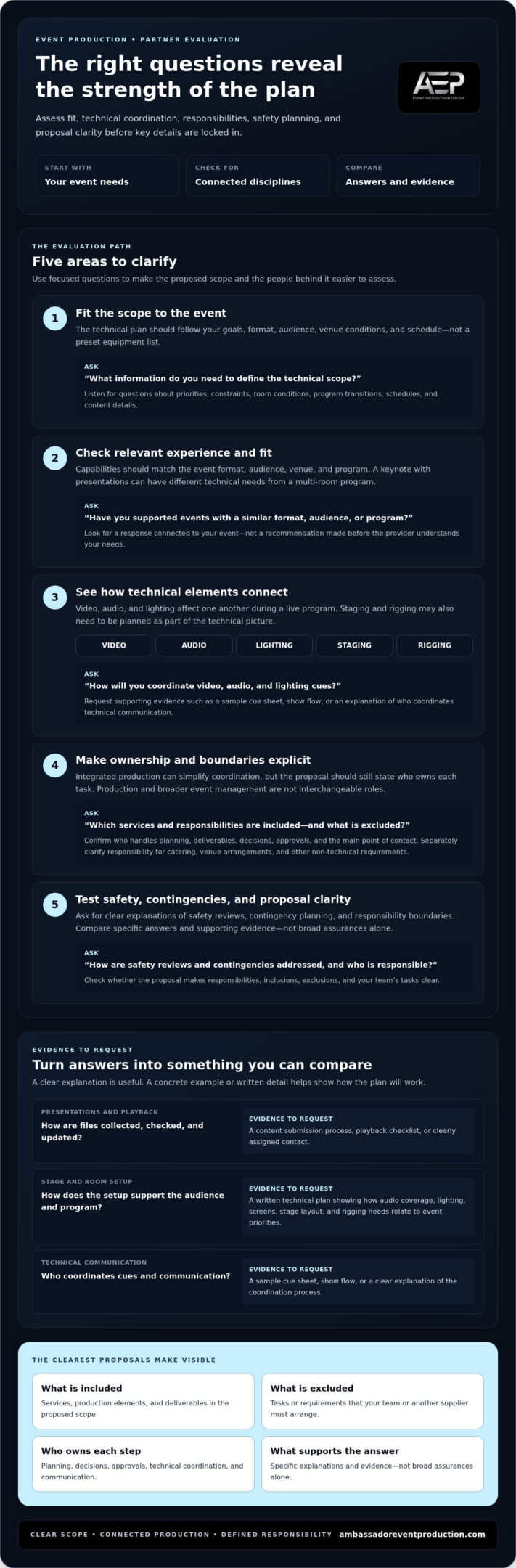
- What information do you need to define the technical scope?
- Have you supported events with a similar format, audience, or program?
- Which production services and responsibilities would you include?
- Who coordinates the technical disciplines and serves as the main point of contact?
Look for questions about your priorities and constraints, rather than an immediate equipment recommendation. A suitable partner should explain how event details shape the proposal and identify any information it still needs.
How do you define the technical scope for an event like ours?
Share the audience size, program format, venue details, and event priorities. A keynote with presentations, for example, has different technical needs from a multi-room program with speakers and video content. Ask what venue information, schedules, and content details the provider needs to build an appropriate scope. Follow-up questions about room conditions, transitions between program segments, and production priorities are more useful than a quick equipment list.
Which production services and responsibilities are included?
Ask whether video, audio, lighting, staging, and rigging can be coordinated in one technical plan. Then request a written breakdown of included services, exclusions, and your team’s responsibilities. Integrated technical work can simplify coordination, but the proposal should still identify who owns each task. Confirm what the provider will execute and what your team or another supplier must arrange.
A technical production partner focuses on delivering production elements, while event management can include broader project coordination and logistics, as outlined in Event management. Don’t assume those roles are interchangeable. Confirm separately who handles planning, catering, venue arrangements, and other non-technical requirements. Clear boundaries help prevent gaps between the production scope and the wider event plan.
Questions That Reveal Whether the Production Team Can Integrate Video, Audio, and Lighting
Video, audio, and lighting affect one another throughout a live program. A presentation cue depends on content being ready, the screen being visible, and the presenter being heard. When each discipline is planned in isolation, details can fall between teams. Ask how technical recommendations connect to your event goals, and listen for a clear explanation of how the production elements will work together.
These questions to ask a potential event production company can help you assess its approach and the evidence behind its answers. BizBash also offers a useful checklist of questions to ask before hiring.
| Ask | Reassuring answer | Follow-up evidence to request |
|---|---|---|
| How will you coordinate video, audio, and lighting cues? | The team can describe how the disciplines communicate and how cues follow the program. | A sample cue sheet, show flow, or explanation of who coordinates technical communication. |
| How are presentations and playback content handled? | The team explains who collects and checks files, and how updates are managed before and during the event. | A content submission process, playback checklist, or clearly assigned contact. |
| How will the stage and room setup support the audience and program? | Recommendations connect audio coverage, lighting looks, screens, stage layout, and any rigging needs to the event’s priorities. | A written technical plan or proposal showing how those elements relate. |
What should I ask about video, presentations, and content playback?
Clarify how presentations, playback cues, screens, and any event recording needs fit into the technical plan. Ask who receives and checks presentation files, when content should be submitted, and how updates are communicated. Then ask what the team will do if a file changes or playback doesn’t work as expected. Look for a defined process and a responsible contact, not a vague assurance that everything will be fine.
How will audio, lighting, staging, and rigging work together?
Ask how audio coverage and lighting looks will support the stage layout and program, and how any rigging needs will be coordinated with those decisions. Find out who oversees communication across technical disciplines, especially when a change affects more than one area. For a wider view of coordinated production, see this integrated technical event production guide. For discipline-specific detail, explore the event audio production guide.
Connected answers are a stronger sign of coordination than an equipment list alone. To review the available technical production services, visit Ambassador Event Production’s technical services.
Questions to Ask About Production Planning, Crew, and Event-Day Communication
A clear production process helps everyone understand what happens next and who’s responsible. Ask the company to describe its sequence from discovery through show execution: gathering event details, developing the technical plan, coordinating with relevant teams, preparing for setup, reviewing cues during rehearsal, and carrying out the show. The steps may vary, but handoffs and responsibilities should be clear.
Use these questions to turn general assurances into practical agreements:
- What deliverables will you provide, and when? Confirm which items apply to your scope, such as the technical plan, production schedule, and cue information.
- Who approves changes? Name decision-makers and put approval points and deadlines in writing.
- How will time-sensitive updates reach the crew? Agree on communication channels and escalation contacts before event day.
- What contingencies have you considered? Ask how the team would assess and communicate a disruption, and who makes decisions. No plan can prevent every issue, so look for a sensible response process rather than a promise of zero problems.
Who will lead technical direction and communicate with our team?
Ask who will be your primary technical contact during planning and who will lead communication during the event. Clarify how schedule or content changes reach the right crew members, who can approve adjustments, and how urgent decisions are escalated. A named contact and agreed process help prevent crossed messages. For more detail on the role, see this live event technical direction guide.
How do you prepare the crew for setup, rehearsal, and showtime?
Ask how the production schedule accounts for venue access, setup, technical checks, rehearsal, and show execution. Confirm whether rehearsal time and cue review are included in the proposed scope or need to be arranged separately. Request a clear outline of crew responsibilities, who supervises each technical area, and whom your team should contact with a question or issue.
Before signing off, put the agreed deliverables, decision-makers, deadlines, rehearsal expectations, and communication plan in writing. This gives both teams a shared reference as the event approaches and makes it easier to identify gaps while there’s still time to resolve them.
Questions That Test Safety, Contingencies, and Proposal Clarity
A polished proposal may look reassuring, but presentation alone doesn’t show whether the technical plan accounts for venue conditions, responsibilities, or possible disruptions. Ask how the production team reviews risks, who confirms requirements with the venue, and how it would handle changes or unexpected issues. A thoughtful answer explains the process and its limits rather than promising that every problem can be prevented.
Use these questions to understand the assumptions behind the recommendations:
- What venue requirements or technical constraints need to be confirmed?
- Who reviews safety considerations and coordinates technical plans with the relevant parties?
- For rigging, who confirms responsibilities, approvals, and any required documentation?
- What contingency steps are planned, and who communicates decisions if circumstances change?
Requirements can vary by venue and event. Ask the provider to identify what applies to your production, and confirm details with the venue or other responsible parties rather than assuming one standard covers every event.
What should I ask about rigging, venue requirements, and safety?
Ask who checks venue information and coordinates the technical plan with the appropriate contacts. For rigging, clarify which party is responsible for planning, approvals, and documentation, and ask what must be confirmed before work proceeds. Look for clear ownership and a process for resolving open questions, rather than an assumption that the venue or another supplier will take care of them.
How do I compare production proposals fairly?
Compare each proposal’s scope, staffing, equipment categories, schedule, deliverables, and client responsibilities. Ask providers to explain exclusions and assumptions, and how approved changes are documented and priced. Don’t compare totals without checking that the proposals cover the same work. A fair comparison starts with aligned scope and assumptions.
A concise comparison can help expose gaps. Check whether each proposal describes:
- Included work: Which technical services, crew responsibilities, and deliverables are covered?
- Conditions: What venue details or client-provided information does the proposal assume?
- Exclusions: Which tasks or costs sit outside the stated scope?
- Changes: Who approves adjustments, and how will their impact be documented?
If an answer is unclear, ask for the proposal to be revised or clarified in writing before comparing options. To discuss technical production requirements and scope, connect with Ambassador Event Production.
How to Choose the Right Event Production Company and Agree on Next Steps
Bring your notes together before making a decision. A simple scorecard helps compare providers on the factors that shape technical execution, rather than letting a polished presentation or broad assurances carry too much weight.
- Technical fit: Does the proposed scope reflect your event goals, format, venue, and program?
- Integration: Can the team explain how video, audio, lighting, staging, and rigging will work together?
- Communication: Are contacts, decision-makers, approvals, and deadlines clear?
- Safety and contingencies: Does the provider describe how it reviews relevant requirements and responds to changes?
- Scope clarity: Are deliverables, exclusions, assumptions, and client responsibilities documented?
Score each area based on specific answers and supporting details, such as a written scope or defined communication process. If a response sounds vague, ask for clarification before treating it as a strength. A strong technical partner can explain its approach while being transparent about what is and isn’t included.
What does a strong production-company answer sound like?
A strong answer starts with questions about your event goals and constraints, then connects recommendations to those details. It identifies who owns each responsibility, explains the process, and makes exclusions clear. Treat broad guarantees or unsupported claims as prompts to ask how the provider plans to manage uncertainty. Clear, evidence-based answers give you a fairer basis for comparing proposals.
What information should I prepare before requesting a proposal?
Gather your event date, format, audience estimate, venue details, and program outline. Add known technical needs, key decision-makers, deadlines, and unresolved questions. This gives providers a useful starting point without requiring you to have every production detail figured out.
Use the questions to ask a potential event production company as a final check: can the team show how its technical scope, coordination, communication, and responsibilities fit your event? An integrated technical partner can coordinate video, audio, lighting, staging, and rigging while keeping the boundaries of its role clear.
For a conversation about your event goals and technical requirements, discuss integrated production needs with Ambassador Event Production.
Choose a Production Partner with Clarity and Confidence
The right production partner should understand your event’s goals, explain how technical services connect, and make responsibilities, deliverables, and contingencies clear. Use your questions to ask a potential event production company to compare specific answers and written evidence, not just polished proposals or broad assurances.
Ambassador Event Production is a family-owned and operated business founded in 1955, providing integrated video, audio, lighting, staging, and rigging services. Its technical production services can coordinate these key disciplines while keeping the scope clear.
Start with your event format, venue details, and program outline, then identify the technical requirements that matter most. Discuss your event’s technical production needs with Ambassador Event Production. Clear questions and a shared understanding of scope can help you prepare for event day.
Frequently Asked Questions
What questions should I ask an event production company?
Ask how the company will define your technical scope, coordinate production disciplines, and communicate with your team. Useful questions to ask a potential event production company include: “What information do you need to recommend a plan?”, “Which services and responsibilities are included?”, and “Who leads technical communication before and during the event?” Also ask how proposals address exclusions, changes, venue requirements, and contingencies. Request specific answers and written details so you can compare providers fairly.
How do I know if an event production company is right for my event?
A suitable company can connect its recommendations to your event’s goals, format, audience, venue, and program. Look for evidence that it understands your technical requirements, can coordinate the services you need, and communicates responsibilities clearly. Ask about similar event formats, but focus on the proposed process and scope, not general experience alone. If key details remain unclear after follow-up, resolve them before you commit.
What should an event production proposal include?
A useful proposal describes the technical scope, included services, deliverables, staffing, schedule, and client responsibilities. It should also identify assumptions, exclusions, and how proposed changes are reviewed and approved. For example, confirm whether rehearsal time, presentation handling, or rigging coordination is included or needs separate arrangement. The proposal should make clear what the production team will provide and where your team or other parties have responsibilities.
Should I hire one company for audio, video, lighting, and staging?
One company may be a good fit if it can coordinate the technical services your event requires and explain how those elements work together. Integrated planning can help align audio, video, lighting, staging, and rigging around the program. However, a single provider isn’t automatically right for every event. Compare its capabilities, communication plan, scope, and accountability with your production needs before deciding.
When should I contact an event production company?
Contact potential providers once you can share your event date, format, venue details, and a program outline. An early conversation gives the production team context to assess requirements and prepare a proposal, though availability and planning needs vary by event. If some details aren’t settled, share what you know and identify what’s still pending. Ask what information the provider needs next and when decisions are required.
How can I compare event production companies fairly?
Compare proposals against the same event details, reviewing scope, staffing, equipment categories, deliverables, schedule, assumptions, exclusions, and client responsibilities. A lower total may reflect a different scope, so ask providers to explain gaps or variations before weighing costs. Look for written evidence and specific answers about coordination and communication. If proposals use different assumptions, ask each company to clarify or revise its scope to make the comparison meaningful.
Does an event production company also handle event planning?
Not necessarily. Event production companies may focus on technical execution, while broader event planning can include logistics and coordination beyond production. Confirm the provider’s responsibilities rather than assuming planning or catering is included. Ambassador Event Production focuses on technical production, including video, audio, lighting, staging, and rigging, and does not provide event planning or catering. Identify who will manage those wider event needs so responsibilities are clear across your team and suppliers.