
Signs of a Reliable AV Company for Event Organizers
A polished proposal can look reassuring, but it can’t show how a production team will respond when the program is live. The signs of a reliable AV company are clearer in its planning, how it connects technical disciplines, and who takes responsibility for execution. If you’re concerned about disruptions or production elements working at cross-purposes, those details matter as much as the equipment list.
Dependable production starts before show day. A capable partner clarifies the event’s technical needs, coordinates the people and systems involved, and explains how the plan will carry through to live execution. To assess that plan, look for a clear scope, named responsibilities, realistic milestones, and a shared understanding of how the program will run.
This article explains what to look for in technical planning, integrated video, audio, lighting, staging, rigging, and accountable crews. You’ll also see how coordination can reduce gaps between production elements and support a smoother event from preparation through live execution. Ambassador Event Production brings these technical disciplines together for professional events.
Key Takeaways
- Look beyond a polished proposal: clear scope, assigned technical responsibilities, milestones, and communication channels show how work will be managed.
- The signs of a reliable AV company include coordination across production disciplines, helping prevent timing and communication gaps during the program.
- Match reliability checks to your event format, from intelligible audio and smooth presentation flow to cue coordination and contingency readiness.
- Use the production plan to understand how preparation connects to live execution and who is accountable if conditions change.
- Integrated technical support can bring video, audio, lighting, staging, and rigging into one coordinated production approach.
Signs of a Reliable AV Company for Live Events
Choosing technical support for a consequential event carries real pressure. A microphone failure, missed cue, or unclear handoff can interrupt the program and pull attention from the message. The signs of a reliable AV company go beyond a confident sales conversation: look for consistent preparation, coordinated technical work, clear communication, and capable execution while the event is live.
Event production brings several disciplines together. A useful overview of live event support includes staging, sound, lighting, and video, all of which can affect how a program unfolds. An equipment list may show what is proposed, but not how the pieces connect, who operates them, or how the team will support the run of show.
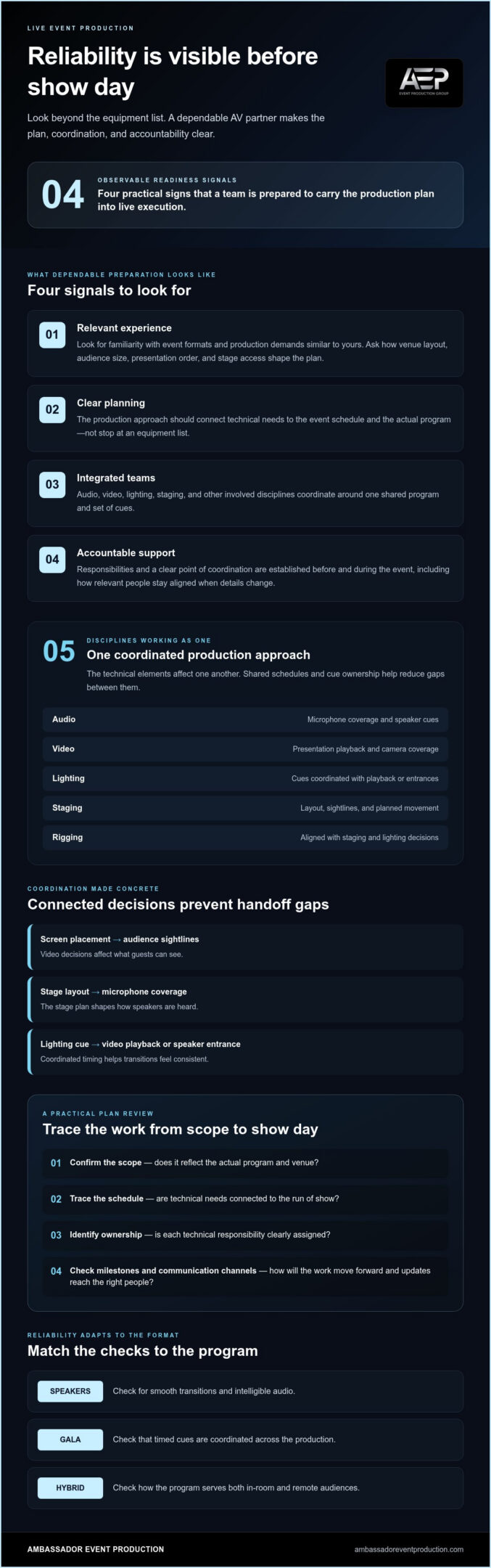
Look for observable evidence of readiness, such as:
- Relevant experience: Familiarity with event formats and production demands similar to yours.
- Clear planning: A production approach that connects technical needs to the schedule and program.
- Integrated teams: Coordination between audio, video, lighting, staging, and other involved disciplines.
- Accountable support: Defined responsibilities and a clear point of coordination before and during the event.
How does event-specific experience demonstrate reliability?
Comparable experience helps a team anticipate the practical demands of your format. Speakers may need smooth transitions, a gala may rely on timed cues, and a hybrid program may need to serve both in-room and remote audiences. Venue layout, audience size, presentation order, and stage access all shape technical decisions. Ask how those details affect the production plan. Years in business alone don’t guarantee a flawless event.
Why should clear communication be visible before show day?
Timely responses, named responsibilities, and shared production information help the organizer, presenters, venue, and technical crew work from the same plan. This prevents avoidable assumptions about who supplies content, manages cues, or communicates a schedule change. A dependable team makes the plan understandable and keeps relevant people aligned as details develop.
Reliability in event AV means preparing together, coordinating clearly, and carrying the technical plan through live execution. Notice whether the conversation turns your goals into practical next steps, rather than stopping at a list of equipment. That distinction helps you assess not just what will be brought in, but how the production will support the event from setup through the final cue.
Why Integrated Audio, Video, Lighting, and Staging Matter
Integrated event production means the technical disciplines are planned and coordinated to support one program, rather than handled as unrelated tasks. Audio, video, lighting, staging, and rigging each have a role, but their decisions affect one another. Screen placement can influence sightlines; stage layout can shape microphone coverage; and a lighting cue may need to land with video playback or a speaker entrance.
Separate workflows can leave gaps. A presenter may be ready to begin while the presentation file isn’t cued, or lighting may change before the audience can clearly see the next speaker. Shared schedules, coordinated technical planning, and clear cue ownership help the crew anticipate these handoffs. For a practical set of questions to ask a production company, BizBash offers a useful checklist for discussing production details.
Integrated production connects every technical cue to the same plan, helping the event feel consistent from one moment to the next. That coordination is one of the signs of a reliable AV company: the team considers how content, sound, stage activity, and visual design work together, not just whether each element is present.
How do audio and video teams coordinate during a live program?
Audio and video teams need a shared view of the run of show. Speaker microphones, presentation playback, camera coverage, and on-screen content all depend on timing and clear cue ownership. If a speaker’s introduction changes, the people managing sound, cameras, and slides need the same update. A corporate event video production guide can help organizers understand how video supports the wider production plan.
What role do lighting, staging, and rigging play in reliability?
Stage layout and lighting design affect whether guests can see speakers, follow transitions, and move through planned entrances and exits. Rigging decisions need to align with the staging and lighting plan and be handled through careful technical execution. The custom stage design guide explores how technical and visual considerations come together. For a production partner that coordinates video, audio, lighting, staging, and rigging, explore integrated event production support.
How to Evaluate an AV Company’s Reliability Before the Event
A useful production plan turns the event’s goals into a practical sequence of technical decisions. Review it in order: confirm the scope, trace the program schedule, identify who owns each technical responsibility, then check the milestones and communication channels that carry the work forward. These details make reliability visible before the crew arrives onsite.
What should a dependable event production plan make clear?
The plan should reflect the actual program and venue, not just list equipment. It should show what production work is included, how the event schedule connects to technical cues, which crew roles support those cues, and what dependencies could affect execution. For example, a presentation transition may rely on the speaker being ready, the correct file being loaded, and the audio and video teams sharing the same timing.
Look for information that brings those moving parts together:
- Scope: The production elements and responsibilities covered by the plan.
- Schedule: Key event moments, setup milestones, and technical checkpoints.
- Roles: Who coordinates each production area and communicates changes.
- Dependencies: Venue conditions, content handoffs, or other details that may affect the plan.
- Communication: How updates reach the organizer and relevant technical crew.
A generic equipment list can indicate what may be used, but it doesn’t explain how the crew will adapt the setup to the room or coordinate it with the run of show. Clear planning connects resources to actions and ownership. Check that the plan addresses the transitions and content handoffs specific to your program, rather than relying on a standard list of gear.
How do rehearsals and contingencies reduce show-day uncertainty?
Technical checks and cue rehearsals give the crew a chance to test the sequence before guests are watching. They can expose a presentation that needs adjustment, a transition that feels rushed, or a handoff that isn’t clear. A practical plan also defines escalation roles, so the team knows who makes decisions and communicates if timing, content, or venue conditions change.
Contingency planning isn’t a promise that nothing will go wrong. It’s a way to prepare for reasonable changes and respond without confusion. The integrated technical event production guide offers further context on how coordinated production disciplines support execution.
These planning details are among the signs of a reliable AV company because they show how preparation continues into the live program. A clear scope, workable schedule, named responsibilities, and rehearsal approach help the organizer understand not only what the production includes, but how the team intends to deliver it.
Which Reliability Signals Matter Most for Your Event?
The right reliability signals depend on what the program asks the production team to do. A conference with frequent presenters needs smooth presentation changes; a gala may rely on well-timed stage and lighting cues; a hybrid event must keep both in-room and remote audiences connected to the program. Use the comparison below to decide which details deserve the closest attention.
| Event format | Priority reliability signals |
|---|---|
| Conference | Intelligible speaker audio, dependable presentation playback, and orderly transitions between sessions or presenters. |
| Executive meeting | Clear speech, controlled presentation flow, and coordinated cues that keep the program focused and on schedule. |
| Gala | Coordination between stage activity, audio, lighting changes, and visual moments such as videos or presentations. |
| Hybrid event | Planned coordination between the in-room program and the experience of remote viewers, including clear audio and well-managed visual content. |
What should organizers prioritize for a conference or corporate meeting?
Start with the audience’s ability to hear speakers and follow presentations without awkward pauses. A straightforward agenda may need fewer transitions than a program with multiple speakers, panels, videos, and presentation handoffs. As the agenda grows more complex, cue coordination and rehearsal become more important. Reliable production support accounts for the pace of the program, not just the individual technical elements. When reviewing a plan, trace a typical presenter change from the speaker handoff to the correct file appearing onscreen.
What changes for a gala, live program, or hybrid event?
Galas and other live programs often depend on a sequence of coordinated moments: a speaker takes the stage, lighting shifts, audio supports the remarks, and a video or visual element follows at the right time. The production plan should connect those cues so the room experiences one coherent program.
Hybrid events add another layer. The technical approach needs to account for how remote viewers receive the program as well as what guests in the room see and hear. The professional event audio production guide offers more context on the role of audio in a well-supported event.
There’s no single package that suits every format. The signs of a reliable AV company include a plan shaped around your agenda, audience, and production cues, with attention directed to the moments that matter most. For coordinated audio production, lighting, video, and technical support, explore event production support.
How Ambassador Event Production Delivers Integrated Technical Support
After identifying the production signals that matter, the next step is finding a partner whose technical scope can support the event as a connected whole. Ambassador Event Production provides video production, audio-visual technical support, audio production, lighting design and execution, staging, and rigging for live events. Coordinating these disciplines around the program can help reduce the handoffs that leave organizers managing separate technical threads.
How does one technical partner support connected event production?
Each production discipline shapes the others. Stage layout influences where presenters appear and how they move. Audio needs to support speech and program content, while video and lighting cues need to align with the run of show. When related technical work is coordinated under one production approach, the team can work from shared program priorities and clearer lines of communication.
That integration is useful whether the event calls for straightforward presentation support or a more layered program with multiple transitions. It doesn’t mean every event needs every service. The technical scope should reflect the format, content, audience, and production priorities, with the right disciplines aligned to execute the plan.
Ambassador Event Production is family-owned and operated and was founded in 1955. That history provides context for the company, while its integrated production scope gives organizers a way to bring key technical elements into a coordinated conversation. Longevity alone can’t guarantee a flawless event; dependable preparation and clear accountability still matter.
What is a practical next step for event organizers?
Begin with a brief outline of the event format, audience, program flow, and technical priorities. Note key moments such as presentations, speaker changes, videos, lighting transitions, or staging requirements. These details give the production conversation a practical starting point and help connect the event’s needs to the appropriate technical scope.
From there, organizers and the production team can align on responsibilities, timing, and how the technical elements support the program. It’s a practical way to identify what needs coordination before show day, rather than treating each piece as a separate request. The signs of a reliable AV company are reflected in how clearly that scope connects to execution.
For integrated video, audio, audio-visual technical support, lighting, staging, and rigging, discuss your event’s technical production needs with Ambassador Event Production.
Plan Your Event Production with Confidence
The signs of a reliable AV company are visible in more than a proposal or equipment list. Clear planning, defined responsibilities, and coordinated technical teams help connect the event’s program to live execution. The right priorities also depend on your format, whether you need smooth presentation changes, well-timed stage cues, or coordination for audiences in the room and online.
Ambassador Event Production brings video, audio, lighting, staging, and rigging together as integrated technical support. The company was founded in 1955 and is family-owned and operated, with technical services that help align production elements with the event program.
Start by outlining your event format, schedule, audience, and technical priorities. Discuss your event’s technical production needs with Ambassador Event Production and take the next step toward a well-coordinated live program. With a clear plan and an experienced technical partner, you can focus on the event while the production details receive thoughtful attention.
Frequently Asked Questions
What are the most important signs of a reliable AV company?
The most important signs of a reliable AV company are clear planning, relevant event experience, coordinated technical teams, and accountable live support. A production plan should connect the schedule to technical responsibilities, milestones, and communication channels. Look for evidence that the team understands how audio, video, lighting, and staging work together for your program. Equipment matters, but readiness depends on how the team plans and executes the production.
How can I tell whether an AV company has experience with my type of event?
Event-specific experience shows in how the production team accounts for your format, agenda, audience, and venue conditions. A conference with frequent speakers has different cue and presentation needs than a gala with timed stage moments. A capable team can explain how those demands shape its technical approach, crew coordination, and rehearsal plan. Years in business can provide context, but they don’t alone establish experience with your event’s particular requirements.
Why does an event need an integrated AV production team?
An integrated team coordinates technical disciplines around one program, which can reduce gaps between separate workflows. For example, a speaker entrance may depend on microphone readiness, lighting, and a video cue occurring in the right sequence. When the people responsible for those elements share the schedule and understand cue ownership, handoffs can be clearer. The aim is not to add complexity, but to make each technical element support the same event experience.
What should an AV production plan include?
A useful AV production plan should identify the scope, event schedule, technical crew responsibilities, key milestones, and communication channels. It should also reflect the venue environment and show how technical cues connect to the program. For instance, a presentation transition may involve the speaker, the correct media file, and the audio and video operators. An equipment list alone doesn’t explain those relationships or who is responsible for each step.
Does a reliable AV company provide contingency planning?
Contingency planning is an important part of preparing for live event conditions. A production team can identify likely points of change, clarify who makes decisions, and define how updates reach the relevant crew. Technical checks and cue rehearsals can also reveal coordination issues before the audience arrives. No plan can prevent every unexpected change, but clear roles and a considered response approach help the team address disruptions calmly.
Is equipment quality enough to make an AV company reliable?
No. Suitable equipment is only one part of dependable event production. The team also needs to plan how equipment will support the program, coordinate it with other technical elements, and operate it during the event. A list of microphones, screens, or lights doesn’t show how cues will be managed or who will respond if timing changes. Assess the preparation and accountability behind the equipment as well as the equipment itself.
How early should an AV company be involved in event planning?
Involve the production team as soon as technical needs could affect the program, venue layout, staging, or audience experience. Early coordination gives the team and organizer time to connect production requirements with the schedule and space, then identify dependencies before they become show-day challenges. The right timing depends on the event’s complexity. A program with multiple speakers, video cues, or hybrid elements may need more coordination than a simpler presentation.