
Event Lighting for Audience Engagement: A Practical Guide
What if the most memorable lighting moment is the one that helps the audience focus, not the one that looks most dramatic? Attractive colors and effects can set a mood, but without a clear purpose they may compete with the message. The right event lighting techniques for audience engagement guide attention, strengthen the atmosphere, and make participation feel natural. Poorly timed changes, by contrast, can distract from a speaker or interrupt an important moment.
This guide shows how to turn engagement goals into a practical lighting approach. Learn how cues, contrast, color, and timing can support the program, from a speaker’s entrance to an audience response. You’ll also see how to shape a clear lighting brief and coordinate lighting with video, audio, and staging. When these elements work together, changes in the room feel intentional, keeping attention on what matters and making the event experience more coherent from start to finish.
Key Takeaways
- Use event lighting techniques for audience engagement to direct attention, build atmosphere, and support participation without competing with the message.
- Choose lighting effects for a clear purpose, whether you want to highlight a speaker, define a space, or create a visual reveal.
- More color and movement don’t automatically improve engagement. Protect speaker visibility, readability, and audience comfort.
- Build a five-step lighting plan around audience needs, program moments, venue conditions, and rehearsal.
- Coordinate lighting cues with video, audio, staging, and rigging to create a more unified event experience.
Why event lighting techniques matter for audience engagement
Audience engagement is more than keeping people in their seats. It includes attention to the event, understanding its message, feeling a connection to what’s being shared, and having opportunities to participate. Lighting can support each of these outcomes by making the program’s priorities visible. It helps the audience know where to look, sense a change in tone, or recognize when a moment calls for interaction, while keeping the speaker and content central.
Purposeful lighting cues help audiences focus on the right part of the experience at the right time. That’s the foundation of effective event lighting techniques for audience engagement. A cue might draw the eye toward a presenter, distinguish the stage from the audience, or make a transition clear. The principles of stage lighting, including selective visibility, focus, and mood, offer a useful framework for deciding what the audience should see and feel.
Those choices depend on more than the stage. Sightlines affect whether people at the back or sides can see the speaker and important visuals. The room matters too: a bright, open conference room calls for a different approach from a dark theater or multipurpose space. The event format also shapes the plan. A presentation may need a clear visual focus, while a discussion needs an open feel that helps people connect with one another.
How lighting directs attention without competing with content
Contrast and selective emphasis guide attention by making one area more visually prominent than its surroundings. During a keynote transition, for example, lighting can shift focus from the outgoing speaker to the next presenter as they approach the stage. This signals a change without relying on a sudden burst of color or movement.
Intentional emphasis doesn’t mean maximum brightness. If effects pull attention away from a speaker, obscure a screen, or change too often, they can make the content harder to follow. Ask one simple question: does this cue help the audience understand what matters now? If not, a quieter transition may serve the moment better.
The audience experience changes with the event moment
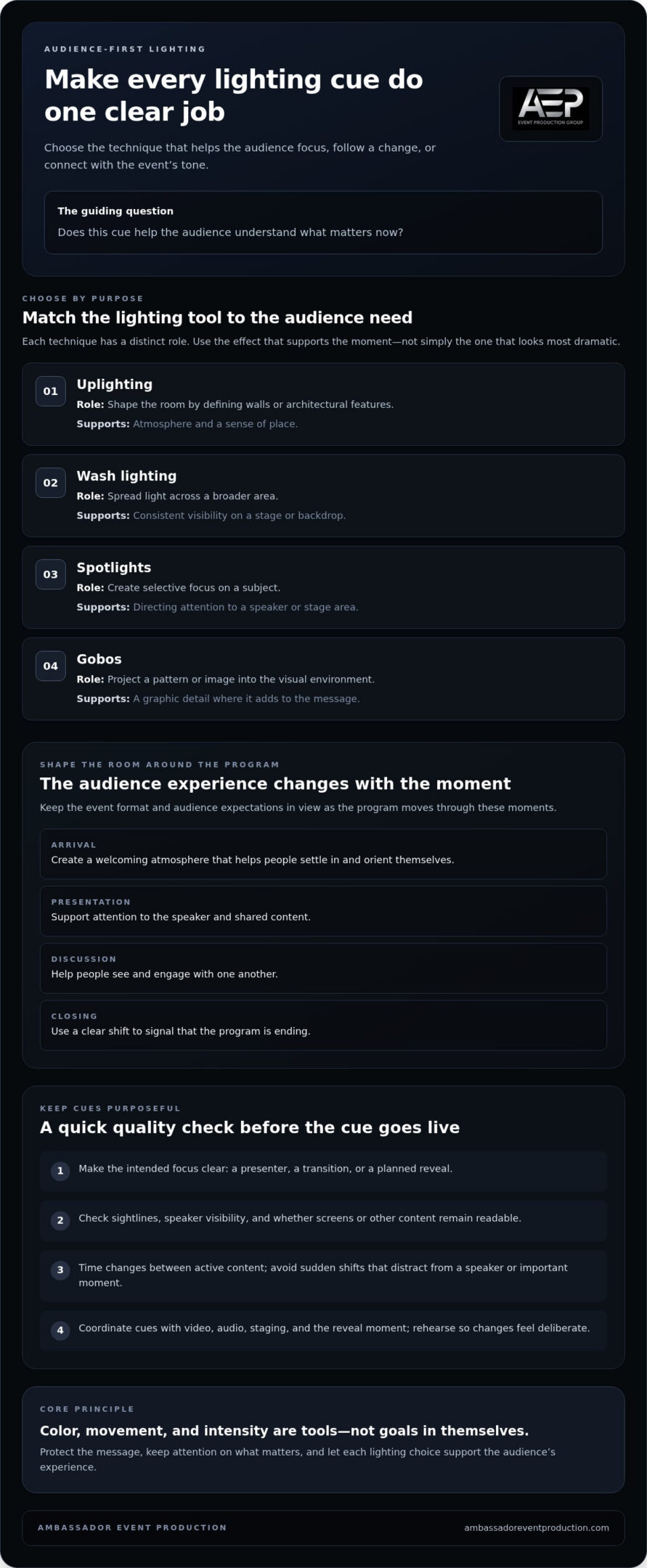
Arrival, presentation, discussion, and closing each call for a different treatment of the room. During arrival, a welcoming atmosphere can help people settle in and orient themselves. For a presentation, lighting should support attention to the speaker and shared content. A discussion benefits from a setting that helps people see and engage with one another, while a closing may call for a clear shift that signals the program is ending.
Let the room’s purpose and audience expectations guide these changes. A formal keynote and an interactive workshop may take place in the same venue, but they don’t need the same visual emphasis. Start with the audience response you want, then choose effects that help create it. Color, movement, and intensity are tools, not goals in themselves.
Event lighting techniques that support attention and participation
Choose a lighting technique by first deciding what the audience should notice or feel at that point in the program. An effect is useful when it helps people orient themselves, follow a change, or connect with the event’s tone. This purpose-first approach turns a collection of fixtures into a coordinated visual language, with each cue doing a clear job instead of competing for attention.
Use uplighting to shape the room, wash lighting to create an even field, spotlights to emphasize a subject, and gobos to add a graphic or pattern where it supports the message. Uplighting can define walls or architectural features, helping establish atmosphere and a sense of place. A wash spreads light across a broader area, which is useful for consistent visibility on a stage or backdrop. A spotlight creates selective focus, while a gobo projects a pattern or image into the visual environment. Match the tool to the audience response you want, not simply to the effect it can produce.
Use lighting cues to frame speakers, transitions, and reveals
Focused light can distinguish a speaker or stage area from the wider room, helping the audience identify the main point of attention. For a transition, adjust the look as one segment ends and the next begins, rather than changing it suddenly during active content. A reveal needs its own planned cue: coordinate the lighting shift with the moment a product, set, or visual element becomes part of the story. Rehearsal helps the cue feel deliberate.
Use color, texture, and movement with intention
Color can reinforce an event’s visual identity and tone, but its effect depends on the context and audience. A textured gobo can add visual interest to a wall or stage surface. Keep it away from screens and other content that needs to stay readable. Moving effects can bring energy to an entrance or reveal, but constant movement may distract during a speech. Reserve them for moments when motion supports the program.
Before choosing a look, connect each planned cue to a purpose: emphasize a speaker, create atmosphere, orient the audience during a format change, or add visual impact to a reveal. Then check sightlines and video content to ensure lighting doesn’t obscure what people need to see. These decisions are central to event lighting techniques for audience engagement, because the audience experiences the cues as part of one event, not as isolated effects.
When lighting needs to work alongside staging, audio, and video, an integrated production approach helps align those elements. Integrated event lighting design connects visual choices with the wider production plan.
More lighting effects do not guarantee stronger audience engagement
A room can be full of color, bright effects, and movement while people struggle to follow the program. Visual impact is useful only when it supports the audience’s experience. If a lighting change competes with a presentation slide, makes a speaker hard to see, or pulls attention away from an important spoken moment, it can weaken comprehension instead of building engagement.
Choose the least distracting cue that achieves the intended audience response. This keeps decisions grounded in purpose. Before adding an effect, consider what the audience should notice, understand, or do. If a simpler look supports that response just as well, restraint may serve the event better.
Balance visual impact with visibility and comfort
Review the full viewing experience, not just how the stage looks from the control position. Can the audience see the speaker’s face, read projected content, and follow the activity onstage? A look that seems balanced from the center may feel too bright from the front or create glare for people seated at an angle. Check the room from several audience positions, including the sides and back.
Use rehearsal to catch practical issues before the room fills. Look for light spilling onto a screen, sharp contrast that makes a speaker difficult to distinguish from the background, or bright sources shining toward seated guests. Review these elements while presentation content is visible. A screen that reads clearly in an empty room may compete with the lighting once the full look is active. Adjust the cue or angle as needed.
- Confirm faces remain easy to see during key speaking moments.
- Check that slides and other visual content stay legible.
- Review the look from different seats, not only from the front.
Choose dynamic effects only when they serve the program
Movement earns its place when it relates clearly to the moment, such as adding energy to an entrance or marking a planned reveal. During a detailed presentation, interview, or reflective pause, a steady look may help the audience stay with the content. The question isn’t whether an effect is impressive, but whether its movement supports the event’s narrative at that point.
Consistency matters, too. If similar program transitions use unrelated visual changes, the audience may find it harder to follow the flow. Establish a visual pattern for recurring moments, then reserve exceptions for meaningful shifts in the program. This gives cues a recognizable role instead of making every change compete for attention.
As you refine event lighting techniques for audience engagement, assess each cue against three questions: does it preserve visibility, fit the program moment, and help the audience follow what’s happening? If it fails one of those tests, simplify the look, adjust its timing, or remove the effect. This disciplined review balances visual ambition with comfort and clarity.
Plan audience-focused event lighting techniques in five steps
A workable lighting plan starts with the audience experience, then translates it into cues the production team can deliver in sync with the program. Use these five steps to move from a broad engagement goal to a tested plan that fits the room and content.
- Set the engagement goal. Identify what you want the audience to notice, feel, understand, or do. “Make the event more exciting” is hard to act on; “help guests focus on the speaker’s main point” gives the team a clearer direction. Include practical audience needs, such as seeing the stage, following presentation content, or recognizing when participation is invited.
- Mark the moments that matter. Review the run of show and flag speaker introductions, transitions, audience interaction, reveals, and closing moments. For each one, note the intended audience response and the content that needs emphasis. A question-and-answer segment, for example, may call for a different room feel than a speaker introduction. This ties lighting changes to the program instead of adding cues simply to create activity.
- Review the venue and viewing conditions. Consider the stage layout, screens, room shape, seating, and audience sightlines. Note where visibility may be affected by the stage arrangement or existing light in the space. These details help determine which cues are practical and where they should focus. For more context on matching a system to production needs, consult the intelligent event lighting technical guide.
- Write a concise cue plan. Record each cue beside its program moment, with a short note describing its purpose, timing, and what should remain visible. For example: “Speaker introduction, bring focus to the stage as the host finishes.” Clear intent helps the technical team execute consistently and coordinate changes with spoken content, video playback, and stage activity. Aligning the lighting plan with the stage layout also helps keep the visual focus practical.
- Rehearse, observe, and refine. Run through cues against the actual program wherever possible. Watch from different parts of the room, check how the speaker and content read together, and confirm transitions happen at the right moment. If a cue arrives during an important sentence or draws attention away from the screen, adjust its timing or simplify it. Rehearsal turns the written plan into a shared, workable sequence.
These steps give event lighting techniques for audience engagement a clear path from goal to execution. Ambassador Event Production provides lighting design and execution as part of integrated technical event production, connecting audience priorities with the wider production plan. See how integrated event production brings these elements together.
Bring audience-first event lighting techniques together with technical production
Lighting cues work best when they’re planned as part of the live production, not added as a separate layer at the end. A shift in light may need to align with a video starting, an audio cue, a speaker moving across the stage, or a change in the set. Coordinating these elements helps the audience experience one clear transition instead of several competing signals.
That coordination turns event lighting techniques for audience engagement into a practical production plan. The production team translates audience goals into cues, then aligns timing and execution with video, audio, staging, and rigging. For a speaker introduction, for instance, the team can coordinate the stage look with the host’s handoff and any accompanying screen content. Shared planning also helps ensure lighting choices work with the stage design and technical setup.
Coordinate lighting with the full live production
Build cues around the program’s actual sequence. If a video introduces a new segment, lighting can transition with playback rather than changing too early and drawing attention away from the screen. If a speaker enters after an audio introduction, the lighting cue can support the handoff and make the change in focus clear. These connections are easier to execute when the production team works from shared timing and cue information.
Staging and rigging also shape how lighting fits the space and the audience’s view. A coordinated approach considers where visual elements sit, what needs to remain visible, and how technical changes support the planned activity. The integrated technical event production guide offers a wider perspective on connecting production disciplines.
Prepare a useful brief for the production team
A clear brief gives the team a shared starting point and turns broad ambitions into workable decisions. Include the event format, audience, program outline, important moments, and the atmosphere you want to create. Add visual references if you have them, and identify anything that must remain easy to see, such as presentation slides, a demonstration, or a speaker’s position onstage.
It also helps to state the audience response you want at key moments. Should guests focus on a presenter, follow a visual reveal, or feel invited into a discussion? That context helps the production team shape a lighting approach that serves the content and fits the technical production. A brief can capture:
- The event format, audience, and program sequence.
- Key moments that need a lighting cue or a change in focus.
- Visual references and content that must remain visible.
- Relevant staging, video, audio, and rigging considerations.
Bring those priorities into the production conversation early so the team can shape a coordinated approach around your goals and requirements. Learn about Ambassador Event Production’s technical production services.
Shape the audience experience from the first cue
Turn the event’s purpose into a shared production brief. Decide what you want people to notice, understand, or take part in, then bring those priorities into conversations about the program and technical setup. This gives the production team a clear foundation for shaping lighting cues that fit the event, rather than adding effects without a defined role.
The strongest results come from thoughtful collaboration. Ambassador Event Production is a family-owned and operated company founded in 1955, bringing event lighting together with video, audio, staging, and rigging. With those disciplines aligned, event lighting techniques for audience engagement can support a live experience that feels intentional and connected.
Share your event format, key moments, and audience goals with Ambassador Event Production. Plan your event lighting with our production team and build a focused, welcoming experience for your audience.
Frequently Asked Questions
Can event lighting work effectively in a daylight venue?
Yes. Event lighting can work effectively in a daylight venue, but the design needs to account for changing natural light. Event lighting techniques for audience engagement can include controlled light that maintains visibility onstage as daylight shifts, rather than trying to make the room uniformly bright. Consider how windows affect the stage and screens at different times, and review the look during setup. A cue that works in the morning may need adjustment later.
How can event lighting reduce glare for the audience?
Reduce glare by reviewing where light sources point and how they reflect off screens, glossy surfaces, or windows. A fixture aimed toward a seated audience can feel uncomfortable, even if the stage looks balanced from the front. Check the room from seats at different angles, then adjust the fixture direction or intensity as needed. Reflective clothing or surfaces near the stage can also create bright spots under certain lighting positions.
What information should I include in an event lighting brief?
Include the event format, audience, program schedule, key moments, and the atmosphere you want for each part. Add the venue layout, stage and screen positions, and camera locations if the event will be recorded or streamed. Share presentation materials or visual references when available, and flag details that could affect the design, such as a speaker moving through the room or a demonstration that needs clear visibility. Note who approves cue changes.
Does event lighting affect how speakers appear in event photography?
Yes. Lighting can affect how clearly and consistently speakers appear in photographs. Strong backlight may make a face look darker, while mixed colors across the stage can create uneven skin tones in images. If photography matters, include camera positions and expected speaker locations in the technical planning, then review sample images during rehearsal. Visual capture teams like Shutterink Photography often highlight how balanced lighting preserves authentic skin tones and details. This gives the team a chance to adjust the look for both the room and the camera, rather than relying only on how it appears in person.
Is colored lighting suitable for a formal corporate event?
Yes. Colored lighting can suit a formal corporate event when it supports the event’s visual identity without distracting from the content. For example, a restrained color accent on a backdrop can add definition while keeping speakers and presentation materials clearly visible. Consider how the color works with the brand palette, room finishes, and camera images. A neutral look on faces paired with color in the surrounding environment can preserve a composed, professional feel.
Can lighting cues change between sessions at the same event?
Yes. Cues can change between sessions to reflect differences in format, speaker needs, or the intended atmosphere. A panel discussion may need a more even look across several participants, while a product demonstration may need focused visibility in a specific area. Treat each session’s cue changes as part of the run of show, and make sure the technical team knows what triggers them. This helps changes feel intentional rather than like unrelated resets.