
Risks of Using Hotel In-House AV Services: Costs, Terms, and Vendor Choice
A hotel’s preferred AV provider may serve the venue’s operating and revenue interests as well as your event. The risks of using hotel in-house AV services include limited vendor choice, possible fees for outside providers, and contract terms that leave little room to negotiate later. In-house support can be convenient, but it isn’t automatically the right fit for every event.
It’s reasonable to want clear costs, reliable technical support, and a production team that understands your event’s needs. This guide explains why venues favor in-house AV, how to compare proposals and contract terms, and what to clarify about staffing, cancellations, insurance, rigging, power, and internet. Getting those details on the table early helps you weigh the trade-offs and choose an arrangement that fits your event and budget.
Key Takeaways
- Negotiate outside-provider rights and any related fees in the hotel contract before signing.
- Clarify which venue rules apply to rigging, power, internet, and outside equipment so you can plan around operational and safety requirements.
- Compare detailed proposals on the same scope, including any bundled services and added venue charges, before choosing an AV arrangement.
- Put expectations for staffing, cancellation terms, insurance, and on-site coordination in writing to reduce event-day uncertainty.
1. Third-party vendor addenda and freedom-of-choice contract language
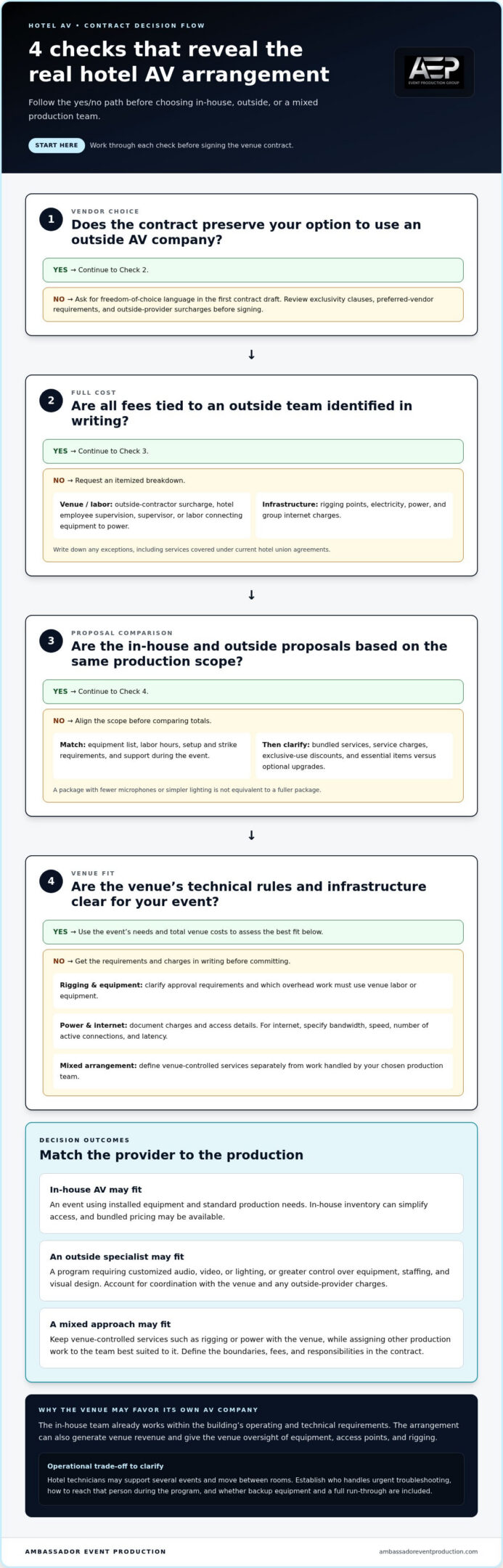
At the hotel request-for-proposal stage, state that your event may use an outside AV company. Ask venues to include freedom-of-choice language in the first contract draft, before signing limits your options. Review exclusivity clauses, outside-provider surcharges, and requirements to use preferred vendors. Negotiating these terms early gives both sides time to define responsibilities and costs.
A third-party addendum can spell out the arrangement. For example, propose that groups using outside contractors won’t pay an outside-contractor surcharge or fees for hotel employees to supervise those contractors. Put any exceptions in writing, including services provided under current hotel union agreements. This clarifies what you’ll pay for instead of leaving labor or supervision charges for later discussion.
Ask the hotel to identify every fee tied to an external team, such as rigging points, a supervisor, electricity, or labor connecting equipment to power. If the venue requires its AV company for specific services, negotiate those boundaries separately from the rest of your production. A mixed approach may preserve venue-controlled services while allowing your chosen team to handle other work. Include agreed fees and requirements in the contract.
Clarify infrastructure costs before committing to a venue. Request power, group internet, and rigging charges alongside the hotel proposal, then compare them with your event’s actual needs. For internet, document the total cost and the agreed access, bandwidth, speed, number of active connections, and latency. These details help prevent a low initial quote from obscuring the full service arrangement.
If the event is scheduled years ahead, negotiate the AV terms now and include them in the signed contract. Ask how future pricing changes affect agreed terms, and record whether outside-provider fees can be waived. A written addendum gives planners a clear basis for comparing proposals and resolving disagreements, regardless of which AV company ultimately supports the event.
2. Why does the venue want me to use the hotel audio visual company?
Venues may prefer their in-house audiovisual company because it already works within the building’s operating and technical requirements. The arrangement can also generate revenue for the venue, while giving its team oversight of equipment, access points, and rigging.
The risks of relying on hotel AV equipment and technical support include limited choice, shared staff, and added charges for outside providers. A presentation can lose momentum if equipment fails or a technician is occupied with another event. Delayed repairs can disrupt speakers, transitions, or audience participation.
Outside equipment isn’t automatically prohibited, but venue rules can restrict how it enters or operates in the space. Hotels may require their own rigging labor and equipment for overhead installations. The venue may also control electrical service and internet access points. Before signing, clarify which equipment needs approval and which work must be handled by venue staff.
Ask for the rigging policy and related fees in writing. Some venues charge for a supervisor, power, or labor connecting equipment to electrical sources. These requirements can be reasonable when a team uses permanently installed systems or works near venue infrastructure. If your event doesn’t need those systems, discuss whether the requirement can be adjusted.
In-house inventory can simplify access, but a standard package may not match every production plan. Compare the proposed screens, audio, lighting, and setup with your event’s actual needs. Confirm substitutions and backup equipment, then schedule a full run-through. That practical test can reveal compatibility problems before presenters take the stage.
Hotel technicians may support several events at the same venue, leaving them moving between rooms. Establish who handles urgent troubleshooting and how that person can be reached during the program. For a separate production team, audio-visual technical support can help coordinate event technology and on-site troubleshooting.
3. Costs and value of in-house versus outside AV providers
Bringing in an outside AV vendor can offer greater control over equipment, staffing, and visual design. The trade-offs include coordinating load-in and technical requirements with the venue, plus possible outside-provider charges. House AV providers may offer bundled pricing or easier access to installed systems, but exclusive-use terms can limit choice.
Disclose plans to use an external vendor during the venue request-for-proposal process. Ask for an in-house proposal and an outside-vendor cost breakdown before comparing venues. This lets you see whether a discount depends on using the hotel’s AV company and whether bringing in your own team triggers supervision, rigging, power, or labor charges.
Compare proposals based on the same production scope. Match the equipment list, labor hours, setup and strike requirements, and support during the event. A quote with fewer microphones or simpler lighting isn’t equivalent to a fuller package. Request plain-language explanations for unfamiliar AV terms, then identify which line items are essential and which are optional upgrades.
Look beyond the quoted total. Some venues add service charges to AV bills, while a bundled in-house proposal may reduce the cost of another venue service. Ask what each package includes, which discounts depend on exclusive use, and whether charges apply if your vendor handles only part of production. Record the answers alongside each bid.
Choosing between providers comes down to fit, scope, and total venue costs. An in-house team may suit an event using installed equipment and standard production needs. An outside specialist may better match a program requiring customized audio, video, or lighting. A combined approach can also work: use venue-controlled rigging or power while assigning specialized production to an external team. Compare the full arrangement before deciding.
4. Vendor experience, labor, cancellation, and insurance questions
Assess a hotel’s AV capabilities before signing by walking through the meeting space with its technical team. Review equipment placement, acoustics, lighting conditions, and the production plan. Ask who will operate each system and how the team will handle a failure during a live session. A room walkthrough can reveal practical constraints that a proposal alone may miss.
The team’s experience should match the program. A panel discussion, for example, needs clear speaker audio, reliable microphone handoffs, and smooth transitions between presentations. Ask who leads setup, testing, and show operations, and whether the same technical contact will remain reachable throughout the meeting. A full AV run-through helps expose equipment or presentation issues before attendees arrive.
Read labor terms line by line. Identify required technicians, supervisors, working hours, overtime rules, and whether the venue bills for a supervisor who isn’t present. Specify which tasks belong to the hotel team and which belong to an outside production crew. If a union agreement affects particular services, state that exception clearly so staffing responsibilities don’t conflict onsite.
Cancellation language deserves the same attention as equipment scope. Check the contract for deadlines, payment obligations, and how charges change if attendance, room use, or production needs change. Clarify whether postponement and cancellation are treated differently. Put any agreed flexibility in writing rather than relying on a planning conversation.
For insurance, establish the venue’s required coverage and how it applies to outside contractors. A third-party provider’s standard Certificate of Insurance may serve as an alternative to venue or in-house AV fees intended to protect facilities and equipment. Make the document and any related requirements part of the contract before load-in.
Set one direct AV contact for show-time troubleshooting, or use an independent AV consultant to support real-time decisions. For production planning that includes video and audio, discuss your event production needs with a technical team.
Ambassador Event Production: Video Production Services
Ambassador Event Production supports events that need coordinated production beyond a hotel’s standard AV package. Its Video Production Services, Audio-Visual Technical Support, Audio Production Services, and Lighting Design and Execution bring presentations, sound, and lighting together around the event’s requirements.
Consider this support when your program includes video content, multiple audio needs, or lighting that calls for careful execution. Sharing the event format, venue constraints, and production priorities helps shape a practical technical approach. The goal is to make the behind-the-scenes elements work together so presenters can focus on their audience.
Contact Ambassador Event Production to discuss technical production support for your event.
Make your production plan work for your event
The risks of using hotel in-house AV services are easier to manage when production choices start with the audience experience. Before committing, translate your event’s purpose into a clear creative brief: what attendees need to see, hear, and remember. That gives every technical decision a practical reference point and helps keep production aligned with the program.
For events where video content and sound need to work together, Ambassador Event Production offers Video Production Services, Audio-Visual Technical Support, and Audio Production Services. The team can shape technical production around your event’s goals, so the technology supports the message rather than competing with it.
Ready to discuss your event’s production needs? Contact Ambassador Event Production and take the next step toward a considered, audience-focused plan.
Frequently Asked Questions
Why does the venue want me to use the hotel audio visual company?
Venues may prefer their in-house AV company because it operates onsite and works within the building’s technical systems. The arrangement can also generate revenue for the hotel through its AV relationship. For planners, the practical benefit is simpler coordination with venue staff. The trade-off is that the hotel’s preferred setup may not offer the production choices or customization your event needs.
What are the common risks of using a hotel’s in-house AV services?
The risks of using hotel in-house AV services can include restricted equipment choices, additional charges, and limited technician availability when several events run at once. A presentation may be affected if equipment fails while support is occupied elsewhere. Before committing, map the event’s needs to the proposed equipment, staffing, backup plan, and venue rules. A program with specialized video or audio needs deserves particular scrutiny.
What hidden fees do hotel AV providers charge for equipment, labor, and setup?
Additional charges can include rigging points, electrical service, labor connecting equipment, a supervisor, or a liaison overseeing an outside team’s load-in. Some venues also apply service charges or room-based fees for outside AV use. Compare the detailed estimate with the event schedule and equipment plan. Check whether labor is itemized alongside a service charge, and clarify which tasks each line covers.
Can hotels require event planners to use in-house AV or charge outside-vendor fees?
Hotel contracts can contain preferred-provider requirements or fees for choosing another AV company. The specific terms depend on the signed agreement, so identify exclusivity language and outside-vendor charges before committing. Planners can propose freedom-of-choice wording or an addendum during negotiations. Record agreed exceptions and costs in the contract rather than relying on verbal assurances during venue discussions.
What contract terms should you check before booking hotel AV services?
Review the AV scope, equipment list, labor responsibilities, setup and strike schedule, cancellation terms, and any fees for outside providers. For internet service, document the total cost and agreed access, bandwidth, speed, connection capacity, and latency. Also clarify rigging requirements and who controls installation. If the event date is years away, put the applicable AV terms in writing for that booking.
What insurance, liability, and damage policies apply to hotel AV equipment?
Check the contract for insurance requirements, responsibility for damage, and the process for reporting an incident involving venue equipment. A third-party provider’s standard Certificate of Insurance may be an acceptable alternative to venue or in-house AV fees intended to protect facilities and equipment. Make sure the agreement explains which party is responsible for its equipment and work, and how claims are handled.