
Advanced Rigging: 2026 Corporate Event Safety Guide
Your most ambitious “wow” moment shouldn’t be a gamble against gravity. As corporate productions push the boundaries of immersive technology, the weight of hanging massive LED walls and complex lighting rigs over an audience creates a unique pressure. It’s common to feel caught between the desire for a breathtaking visual experience and the underlying anxiety of structural safety, especially when venue rules seem to conflict with industrial standards.
We believe that true peace of mind comes from precision and a legacy of technical excellence. This guide will help you master these complexities by debunking common myths and implementing advanced rigging techniques for corporate events that prioritize engineering over guesswork. We’ll preview the essential safety protocols and integrated staging strategies you need for the 2026 season, ensuring your technical execution is as stable as it is spectacular. You’ll gain a clear roadmap for balancing aesthetic ambition with uncompromising structural integrity, allowing your team to focus on the performance while the technical details remain securely managed behind the scenes.
Key Takeaways
- Learn how to implement advanced rigging techniques for corporate events to navigate the unique challenges of low-clearance ballrooms and temporary structural loads.
- Understand the critical difference between static and dynamic loads to ensure that moving lights or performers don’t compromise your overhead integrity.
- Discover why certain bridle angles can accidentally double the stress on a venue point and how to engineer safer configurations in tight spaces.
- Establish a clear 2026 safety chain of command that defines the roles of your Lead Rigger and Technical Director for consistent pre-show inspections.
- See how an integrated approach to staging and AV production prevents dangerous “siloed” errors where different crews unknowingly overload the same structural points.
Debunking the ‘Indoor Safety’ Myth: Why Corporate Rigging is Complex
Advanced event rigging is the strategic engineering of overhead loads in temporary environments. It’s a discipline where visual ambition meets structural reality. Many professionals fall into the trap of believing that indoor environments are “static” and therefore inherently safer than outdoor sites. While you don’t have to worry about wind gusts in a ballroom, the lack of environmental variables often leads to a false sense of security. Utilizing advanced rigging techniques for corporate events is essential because indoor spaces involve complex point load limits and restrictive ceiling heights that demand extreme precision.
Another common misconception is that trussing is a “plug-and-play” solution. It’s a mistake to assume that hardware alone guarantees safety without specific load calculations for every point. Corporate events often present higher risks than permanent installations because of their rapid setup and strike timelines. When teams are rushed to meet a tight show-start, the temptation to rely on “standard” setups grows. True safety requires verifying the math for every single motor and shackle, even when the clock is ticking.
The Danger of ‘Standard’ Truss Assumptions
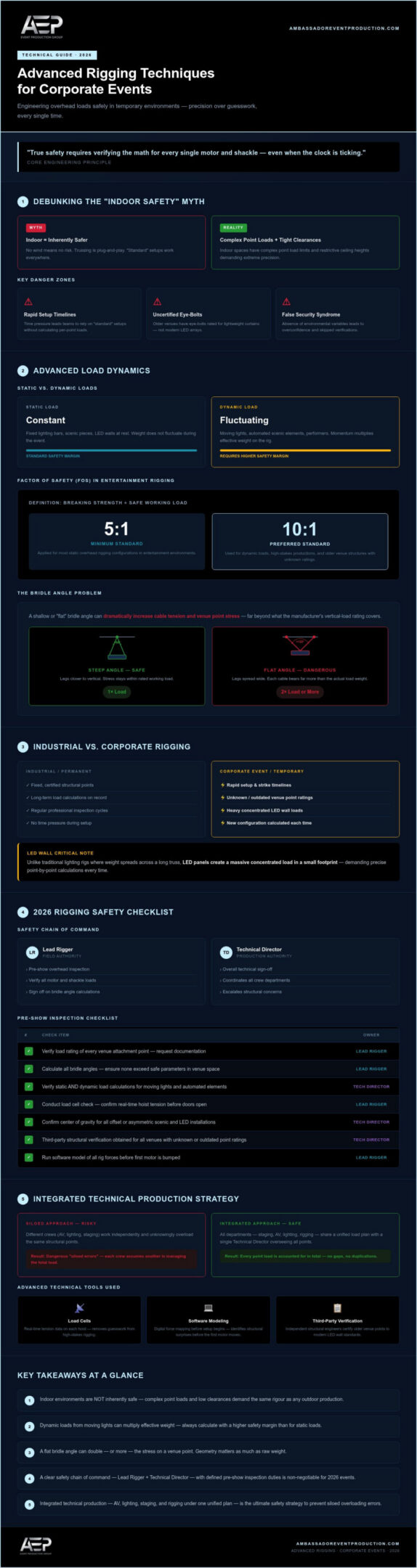
Assuming a truss can support its full rated load without accounting for bridle angles is a major risk. A bridle that’s too shallow or “flat” can significantly increase the tension on the cables and the venue’s attachment points; sometimes even doubling the stress. Manufacturer ratings are based on ideal vertical loads, but advanced rigging techniques for corporate events account for real-world application in 2026 venues that rarely offer perfect conditions. To manage these variables, the Factor of Safety, which represents the ratio between the breaking strength of a component and its safe working load, is typically set at 5:1 or 10:1 in entertainment rigging.
Deceptive Venue Points: Why You Can’t Trust Every Eye-Bolt
It’s a myth that every venue-installed point is automatically certified for the weight of modern LED walls. The technical requirements for conference staging have changed as technology has become heavier and more concentrated. Older venues might have eye-bolts that were rated decades ago for lightweight curtains or small lighting bars, not the massive technical arrays required today. We prioritize third-party structural verification for older venues to ensure that the “behind-the-scenes” infrastructure is just as reliable as the show itself. Conducting a thorough event venue rigging assessment before finalizing your design is the most reliable way to uncover these hidden limitations before they become on-site emergencies.
The Science of Precision: Advanced Load Dynamics in Ballroom Environments
Precision in a corporate ballroom isn’t just about total weight; it’s about how that weight behaves during the show. While static loads remain constant, dynamic loads introduced by moving lights or automated scenic elements create fluctuating forces. These “live” loads require a higher safety margin because the momentum of a moving object can multiply its effective weight on the rig. Implementing advanced rigging techniques for corporate events means calculating these dynamic shifts before the first motor is ever bumped.
Bridle geometry is another area where small errors lead to large risks. A “flat” bridle, where the angle between the two legs is too wide, can easily double the stress on a single venue point. We use precise calculations to ensure every angle stays within safe parameters, protecting the building’s structural integrity. This is especially vital when hanging modern LED walls. Unlike traditional lighting where weight is distributed across a long truss, LED panels create a massive, concentrated load in a small footprint. To manage this, we often utilize load cells, which provide real-time data on exactly how much tension is on each hoist, removing the guesswork from high-stakes productions.
Calculating the Center of Gravity for Complex Rigs
Offset loads, such as front-heavy projectors or asymmetric scenic pieces, demand sophisticated counter-rigging. If the center of gravity isn’t perfectly aligned, you risk “hoist-jumping,” where one motor takes on the entire load while the other goes slack. This can lead to sudden structural failure. We rely on software modeling to map these forces in a digital environment first. This proactive approach allows our staging and rigging experts to identify potential structural surprises long before the crew arrives on site.
Thermal and Environmental Factors Indoors
Environmental factors aren’t limited to outdoor festivals. In large arenas or high-ceiling ballrooms, powerful HVAC systems can create significant airflow, resulting in a “sail effect” on large banners or soft goods. This adds lateral tension the rig wasn’t originally designed for. Additionally, the heat generated by high-intensity lighting can impact motor lubricants and cable integrity over long show runs. We also account for the weight of cable looms. If not managed properly, heavy bundles of power and data lines can add hundreds of pounds of “hidden” weight to one side of your truss, throwing off your carefully calculated balance.
Industrial vs. Corporate Rigging: Why Venue Specs Change the Game
While industrial rigging focuses on permanent, heavy-duty lifting for construction or manufacturing—much like the specialized technical operations managed by Panama Ship Service in the maritime sector—corporate event rigging is a distinct discipline defined by temporary installations and aesthetic requirements. You aren’t just moving steel; you’re creating an environment where high-end technology hangs invisibly above an audience. This requires advanced rigging techniques for corporate events that respect the specific architectural limits of luxury hotels and convention centers. Unlike industrial sites, these venues often have decorative finishes and restricted access that demand a more surgical approach to technical execution.
In low-clearance ballrooms, you don’t always have the vertical space for complex bridles. You’re often forced to use dead hangs, which provide a direct vertical connection but offer less flexibility in placement. If you must use a bridle, the geometry becomes critical. Shallow angles increase tension exponentially, making precise calculations mandatory to avoid overstressing the building’s infrastructure. It’s also vital to navigate the Venue Rigging Policy. Many premium hotels require you to work with specific, approved technical partners who understand the building’s unique structural quirks. This isn’t just bureaucracy; it’s about protecting the asset and ensuring safety through a legacy of reliable performance.
Modern convention centers typically feature either heavy-duty I-beams or open web joists. Identifying these is the first step in any rigging plot. One common myth is that adding more points automatically increases safety. In reality, redundant points often lead to uneven weight distribution, where one motor unknowingly carries the entire load while others remain slack. Knowing how to read a venue’s rigging plot helps identify no-fly zones, such as areas where HVAC ducts or decorative chandeliers obstruct structural access. A professional structural rigging assessment for your venue will map these no-fly zones and point load capacities in detail, giving your design team accurate parameters from the very start.
Ground-Support Systems: When You Can’t Hang from the Ceiling
When the ceiling simply can’t support the weight, we pivot to ground-supported towers. This shifts the focus from ceiling points to floor load limits. In carpeted ballrooms, advanced rigging techniques for corporate events include specialized ballast and outrigger placement to prevent towers from shifting or damaging the floor. We adhere to strict height-to-base ratios to ensure stability. By integrating stage design with AV and lighting, we create a stable, self-supporting structure that maintains the visual impact without relying on the roof. For productions where the platform itself must bear significant overhead loads, modular stage systems for conferences offer the structural flexibility to safely distribute those forces across a precisely engineered foundation.
Implementing a 2026 Rigging Safety Checklist for High-Stakes Events
High-stakes events leave no room for error or ambiguity. Establishing a clear chain of command is the first step in ensuring a safe environment for both your crew and your audience. The Lead Rigger manages the physical execution on the floor, while the Technical Director oversees how the rig integrates with other departments. This structured approach is a cornerstone of advanced rigging techniques for corporate events, ensuring that safety isn’t just a goal but a measurable, verified outcome of the production process. For companies that prioritize specialized risk management during technical work, vitasecure.be provides professional safety services to help manage these critical operations.
Hidden fatigue can hide in plain sight, even in well-maintained equipment. We look for broken wires or “bird-caging” in steel wire rope and thinning or UV damage in polyester round slings. It’s a myth that new gear is automatically safe; batch-testing and detailed certification logs are mandatory for every piece of equipment in our inventory. Most industry standards mandate that polyester round slings be removed from service after five years of use, regardless of their visual condition. This proactive replacement schedule ensures that the “behind-the-scenes” gear never becomes the weak link in your production.
Live Monitoring and Motor Control Safety
Synchronized motor control is essential to prevent truss torque, which occurs when one end of a rig moves faster than the other and twists the metal. Once the rig reaches its final trim height, we install secondary “safeties” or steel backups to provide an extra layer of protection. Managing the human factor is also critical to 2026 safety standards. Crew fatigue during late-night strikes can lead to lapses in judgment, so we implement strict oversight and methodical pacing to ensure the strike is as safe as the load-in. If you’re planning a complex production, partnering with a seasoned technical team ensures these protocols are followed to the letter.
Why Integrated Technical Production is the Ultimate Safety Strategy
Siloed production is one of the most significant risks in modern event execution. When a lighting crew adds extra fixtures or a video team swaps out an LED panel without communicating with the rigger, the structural math changes instantly. This lack of communication can lead to dangerous point overloads. By contrast, integrating stage design with AV and lighting ensures that every department is aligned from the initial CAD drawing to the final load-in. This cohesive approach is a hallmark of advanced rigging techniques for corporate events, as it eliminates the hidden variables that lead to structural stress.
Working with a “one-stop” technical partner reduces the risk of miscommunication. When a single team handles the audio, video, lighting, and rigging, the lines of responsibility are clear. This integration allows for a seamless flow of information, where weight adjustments in one area are immediately accounted for in the rigging plot. At Ambassador Event Production, we bring over 70 years of experience in live event technical direction to every project. This longevity has taught us that safety isn’t an isolated task but a result of total technical harmony.
Unified Weight Management Protocols
A single master weight plot is the most effective tool for preventing point overload. For multi-day summits, where technical needs might shift between sessions, a unified technical production approach is essential. We once managed a last-minute LED wall expansion where the client requested a 20% increase in surface area just days before the show. Because our design was integrated, we recalculated the entire rig’s center of gravity in hours rather than days, ensuring the new weight didn’t compromise venue compliance. This level of responsiveness is only possible when your technical departments operate as a single unit. Equally important is ensuring the stage platform itself is engineered to accommodate these shifting load requirements; purpose-built modular stage systems for conferences make it far easier to adapt deck configurations without compromising the structural integrity of the overall production.
The Value of a Heritage Partner
Longevity in this industry translates to a deeper understanding of venue nuances that a checklist simply can’t capture. Since 1955, our family-owned business has navigated every imaginable venue challenge, from historic ballrooms with fragile ceilings to modern arenas with complex HVAC airflow. Our crew operates with a quiet confidence that comes from decades of proven performance. We don’t just provide equipment; we act as a dependable ally that handles the complex logistics so you can focus on your message. If you’re planning a high-stakes production for 2026, we invite you to reach out for a comprehensive technical assessment of your event needs.
Elevating Your 2026 Production Standards
Executing a flawless corporate event requires moving beyond basic setups toward a disciplined, engineering-led approach. We’ve explored how advanced rigging techniques for corporate events transform potentially high-risk overhead loads into stable, safe, and visually stunning environments. By prioritizing precise load dynamics and respecting the unique structural limits of every venue, you ensure that your most ambitious creative moments never come at the expense of safety.
Realizing this vision is easier with a partner who understands the intricate relationship between staging, lighting, and structural integrity. Ambassador Event Production brings over 70 years of technical excellence to every project, offering national coverage for global brands that demand consistency and reliability. Our integrated staging, lighting, and rigging solutions remove the stress of complex logistics; this allows your team to shine in the spotlight while we handle the technical heavy lifting behind the scenes. Partner with Ambassador for your next high-stakes production to ensure your 2026 event is executed with the highest standards of care. We look forward to building something extraordinary together.
Frequently Asked Questions
What is the difference between static and dynamic loads in event rigging?
A static load is a stationary weight that doesn’t move once it’s at trim height, such as a basic lighting truss. A dynamic load is a weight in motion, like an automated scenic piece or a performer. These “live” loads create extra force because of momentum, which can multiply the effective weight on your points. Utilizing advanced rigging techniques for corporate events helps us calculate these dynamic forces accurately to maintain a high safety margin.
Does my corporate event really need a certified structural engineer for rigging?
Yes, a certified structural engineer is essential whenever a production exceeds the standard rated limits of a venue or involves custom built-from-scratch structures. While our team handles standard calculations, an engineer provides a formal stamp of approval for unconventional designs. This step is a critical part of a professional technical strategy, ensuring that your ambitious visual concepts are backed by verified physics and building-specific compliance for the 2026 season.
How much weight can a standard ballroom ceiling point typically hold?
There is no universal “standard” weight because every ballroom is built differently. Most modern convention centers offer points rated between 500 and 1,000 pounds, while older hotels might only support 250 pounds or less. You should never assume a point’s capacity. We always verify the venue’s specific rigging plot and point load certificates before designing your rig to ensure every piece of equipment is safely supported without structural risk.
What are the common signs of hardware fatigue that I should look for?
You should look for visible deformities such as kinks, “bird-caging,” or broken wires in steel wire rope. For polyester round slings, look for thinning, heat damage, or cuts in the outer jacket. Shackles and bolts should be checked for nicks, cracks, or any signs of stretching. We perform these inspections during every load-in to ensure that the behind-the-scenes hardware remains reliable and safe for the duration of your high-stakes corporate event.
Is it safer to use ground-supported trussing or overhead rigging for LED walls?
Neither is inherently “safer” if engineered correctly, but they serve different needs. Overhead rigging is often preferred for a clean aesthetic, provided the ceiling points can handle the concentrated weight of heavy LED panels. If the venue has low point limits, ground-supported systems are a more stable choice. These systems shift the weight to the floor, where we use advanced ballast techniques to ensure the wall remains perfectly secure without stressing the roof.
Why is a ‘bridle’ used in rigging, and how does it affect safety?
A bridle is used when a rigging point isn’t located directly above where the equipment needs to hang. It uses two or more cables connected to different points to create a new “virtual” point in the center. While useful, bridles significantly impact safety because the angle of the cables affects tension. A shallow or “flat” bridle angle can double the stress on your hardware, making precise mathematical calculations a mandatory part of our process.
How often should event rigging hardware be inspected and certified?
Rigging hardware requires a multi-tiered inspection schedule to maintain its certification. Our crew performs a visual “pre-flight” check on every shackle and sling before it goes into the air. Beyond these show-by-show checks, equipment should undergo a thorough annual inspection by a qualified professional. We keep detailed logs of these certifications to ensure our inventory meets the rigorous standards required for advanced rigging techniques for corporate events in high-stakes environments.
What are the OSHA requirements for rigging in a corporate event setting?
OSHA requires that all rigging activities be supervised by a “competent person” who can identify hazards and has the authority to correct them. This includes ensuring all hardware is properly rated for its intended use and that personnel are trained in safe lifting practices. While OSHA provides the baseline, we often exceed these rules by following entertainment-specific standards that account for the unique temporary nature of corporate productions and ballroom architecture.