
Benefits of a Dedicated Event Technical Crew
What makes the difference between a smooth event and a stressful one? Often, it is how the people behind the production work together. When audio, video, lighting, staging, and rigging follow disconnected workflows, a small program change can cause delays or leave responsibilities unclear. The benefits of a dedicated event technical crew start with a coordinated operation, where each production discipline is considered as part of the whole.
That coordination can reduce friction for your event team and help create a consistent experience for attendees. A technical partner who understands your event goals can align production details, communicate across disciplines, and manage the behind-the-scenes work that keeps the show moving. This article explores the practical advantages of integrated technical execution, compares a dedicated crew with fragmented vendors or equipment-only arrangements, and outlines what to discuss when connecting production decisions to event goals. Ambassador Event Production brings together audio, video, lighting, staging, and rigging for professional and corporate events.
Key Takeaways
- A dedicated technical crew aligns production professionals around one event and a shared technical plan, separate from planning or catering responsibilities.
- The benefits of a dedicated event technical crew include clearer roles and better alignment across schedules, cues, setup, and rehearsals.
- Separate specialists can suit clearly defined production needs, while events with connected technical requirements may benefit from an integrated approach.
- Assess your event format, technical disciplines, schedule, and production complexity to determine the level of support that fits.
- Mapping decision-makers, presenters, cues, and technical handoffs can help clarify production needs before execution begins.
What a Dedicated Event Technical Crew Does for Your Production
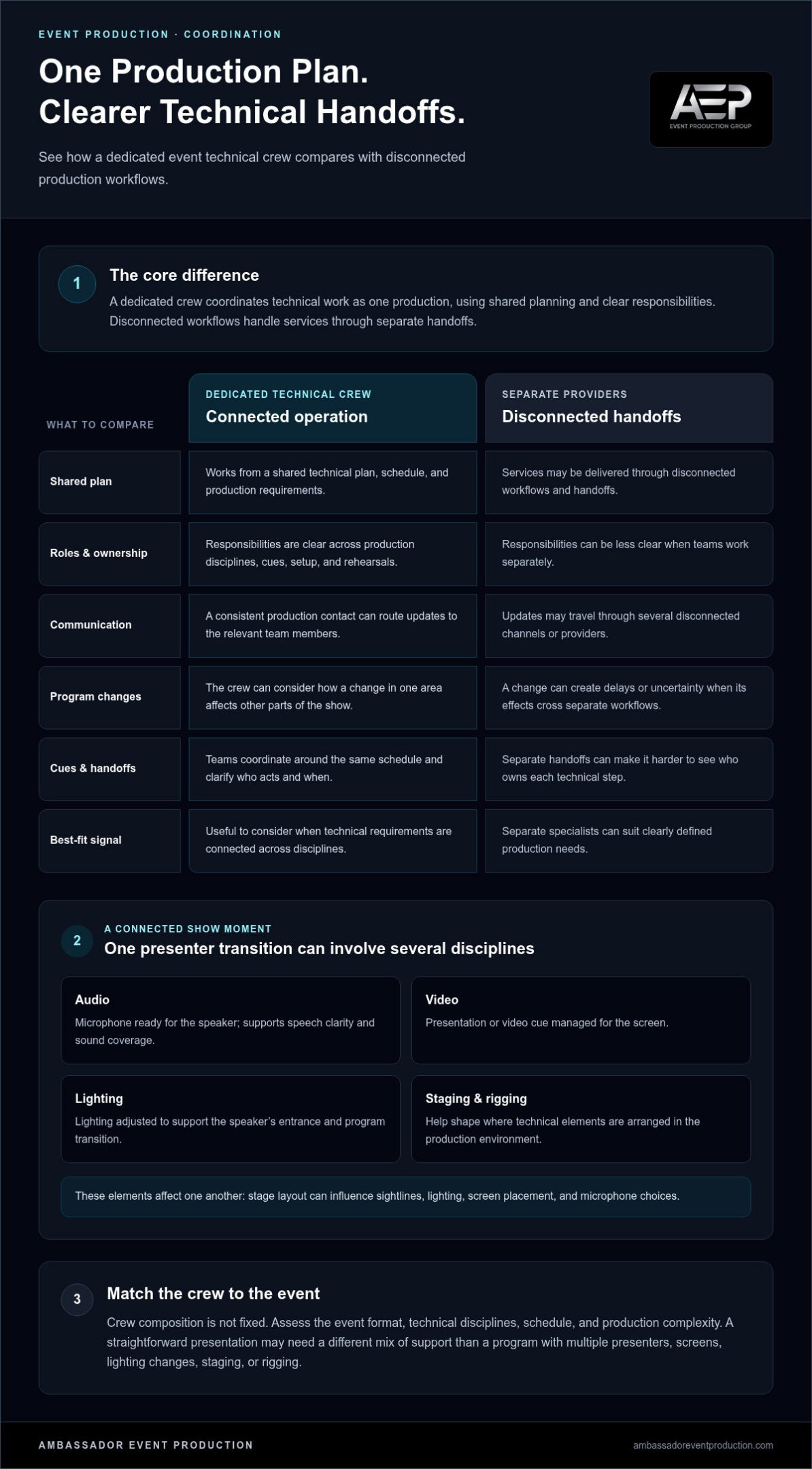
A dedicated event technical crew is a group of production professionals aligned around one event, working from a shared technical plan with clear responsibilities across disciplines. Put simply: a dedicated crew coordinates the technical work as one production, rather than delivering separate services through disconnected handoffs. That distinction matters when a presentation, speaker, video cue, and lighting change all need to work together in real time.
Technical production supports an event’s delivery. It does not replace event planning, catering, or general event management. The production team focuses on the technical systems and cues that help presenters communicate clearly and give the audience a coherent experience. This is where the benefits of a dedicated event technical crew become practical: production decisions can be shaped around what the event needs to achieve.
Which technical disciplines make up an event crew?
The crew’s mix depends on the event format and technical requirements. As the overview of Technical crew roles illustrates, responsibilities can span sound, lighting, and stage-related work. In event production, connected disciplines may include:
- Audio production: Supports speech clarity, playback, and sound coverage suited to the room.
- Video production: Manages presentations, screens, recording, or live visuals as the project requires.
- Lighting: Shapes visibility and atmosphere, and can support transitions between program moments.
- Staging and rigging: Help establish the physical production environment and support how technical elements are arranged.
These elements affect one another. Screen placement can influence sightlines, while stage layout can shape lighting and microphone choices. Coordinating them helps the production feel intentional rather than assembled in separate pieces.
What does dedicated mean during event production?
Dedicated means the technical roles share planning context, understand their responsibilities, and coordinate around the same schedule and production requirements. Rather than relaying changes through a chain of separate providers, the team can account for how a change in one area may affect another. For example, a presenter’s transition to a video playback cue may involve the audio, video, and lighting teams. A shared plan helps clarify who acts and when.
The crew’s composition is not fixed. A straightforward presentation may call for a different combination of support than a program involving multiple presenters, screens, lighting changes, staging, or rigging. Start by matching technical roles to the event’s actual needs, then align those roles around the intended audience experience.
How a Dedicated Event Technical Crew Improves Coordination and Reliability
Live production involves more than completing individual tasks. The schedule, technical setup, presenter needs, and show cues must fit together, and a change in one area can affect others. A dedicated crew works from shared production information, helping everyone understand both their own responsibilities and the handoffs that depend on them.
This is one practical benefit of a dedicated event technical crew: fewer repeated briefings and less uncertainty about who is responsible for each technical step. With a consistent point of contact for production communication, updates can reach the relevant team members instead of traveling through several disconnected channels. This does not remove every risk, but it helps the team prepare for issues and respond with a clearer picture of the production.
Clear roles and communication from setup through showtime
Coordination starts before the audience arrives. Defined responsibilities help organize setup, equipment checks, rehearsals, and event execution. The technical team can use the schedule to identify when the room needs to be ready, when presenters should rehearse, and who is responsible for each cue or adjustment.
Clear communication matters when plans change. If a speaker’s presentation order shifts, the update may affect playback timing, microphone preparation, or a lighting transition. A shared plan gives the crew a practical reference point, while a consistent production contact helps route the change to the people who need it. Preparation supports reliability without suggesting that live events can be made entirely free of surprises.
Connected audio, video, lighting, staging, and rigging
Technical disciplines work together in real time. A speaker introduction may require a microphone ready on stage, a presentation visible on screen, and lighting adjusted for the speaker’s entrance. Staging and rigging shape where those elements can sit safely and effectively. Integrated planning can identify these dependencies before event day, so setup and rehearsal account for how the parts interact rather than treating each one as a separate task.
A shared production picture also makes updates easier to assess. A revised stage layout, for example, may affect sightlines, lighting positions, and screen placement. The team can consider those connections together and communicate the implications before they become last-minute surprises. For a closer look at how the disciplines fit together, explore this guide to integrated technical event production.
For professional and corporate events, coordinated audio, video, lighting, staging, and rigging can help keep technical execution aligned with the intended audience experience. Ambassador Event Production brings these disciplines together as part of its production work. If you’re shaping a production approach, review technical production support as a starting point for aligning event needs with the technical plan.
Dedicated Event Crew vs. Separate Vendors: What Changes?
The right production model depends on how much the technical elements rely on one another. Separate specialists can be a sensible fit for a straightforward event with a narrow scope. A coordinated crew can bring practical value when sound, video, lighting, staging, and rigging must work together on a shared schedule. The benefits of a dedicated event technical crew matter most when those connections create more decisions and handoffs to manage.
| Consideration | Separate technical vendors | Dedicated coordinated crew |
|---|---|---|
| Coordination | Each specialist focuses on their defined service; the event team may need to connect related tasks. | Technical roles work from a shared production plan and account for dependencies between disciplines. |
| Communication | Updates may need to pass between separate contacts and the event team. | Shared context can make it clearer who needs each update and how it affects production. |
| Scope | Useful for a limited, clearly bounded technical need. | Can support an event with several connected technical requirements. |
| Event-day handoffs | Responsibilities may transfer between providers at defined points. | Roles and transitions can be coordinated around the same schedule and cues. |
When separate technical services may be enough
If an event has a simple format, limited technical requirements, and few dependencies, separate services may be all that’s needed. For example, a single defined audio requirement may involve fewer cross-discipline decisions than a program with presenter cues, video playback, lighting changes, and staging. A narrow scope makes it easier to identify who is responsible for each task. The goal is not to choose the largest production model, but to match support to the work.
When one coordinated crew adds practical value
As production elements connect, coordination becomes more consequential. A change to the running order may affect a presenter’s microphone, video playback, lighting cues, or a stage transition. With a shared view of the event, technical roles can consider those dependencies together and clarify handoffs before execution. That does not guarantee that nothing will change; it helps the team understand the impact and communicate adjustments.
For programs with multiple presenters, timed cues, or complex staging, live event technical direction can help bring decisions and cues into focus. Ambassador Event Production coordinates technical production across video, audio, lighting, staging, and rigging for professional and corporate events. Explore technical production support as you consider the approach that fits your event’s scope.
How to Decide Whether Your Event Needs a Dedicated Technical Crew
The right level of technical support should follow the production brief, not a one-size-fits-all package. A focused event with few technical dependencies may need a narrower scope, while a program with several disciplines, timed cues, and multiple presenters may call for closer coordination. Use this assessment to identify what your event requires.
- Consider the event format. Is it a single presentation, a conference with several sessions, or a program with live and recorded elements? Think about how the format shapes audience needs and the flow of the event.
- Map the technical disciplines. Note which elements are needed: audio for speech and playback, video for presentations or visuals, lighting, staging, and rigging. Not every event requires every discipline. Focus on what supports the program.
- Review the schedule and cues. List speakers, content changes, transitions, and other moments that depend on technical action. Several timed cues or frequent changes can increase the need for coordinated responsibilities.
- Assess the production complexity. Consider how the venue, schedule, audience, and technical elements interact. A change to one part of the plan may affect another, so identify dependencies and handoffs in advance.
The more disciplines and timed transitions your event connects, the more useful it can be to align production roles around one plan. The benefits of a dedicated event technical crew depend on the actual scope: the goal is clear coverage of the work, not a larger crew than the production needs.
Align crew responsibilities with the event plan
Before selecting support, map who makes decisions, who provides presenter and content updates, and who owns technical communication and event-day execution. Then discuss how those responsibilities carry through planning, setup, testing, rehearsal, and show operations. Clear ownership helps prevent important updates from falling between teams.
Use this checklist with your event stakeholders:
- Which audio, video, lighting, staging, or rigging elements does the program require?
- Who are the presenters and decision-makers, and how will changes reach the technical team?
- What cues, content changes, and transitions need coordination?
- What are the venue and schedule considerations for setup, testing, and rehearsal?
- Who leads technical communication and coordinates event-day handoffs?
For more on connecting these moving parts, read the guide to technical event logistics and production. To align technical support with your event brief, discuss your production requirements with Ambassador Event Production.
What Working with an Integrated Event Technical Production Partner Looks Like
An integrated production relationship starts with the event’s purpose and practical requirements. What should the audience see and hear? How will presenters use the stage? Which moments depend on a video cue, a lighting change, or a microphone handoff? Working through these questions helps turn the event brief into a technical approach shaped around the program, rather than a fixed package.
From production requirements to coordinated execution
Once the requirements are clear, the technical team can align the relevant disciplines and responsibilities. A program with presentation video, live speakers, and stage transitions, for example, calls for the team to consider how audio, video, lighting, staging, and any rigging needs fit together. The right mix depends on the production; not every event requires every discipline.
That shared approach carries through preparation, setup, testing, rehearsal, and event delivery. The team can use the schedule and program cues to guide technical setup, identify dependencies, and coordinate handoffs. If the event plan changes, shared context helps the people responsible for affected technical elements understand what needs to be adjusted. This is how the benefits of a dedicated event technical crew translate into practical support for the wider event team.
A technical partner that supports the event team
Ambassador Event Production supports professional and corporate events across video, audio, lighting, staging, and rigging. The focus is technical production: coordinating the behind-the-scenes work that helps presenters deliver the program and audiences experience it as intended. Event planning and catering remain distinct from that production role.
Ambassador Event Production is family-owned and operated, with a history dating to 1955. The event team brings its goals and program knowledge; the technical partner contributes production expertise and coordination across the relevant disciplines.
If you’re considering how technical production should support your program, discuss your event’s technical production. A conversation about the format, technical requirements, schedule, and key cues can help establish a clear next step for aligning production with the experience you want to deliver.
Bring Your Event’s Technical Plan Together
A clear production approach starts with the event’s needs: its format, technical disciplines, schedule, and key handoffs. For a straightforward program, separately defined technical services may be a good fit. When audio, video, lighting, staging, and rigging depend on one another, coordinating those roles around a shared plan can help reduce confusion and support a consistent experience.
The benefits of a dedicated event technical crew come from more than having specialists on hand. Shared context, clear responsibilities, and considered coordination help technical execution support the event’s goals. Ambassador Event Production brings integrated technical production across video, audio, lighting, staging, and rigging.
Ready to align production with your event’s needs? Discuss your event’s technical production with Ambassador Event Production. Share your event format, technical requirements, schedule, and key cues to start shaping a coordinated production approach.
Frequently Asked Questions
What does a dedicated event technical crew do?
A dedicated event technical crew coordinates the technical work needed to deliver an event, with production professionals working from a shared plan. Depending on the program, that work may include audio for speakers and playback, video for presentations or live visuals, lighting, staging, and rigging. The crew aligns technical responsibilities with the schedule and cues, supporting presenters and audiences through setup, testing, rehearsals, and event execution.
What are the benefits of hiring a dedicated technical crew for an event?
The benefits of a dedicated event technical crew include clearer responsibilities, fewer disconnected handoffs, and stronger coordination between technical disciplines. With a shared understanding of the schedule and production requirements, teams can see how a change to a cue or presentation may affect other elements. This can make communication and preparation more manageable, helping technical execution support the event’s intended experience without promising that every live issue can be prevented.
How is a dedicated event crew different from hiring separate AV vendors?
A dedicated crew coordinates relevant technical roles around one event and a shared production plan. Separately booked specialists typically focus on their defined services, so the event team may need to connect updates and responsibilities between them. Separate vendors can suit clearly bounded requirements with few dependencies. A coordinated crew may be useful when audio, video, lighting, staging, or rigging must align with shared cues, schedules, and event-day handoffs.
When does an event need a dedicated technical crew?
An event may benefit from a dedicated technical crew when it involves several connected disciplines, multiple presenters, timed cues, frequent content changes, or complex staging. Consider how many technical handoffs the schedule requires and whether a change in one area could affect another. A simple program with limited technical needs may require a narrower scope. The best fit depends on the event format, venue, audience, schedule, and production requirements.
Can one technical crew manage audio, video, lighting, staging, and rigging?
A coordinated technical production team can bring these disciplines together, with the crew’s composition and responsibilities shaped by the event’s requirements. Audio supports speech and playback, video handles presentations or visuals, lighting supports visibility and transitions, and staging and rigging help shape the production environment. The key is planning how the relevant roles connect. Not every event requires every discipline, and responsibilities depend on the production scope.
How does a dedicated crew help reduce event-day technical issues?
A dedicated crew helps manage operational risk by aligning responsibilities, schedules, technical setup, and cues before event day. Testing and rehearsals can help the team identify dependencies, clarify handoffs, and understand how changes may affect other parts of the production. For example, moving a presentation cue may affect playback timing and the presenter’s microphone readiness. Preparation can support a more considered response, though it can’t guarantee an issue-free event.
What should event organizers prepare before speaking with a technical production team?
Prepare a working event schedule, the program format, presenter and decision-maker details, and any known content or cue changes. List the technical elements you expect to need, such as audio, video, lighting, staging, or rigging, without assuming every item is required. Note venue and audience considerations, plus setup, testing, rehearsal, and event-day expectations. This information helps the production team understand the brief and discuss suitable technical responsibilities and coordination.