
Budgeting for Event AV: In-House vs. Pro Production 2026
Did you know that your venue’s in-house AV quote could be as much as 200% higher than a proposal from an independent partner? It’s a jarring realization for many event professionals, especially when choosing between in-house AV vs professional production company teams for a 2026 conference. You’ve likely felt that familiar sense of frustration while reviewing a banquet event order, watching as service charges and patch fees stack up without adding any visible value to your stage.
We understand the pressure of protecting your brand’s reputation while managing a high-stakes budget. It’s about more than just the bottom line; it’s about the peace of mind that comes from knowing your keynote won’t be derailed by a technical glitch. By mastering the technical variables of your next event, you can eliminate hidden fees and mitigate the risks that lead to costly overruns. This article provides a clear ROI comparison of these two vendor models. We’ll explore the true cost of labor, rigging safety standards, and how a dedicated technical partner ensures your event runs seamlessly from the first load-in to the final curtain call.
Key Takeaways
- Understand the fundamental operational differences between in-house AV vs professional production company teams to determine which model best aligns with your event’s technical stakes.
- Learn why technical integration and system design matter more than a simple equipment list when budgeting for high-fidelity audio and video.
- Identify the critical roles of specialized labor, such as A1 and V1 engineers, and prioritize rigging safety to mitigate liability in complex environments.
- Uncover common venue contract “traps,” including opaque service fees and outside vendor “corkage” charges, to ensure a surprise-free 2026 budget.
- Master a 5-step framework for building precise AV budgets that focus on ROI and brand protection rather than just the lowest quote.
Evaluating the Choice: In-House AV vs. Professional Production Companies
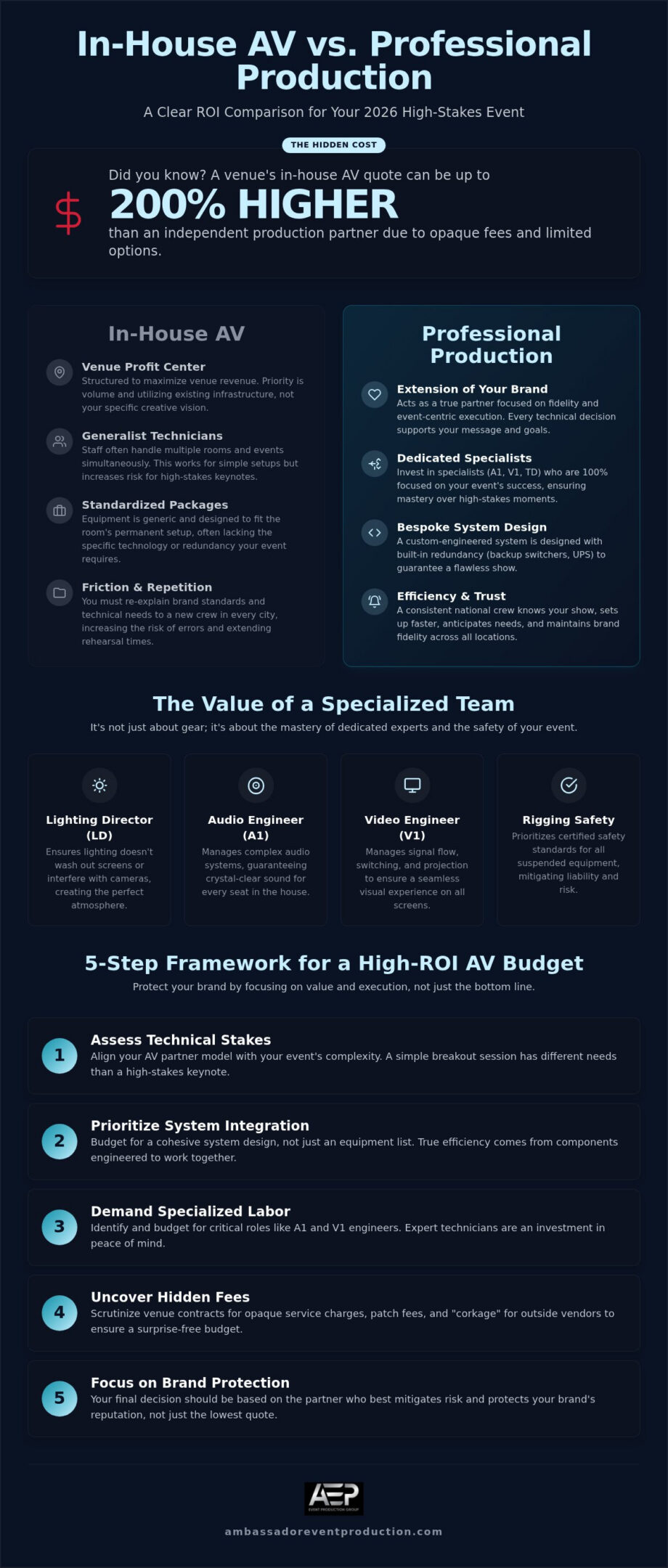
Choosing between an in-house AV vs professional production company often depends on who the service is designed to protect. In-house providers are fundamentally structured as profit centers for the hotel or convention center. Their priority is volume, which means they often rely on standardized equipment packages that fit the room’s infrastructure rather than your specific creative vision. A professional production partner, however, focuses on fidelity and event-centric execution. We operate as an extension of your brand, ensuring every technical decision supports your messaging and audience engagement.
This difference in focus impacts the entire lifecycle of your event. In-house teams frequently use generalist technicians who handle multiple rooms simultaneously. While this works for basic breakout sessions, high-stakes keynotes require a deeper level of mastery. When you partner with an outside production house, you’re investing in specialists who are dedicated solely to your success. They aren’t distracted by the room next door; they’re focused on your signal flow, your lighting cues, and your peace of mind.
Convenience vs. Continuity
The “one-stop” convenience of venue-provided services is a common industry myth. While it seems easier to sign a single contract, this approach often masks significant technical limitations. The hidden cost of using in-house teams is the friction of starting over in every city. You’re forced to re-explain your brand standards, your executive’s preferences, and your technical requirements to a new crew at every tour stop. This lack of continuity increases the risk of errors and extends rehearsal times.
- Brand Fidelity: A consistent national crew maintains the same visual and auditory standards across all locations.
- Efficiency: Teams that know your show can set up faster and troubleshoot issues before they reach the stage.
- Trust: Long-term partnerships allow for a collaborative environment where technicians anticipate your needs.
The Scope of Technical Integration
True budget efficiency is found in integrated technical event production. When you manage video, audio, lighting, and rigging under a single unified plan, you eliminate the communication gaps that plague multi-vendor setups. Piecemeal rentals often lead to “technical friction” where hardware from different providers doesn’t communicate effectively. This leads to delays that your budget simply can’t afford.
By looking at the broader technical event production landscape, a Technical Director can align all elements of the show. They ensure the lighting doesn’t wash out the LED wall and that the audio system is tuned specifically for the room’s acoustics. The debate of in-house AV vs professional production company isn’t just about gear; it’s about the safety and synergy of the entire technical team. This integrated model reduces logistical errors and provides a single point of accountability, ensuring your event remains on schedule and within your financial parameters.
Equipment Standards and the Cost of Technical Integration
Success in a high-stakes environment doesn’t come from a list of model numbers on a quote. It comes from how those components are engineered to work together. When comparing an in-house AV vs professional production company, the most significant difference lies in system design versus equipment lists. In-house providers often provide a generic inventory that fits the room’s permanent infrastructure. A professional partner, such as JVG Sound Lighting & Visual Pty Ltd, designs a bespoke system with built-in redundancy to ensure your keynote is delivered without failure. Budgeting for backup switchers, secondary audio consoles, and uninterruptible power supplies is a necessary investment in your brand’s reputation.
Technical integration is the process of unifying video, audio, and lighting into a single, cohesive workflow. This reduces the “technical friction” that occurs when disparate systems are pieced together. For example, ensuring that your lighting design doesn’t interfere with camera sensors requires a deep understanding of color temperatures and shutter speeds. When these elements are managed by a single team, the risk of logistical errors drops significantly. This integrated approach ensures that every piece of gear serves the narrative of the event rather than just filling a slot on a rental sheet.
Modern corporate summits require resolution and brightness that traditional projectors often struggle to achieve. LED video walls have become the 2026 standard for dynamic environments, offering superior contrast even in fully lit rooms. While the initial cost of LED exceeds static backdrops, the flexibility to change branding instantly provides a higher ROI. To truly capture the room’s energy, multi camera video production for events is essential. It allows remote attendees and those in the back of the hall to see every nuance of the speaker’s delivery, transforming a simple presentation into a cinematic experience.
High-Fidelity Audio Standards
Large ballrooms present unique acoustic challenges that generic sound systems can’t solve. Clear messaging relies on sophisticated live event audio mixing techniques that account for room reflections and audience absorption. In 2026, managing complex RF environments is more difficult than ever due to crowded wireless spectrums. A professional production team provides dedicated frequency coordination to prevent interference from local cellular towers or neighboring events. This level of technical oversight is why many planners choose to partner with a specialized production team to handle their most sensitive audio requirements. It’s the difference between a muffled speech and a crystal-clear call to action.
Specialized Labor and the Critical Importance of Rigging Safety
Labor is often the most misunderstood line item when comparing an in-house AV vs professional production company. It’s easy to look at a daily rate and assume equivalence, but the expertise behind the title varies wildly. Specialized labor encompasses the engineering, rigging, and technical direction required to execute a complex show. In 2026, the standard for corporate events has shifted; you aren’t just paying for someone to push a fader. You’re paying for an A1 (Audio Lead) who understands acoustic modeling and a V1 (Video Lead) who can manage high-resolution signal distribution across miles of fiber optic cable. These roles are critical because they protect your event from the technical drifts that cause keynotes to falter.
Budgeting for a consistent national technical crew also eliminates the hidden costs of “starting over” in every city. While you’ll need to account for travel and per diem, this investment ensures your team arrives with a deep understanding of your brand standards. They don’t need to be briefed on your executive’s preferred microphone or your specific lighting cues; they already know them. This continuity leads to faster setups and significantly reduced rehearsal stress, which ultimately saves money by minimizing overtime and technical delays.
Engineering and Structural Rigging Safety
Rigging is a matter of life safety. According to OSHA 29 CFR 1926.251, a qualified rigger is required for any assembly or disassembly where workers are in a fall zone. While in-house teams might offer basic support, a professional production partner brings certified riggers who perform rigorous weight-load calculations. This prevents catastrophic structural failures. Expert stage lighting design is entirely dependent on this structural integrity. If the rigging plan isn’t sound, the entire visual environment is at risk. Budgeting for these safety inspections and qualified personnel isn’t just a compliance step; it’s a non-negotiable shield against liability and OSHA fines that can reach $16,550 for serious violations.
Technical Direction and Show-Site Management
A project’s success is often determined before the first attendee enters the room. This is where live event technical direction becomes your greatest asset. A Technical Director unifies the flow of video, audio, and lighting, managing the transition between setup, rehearsal, and show hours. Unlike venue “house” labor, a dedicated technical team travels with your brand. This consistency eliminates the learning curve associated with new venue crews. You’re investing in a team that knows your show’s rhythm, which significantly reduces stress during the high-pressure strike and load-out phases. This integrated approach ensures that every technician on site is aligned with your specific goals, rather than just fulfilling a venue work order.
Navigating Venue Contracts and Avoiding Hidden ‘In-House’ Fees
Many planners don’t realize that in-house AV is structured as a profit center for the venue, not just a service for the client. Venues often collect commissions between 30% and 50% from their in-house providers. This business model explains why your bill is so high; the provider must inflate their rates to cover the venue’s cut. When you’re weighing the choice of in-house AV vs professional production company support, you have to look beyond the basic equipment list. You’re navigating a complex web of service charges and “corkage” fees designed to keep your production within the venue’s ecosystem. Navigating these contractual nuances often requires specialized industry knowledge; consulting with a professional like Dominic Marc Short – Independent Consultant can help you secure better terms and avoid common procurement pitfalls.
Hidden fees can derail a 2026 event budget quickly. Patch fees for connecting outside equipment to the house sound system often range from $75 to $150 per day, per room. Power drops are even more significant, typically costing between $500 and $1,200 each. If your production requires hanging gear, expect rigging point access fees of $300 to $800 per point. These costs exist regardless of which vendor you choose, but an outside production partner will help you audit these line items for accuracy. They’ll ensure you aren’t paying for power or patches you don’t actually need.
Logistics and drayage also play a major role in your final invoice. This is the cost of moving equipment from the loading dock to your specific ballroom. Major national venues often have strict union rules and loading dock constraints that can add thousands to your labor bill. Understanding these requirements early prevents the “dock shock” that occurs when unexpected union loaders are mandated by the venue’s contract. A dedicated production partner manages these logistics so you can focus on your attendees.
The best time to secure your right to an outside vendor is before the venue contract is signed. You have the most leverage during the RFP stage. Ensure your contract explicitly allows for external partners without punitive supervisory fees or “outside vendor” penalties. This flexibility is vital if you want to implement a custom stage design that requires specialized rigging or non-standard hardware. Balancing venue convenience with the need for technical mastery requires clear, pre-negotiated terms that protect your budget.
Power and Rigging Infrastructure Costs
High-draw LED walls and complex lighting systems require substantial house power. You need to verify the venue’s capacity and the proximity of power vaults to your stage early in the planning process. Ceiling heights and the density of rigging points also dictate your staging possibilities. If you’re planning a large-scale summit, structural compliance is non-negotiable. Our team can help you review your venue contract to identify these technical bottlenecks before they become expensive surprises during your load-in.
5-Step Framework for High-Stakes Event AV Budgets
Creating a budget that survives the pressure of a live environment requires a methodical approach. When you evaluate the in-house AV vs professional production company models, your decision should be rooted in risk mitigation. A well-constructed budget is a roadmap for technical success, ensuring that your resources are allocated where they impact the audience experience most. This 5-step framework provides the clarity needed to build a precise, surprise-free budget for your 2026 events.
- Step 1: Define Technical Must-Haves: Base your requirements on audience size and the stakes of your messaging. A 500-person keynote requires a different engineering standard than a small breakout session.
- Step 2: Request Integrated Proposals: Ensure your quotes include all labor, logistics, and safety oversight. An integrated model reduces communication gaps and prevents line-item creep.
- Step 3: Audit Venue Contracts: Look for the hidden power, rigging, and patch fees we discussed earlier. Identifying these early allows you to negotiate or budget for them accurately.
- Step 4: Build a 10-15% Contingency: Technical show-flows often evolve during rehearsals. A dedicated contingency fund handles last-minute adjustments without derailing your financial plan.
- Step 5: Evaluate Based on Expertise: Focus on the qualifications of the lead engineers (A1/V1) and the redundancy of the system design rather than just the lowest number on the page.
The RFP Process for Technical Excellence
To receive apples-to-apples quotes, your RFP must be specific about your expectations for redundancy and engineering standards. Ask potential partners how they handle signal failure or what their backup plan is for a primary audio console. The cheapest bid often carries the highest risk of technical failure because it typically cuts corners on backup hardware or qualified labor. A professional partner will be transparent about these requirements, helping you understand the “why” behind every cost. This transparency builds the trust necessary for a high-fidelity execution.
The ROI of a Technical Partnership
Investment in a consistent technical crew pays dividends across multiple events. When the same team manages your production nationally, setup times decrease and the risk of recurring errors vanishes. This continuity allows for technical asset reuse and more efficient planning cycles over time. Ultimately, your choice between an in-house AV vs professional production company is an investment in your brand’s reputation. Seamless technical execution doesn’t just happen; it’s engineered by a trusted partner who prioritizes your success as much as you do. This long-term perspective transforms AV from a line-item expense into a strategic asset.
Securing Technical Excellence for Your 2026 Events
Navigating the complexities of venue contracts and technical integration doesn’t have to be a source of stress. When you prioritize specialized labor and uncompromising rigging safety, you’re investing in the longevity of your event’s success. The choice between an in-house AV vs professional production company boils down to your need for continuity and expert-led execution. We’ve shown how integrated teams reduce logistical friction and how auditing venue power fees protects your bottom line.
Ambassador Event Production has been trusted by national brands since 1955 to manage these high-stakes logistics. Our expert-led integrated technical production teams focus on high-fidelity results and uncompromising safety standards so you can focus on your audience. We invite you to Request a Technical Production Consultation for Your 2026 Event to ensure your next keynote is delivered with absolute precision. Your vision deserves a technical partner that respects your budget as much as your brand. You’ve got the roadmap; now it’s time to build something extraordinary.
Frequently Asked Questions
Why is professional external AV often more expensive than in-house venue services?
Professional external AV often appears more expensive because the quote includes dedicated, high-tier labor and redundant equipment that in-house teams omit. While in-house providers benefit from being on-site, their bills are frequently inflated by commissions paid back to the venue, which can reach 50%. When comparing an in-house AV vs professional production company, you’re paying for a team that prioritizes your brand’s fidelity over the venue’s profit margins.
How much of my total event budget should be allocated to AV and technical production?
Production and AV typically represent the third-largest expense for a corporate event, following the venue and catering. In 2026, planners should allocate between 20% and 30% of their total budget to technical production for high-stakes environments. This ensures you have the necessary resources for high-fidelity audio, LED video walls, and the specialized engineering required to prevent technical glitches during your most important sessions.
What are the most common hidden costs in a venue AV proposal?
The most common hidden costs include patch fees, power drops, and service charges. Venue proposals often hide these line items until the final banquet event order is issued. You might see charges of $75 to $150 per day for patching into the house sound or $500 to $1,200 for a single power drop. Auditing these fees early helps you build a more accurate and surprise-free budget for your event.
Can I save money by providing my own equipment for certain technical needs?
Providing your own equipment rarely results in meaningful savings. Most venues charge “outside vendor” or “corkage” fees that match the cost of renting their house gear. Additionally, using disparate equipment increases the risk of technical friction and compatibility issues. A professional partner ensures all hardware is integrated and redundant, protecting you from the liability and failure risks associated with unverified, piecemeal equipment setups.
How far in advance should I involve a technical production partner in my planning?
You should involve a technical production partner during the RFP stage, before you sign a venue contract. This allows your partner to evaluate the venue’s infrastructure for custom stage design and negotiate out punitive outside-vendor fees. Engaging a partner at least six to nine months in advance ensures you have the leverage to secure a fair deal and the time to engineer a zero-failure technical plan.
What is the impact of hybrid event requirements on a standard AV budget in 2026?
Hybrid requirements in 2026 significantly increase the need for specialized labor and bandwidth. You’re essentially producing two separate events simultaneously: one for the room and one for the stream. This requires dedicated audio mixing for remote feeds and additional video switching capabilities. Budgeting for hybrid elements means accounting for higher internet costs and the V1 engineers needed to manage complex signal distribution for remote attendees.
Why does labor make up such a large percentage of a professional AV quote?
Labor is a significant portion of a professional quote because it covers the expertise of A1 and V1 lead engineers. These specialists manage complex RF environments and high-resolution video distribution that house generalists can’t support. Professional labor also includes the time required for setup, technical rehearsals, and strike. This investment in human capital is what guarantees a seamless show-flow and protects your brand from high-profile technical errors.
How do rigging safety requirements affect the overall event staging budget?
Rigging safety requirements add essential costs for certified labor and structural inspections. OSHA standards mandate qualified riggers for any equipment hung over an audience, which is a non-negotiable liability protection. While these safety measures increase the staging budget, they prevent catastrophic failures and protect you from significant fines. Budgeting for professional rigging ensures that your lighting and video elements are secured according to strict national safety protocols.