
Custom Event Audio Visual Production: A Guide to Integrated Event Technology
What if the sound, screens, lighting, and stage at your event all supported the same goal instead of competing for attention? A standard equipment package may not suit your venue, audience, or event format, and gaps between technical teams can become harder to manage once the program is underway. Custom event audio visual production brings technical decisions together around the experience you want to create.
This guide explains how audio, video, lighting, staging, and rigging can support one another. You’ll learn how to match the technical scope to your event objectives, venue, and audience, and what information to bring to production discussions. A coordinated technical plan helps clarify decisions and responsibilities before event day. Ambassador Event Production provides video, audio, lighting, staging, and rigging support for professional and corporate events nationwide.
Key Takeaways
- Custom event audio visual production tailors technical systems and execution to your event’s purpose, audience, and requirements.
- Audio, video, lighting, and staging work best when coordinated around the event brief and venue conditions.
- Compare a standard setup with a tailored scope to identify what fits without adding unnecessary complexity.
- Prepare for a productive technical discussion by gathering your schedule, venue details, audience information, and known constraints.
- Ambassador Event Production brings video, audio, lighting, staging, and rigging together for professional and corporate events nationwide.
What Custom Event Audio Visual Production Means for Your Event
Choosing technical elements for an event is more than picking a screen, microphones, or stage lighting. Each choice should serve the audience and the purpose of the program. A leadership meeting may need clear speech and readable presentation visuals. A conference with several sessions may need different technical arrangements as the schedule and spaces change. Custom event audio visual production means shaping the technical plan and its execution around those specific requirements.
Start with the event brief, then account for the format, venue, audience, and program. Consider what attendees need to hear and see, how speakers will use the space, and when the program shifts from one moment to the next. The broad components of audiovisual technology include sound and visual media, but event production connects the elements that need to work together. A screen’s placement affects sightlines, for example, while stage layout and lighting influence how speakers and content appear to the audience.
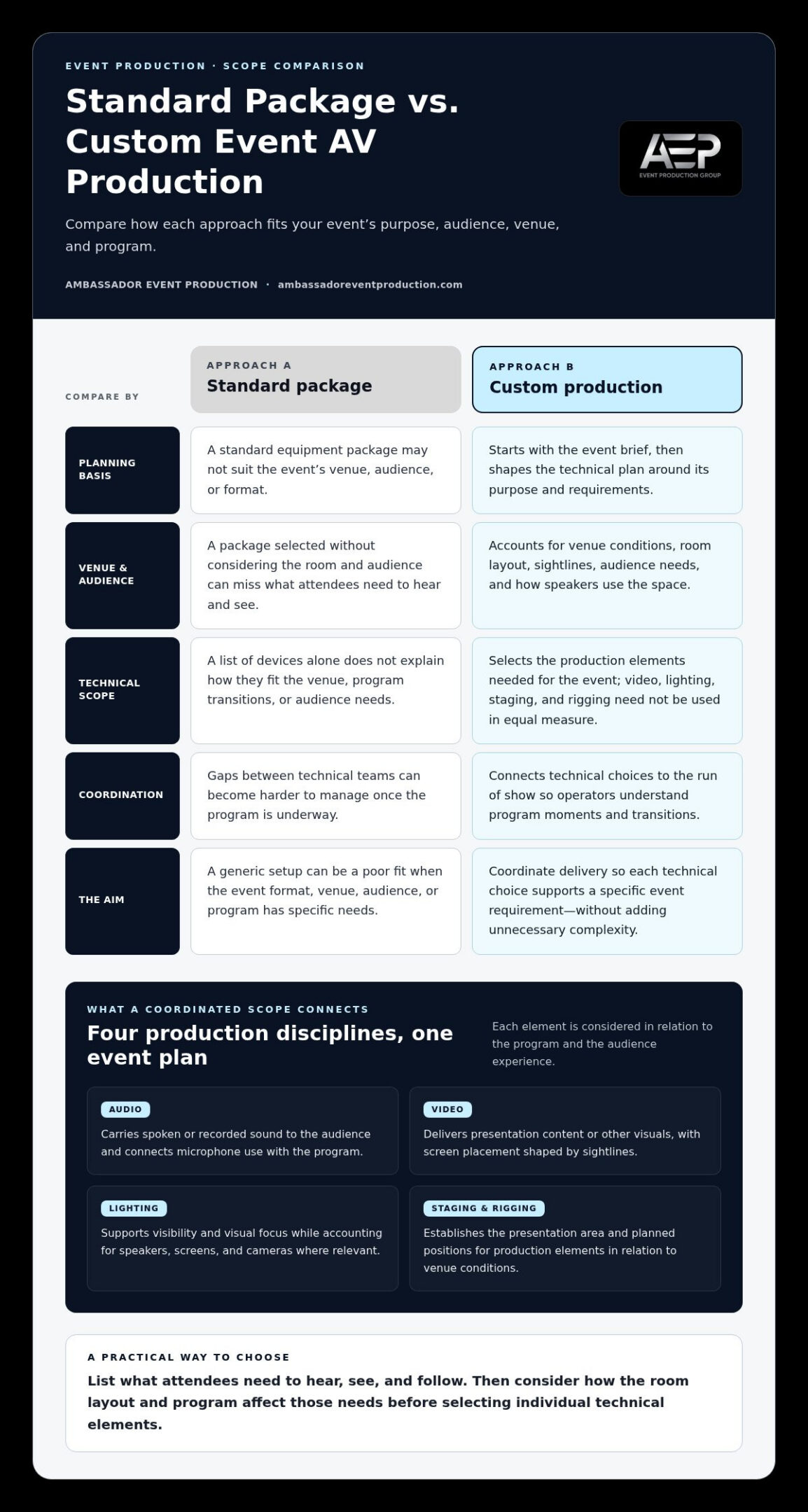
This is the difference between a purpose-built technical scope and selecting equipment without considering how the event will use it. A list of devices alone doesn’t show how they fit the venue, program transitions, or audience needs. Customization also doesn’t mean adding every production discipline or choosing the most elaborate setup. The aim is coordinated delivery, with each technical choice supporting a specific event requirement.
Which event needs call for custom production?
Custom production is useful when the format, audience, venue, or program makes a generic setup a poor fit. An executive meeting may prioritize intelligible discussion and unobstructed views of presentations. A conference may need technical support across a varied schedule, while a high-stakes corporate presentation or a luxury performance concept like Catwalk Opera may depend on coordinated visuals, sound, and stage presentation. The right scope differs by event; not every gathering needs video, lighting, staging, and rigging in equal measure.
Start by listing what attendees need to hear, see, and follow. Then consider how the room layout and program affect those needs. This gives the production discussion a practical focus before individual technical elements are selected.
What does a technical production partner handle?
A technical production partner translates event requirements into coordinated technical execution and support. Depending on the event, that work can bring together video production, audio-visual support, audio production, lighting design and execution, staging, and rigging. The partner’s work centers on production, not event planning or catering. For a closer look at how technical disciplines come together, explore this technical event production guide.
Clear responsibilities matter as much as the equipment plan. Establish what the technical team is responsible for, how those requirements connect to the program, and which venue details may shape execution. With those points understood, organizers can make informed choices and keep the focus on the event’s purpose.
How Custom Event AV Production Connects Audio, Video, Lighting, and Staging
An integrated production plan begins with the event brief and the realities of the venue. The program clarifies what attendees need to hear and see, when content changes, and how speakers use the space. Venue layout, sightlines, available positions, and other site conditions then shape how the technical elements can work together. The result is a connected plan, not a collection of separate equipment choices.
At a high level, signal flow describes how content and sound travel from their source to the audience. A presentation needs to reach the display, for instance, while a speaker’s microphone needs to carry their voice through the sound system. The production team coordinates these paths with the run of show, so operators understand what happens at each transition and how the technical disciplines support it.
- Audio: Carries spoken or recorded sound to the audience and connects microphone use with the program.
- Video: Delivers presentation content or other visuals, with screen placement shaped by audience sightlines.
- Lighting: Supports visibility and the intended visual focus while accounting for speakers, screens, and cameras where relevant.
- Staging and rigging: Establish the presentation area and support planned positions for production elements in relation to venue conditions.
Integrated technical coordination matters because each production choice affects the audience’s experience of the next. A screen may be well placed but still block a view or compete with the speaker’s position. Custom event audio visual production brings these dependencies into one plan, helping the team anticipate handoffs and keep technical execution aligned with the event.
How audio and video work together for clear communication
Microphone use, sound reinforcement, presentation playback, and sightlines should be considered together. If a speaker moves between a lectern and a screen, the plan needs to account for how attendees hear them and whether they can see the content. Coordinating the presentation sequence with audio and video operation also clarifies when slides, recorded material, or live remarks take focus. These principles align with high-fidelity event audio production standards.
How lighting, staging, and rigging shape the technical setup
Stage layout affects where presenters stand and where visual content appears. Lighting positions need to support the intended look without undermining visibility, while rigging needs and venue conditions influence where production elements can be placed. These decisions are connected, so consider them together rather than in isolation. A custom stage design guide can help organizers understand how layout and technical requirements inform one another.
For a production discussion, bring the event brief, schedule, presentation needs, and venue information together. This gives the technical team a practical foundation for coordinating the relevant disciplines. To see how Ambassador Event Production brings these areas together, explore integrated event production support.
Custom AV Production or a Standard Package: Which Fits Your Event?
A standard technical setup can fit when the program and venue have straightforward, predictable requirements. A custom scope is more suitable when the event calls for coordination across disciplines or has distinctive venue conditions. The decision isn’t about choosing the bigger setup. It’s about matching the level of coordination to what the event needs to accomplish.
Use the comparison below as a starting point. The right fit depends on how closely the setup aligns with your schedule, space, and audience needs.
| Consideration | Standard setup may fit when | Custom scope may fit when | Trade-off to consider |
|---|---|---|---|
| Venue | The room layout and conditions are familiar and straightforward. | The space has distinctive layout or production requirements. | A simpler plan can reduce decisions, while a tailored plan can address venue-specific dependencies. |
| Program | The schedule has a consistent format and few technical transitions. | Sessions, speakers, or content change in ways that require coordination. | More varied programs need clearer planning across technical roles. |
| Production disciplines | A focused set of technical elements supports the event’s needs. | Audio, video, lighting, staging, or rigging must work together in a particular way. | Customization should solve a real need, not add complexity for its own sake. |
| Audience experience | The audience can hear, see, and follow the program with a simple arrangement. | Specific sightlines, presentation needs, or stage use call for a coordinated approach. | Both approaches need clear responsibilities and coordinated execution. |
When is a standard technical setup sufficient?
A standard setup may suit a presentation with a stable venue, a straightforward run of show, and a focused technical requirement, such as supporting a speaker and presentation visuals. A simple scope can help organizers concentrate on the essentials. It still needs agreed responsibilities, a shared schedule, and coordination so the planned elements support the program when needed.
When do event requirements call for a custom scope?
Consider a custom scope when several disciplines depend on one another, the program includes complex transitions, or venue conditions shape how production can be arranged. For example, screen placement, stage layout, and lighting may need to be considered together. The aim is a coordinated solution, not extra technology. If video is central to the event, explore corporate event video production services.
To assess the options, list the event’s essential technical outcomes, then note where the venue or schedule creates dependencies. This makes it easier to judge whether a standard arrangement can meet the brief or a tailored scope is more appropriate. Explore integrated event production support to see how technical disciplines can be brought together around an event’s requirements.
How to Prepare a Useful Brief for Custom Event Audio Visual Production
A useful production brief doesn’t need to be technical. It should explain what the event is meant to achieve, how the program will unfold, and what the venue can support. That context helps the production team distinguish essential requirements from optional enhancements and shape a scope around the event rather than assumptions.
Use this checklist to gather information before a technical discussion. If some details are still developing, mark them as open questions so the team can distinguish confirmed requirements from items that may change.
- State the event objectives. Describe what attendees should understand, see, or experience. Note the outcomes that technical production needs to support.
- Describe the format and audience. Include the event type, expected audience, how attendees will use the space, and any audience needs that affect communication or visibility.
- Share the program schedule. Provide the agenda, presenter order, and major moments such as opening remarks, panel discussions, presentations, or transitions. Flag timing that may change.
- Summarize presenters and content. Identify speakers and how they’ll present. List known presentation materials, video playback, or other content requirements, including anything still being prepared.
- Provide venue documentation. Attach available room plans and details about the space, access, and technical restrictions. Note room layouts, fixed features, or known limitations that could affect the setup.
- Separate essentials from preferences. Identify the technical outcomes the event depends on, then list desirable but nonessential enhancements. Include known constraints and assign one contact to share production-related updates.
An effective production brief explains the event’s purpose, audience, schedule, venue, content, priorities, and constraints in one current reference. It doesn’t have to prescribe the technical solution. Clear priorities give the production team a practical foundation for recommending how the relevant disciplines should support the program.
What event and venue information should the brief include?
Capture the event format, audience expectations, agenda, presenter details, and key program moments in one place. Add available venue plans, room information, access details, and known technical restrictions. Include presentation materials and video needs, or describe content that’s still in progress. This helps the team understand both the program and the environment where production will take place.
How should organizers prioritize technical requirements?
Start with what attendees must be able to hear, see, and follow. Mark those outcomes as essential, then identify optional enhancements separately. Highlight schedule changes and transitions that affect technical execution, such as a shift from a presentation to a panel. Keep the brief current and direct updates through one production contact to reduce conflicting information.
Bring your draft brief and available venue information into a production discussion with Ambassador Event Production to shape a technical scope around your event’s priorities.
How Ambassador Event Production Delivers Custom Technical Event Production
Professional and corporate events depend on technical choices that fit the program, venue, and audience. Ambassador Event Production works with clients nationwide as a technical production partner, bringing relevant disciplines together around those needs. The focus is practical execution: understanding what the event calls for, aligning the technical scope, and supporting the production requirements behind the scenes.
That work can bring together video production, audio-visual technical support, audio production, lighting design and execution, staging, and rigging. Each event calls for a different combination. A presentation may center on video and sound, while another program may need stage and lighting elements coordinated with its schedule. The goal is not to include every discipline by default, but to connect the technical work to the event’s priorities.
One technical partner across production disciplines
Working across production disciplines gives organizers a coordinated technical point of contact instead of a set of disconnected requirements. The event brief provides a useful starting point: objectives, audience, format, schedule, venue information, content needs, and constraints help shape the scope. These details create a shared reference, making it easier to identify dependencies and clarify which technical elements support each part of the program.
Ambassador’s role is technical production and support, not event planning or catering. As the scope develops, the team aligns relevant production capabilities with the project’s needs, whether that involves coordinating presentation content with audio support or considering lighting alongside staging. This integrated approach keeps technical responsibilities connected to the event brief without treating technology as an end in itself.
Start a conversation about your event’s technical needs
A clear first conversation can begin with a few practical details. Share the event format, a draft schedule, available venue information, and the technical outcomes that matter most to your audience. Note key transitions, presentation or video requirements, and known constraints. If some details are still taking shape, identify what’s settled and what may change.
From there, the production scope can be shaped around the project rather than assumed to fit a fixed package. This allows the technical plan to reflect the event’s actual requirements and the relationships between its production elements. A clear brief helps organizers move into production discussions with a better understanding of what needs to work together.
For support connecting your event requirements with the right technical production scope, discuss your event’s technical production needs with Ambassador Event Production.
Turn Your Event Requirements Into a Clear Production Plan
Your next step is to turn event priorities into decisions the production team can act on. Before the technical conversation, identify what the audience must hear, see, and understand, then note which parts of the program depend on technology working together. That focus keeps custom event audio visual production tied to a purpose, not a checklist of equipment.
You don’t need every detail finalized to begin. A draft schedule, venue information, and a short list of essential outcomes can give the discussion a useful starting point. From there, you can work through open questions, clarify responsibilities, and shape a technical scope that fits the event as it develops.
Ambassador Event Production brings a collaborative, practical approach to technical production for professional and corporate events. To move from requirements to a coordinated plan, start planning your event’s technical production.
Frequently Asked Questions
What is custom event audio visual production?
Custom event audio visual production coordinates technical services to fit an event’s format, audience, venue, and program. The scope may connect sound, video, lighting, staging, and rigging where they support the event’s needs. For example, a product presentation with a speaker introduction and a video playback cue needs those moments considered as part of the same program. The precise combination depends on the event’s requirements.
What does custom AV production include for a corporate event?
A corporate production scope may include video production, audio-visual technical support, audio production, lighting design and execution, and staging or rigging. Not every event needs each service. A meeting focused on discussion may prioritize audio support, while a presentation with several speakers may have additional video or stage requirements. The technical approach should reflect the organizer’s information and the practical needs of the program.
How do I know whether my event needs custom AV production?
Consider a custom scope if technical requirements depend on one another, the program includes distinct transitions, or the venue creates specific setup considerations. For instance, a presentation that changes into a panel discussion may call for a different arrangement as the program shifts. If the event has a consistent format and straightforward needs, a simpler technical scope may be enough. Start with what attendees need from the event.
Is custom event production the same as renting AV equipment?
No. Equipment rental is about access to equipment; custom event production centers on defining and executing the technical scope. The distinction matters when the event requires coordination during program moments, such as switching from a presenter’s slides to video playback. Production support connects those requirements to the event schedule and technical responsibilities, rather than leaving organizers with equipment choices alone.
What information should I provide for an event AV production brief?
Share the event’s purpose, format, audience, schedule, venue details, content requirements, and known restrictions. Add practical notes that can affect execution, such as whether a presentation file is still being revised or a session includes a live question period. These details help the production team understand what’s fixed and what may change, so the technical plan can account for the program’s actual needs.
Can audio, video, lighting, and staging be managed as one production?
Yes. An integrated technical scope can coordinate these disciplines as parts of the same event, with the team considering how one decision affects another. For example, a change from a keynote to a panel may affect stage use, microphone needs, presentation playback, and lighting focus. Planning those relationships together gives technical operators a shared understanding of the program and helps keep production aligned as it unfolds.