
Event Lighting Design: 2026 Technical Production Guide
A stunning visual concept is nothing more than a liability if it fails to account for the technical realities of your venue. You’ve likely seen it before: a lighting rig that looks brilliant in the ballroom but washes out the CEO on the live stream, or a communication gap that leaves the video team struggling to adjust for a last-minute color change. These technical friction points don’t just ruin the aesthetic; they create unnecessary stress during high-stakes moments when your brand’s reputation is on the line.
We understand that you need more than just equipment. You need a cohesive strategy that integrates every technical layer. This guide is designed to help you master the complexities of event lighting design and execution, ensuring your next corporate gathering is both visually impactful and technically flawless. Drawing on decades of experience in integrated production, we will show you how to synchronize lighting with audio and video departments, manage rigging safety with confidence, and create a worry-free execution phase. By the end of this article, you’ll have the technical roadmap to turn a complex logistical challenge into a seamless brand experience that resonates both in the room and on camera.
Key Takeaways
- Understand the vital distinction between a creative lighting concept and the physical technical execution required to bring that vision to life within a specific venue.
- Learn how a structured 5-step approach to event lighting design and execution-starting with comprehensive site surveys and CAD plotting-eliminates last-minute technical failures.
- Discover why integrating lighting with video production is essential for maintaining color integrity and visual clarity for both in-person attendees and digital audiences.
- Ensure your event remains compliant and secure by prioritizing professional rigging standards and structural integrity for all overhead technical installations.
- Identify the advantages of partnering with an experienced guide who can synchronize lighting, audio, and staging for a seamless, worry-free production phase.
What is Professional Event Lighting Design and Execution?
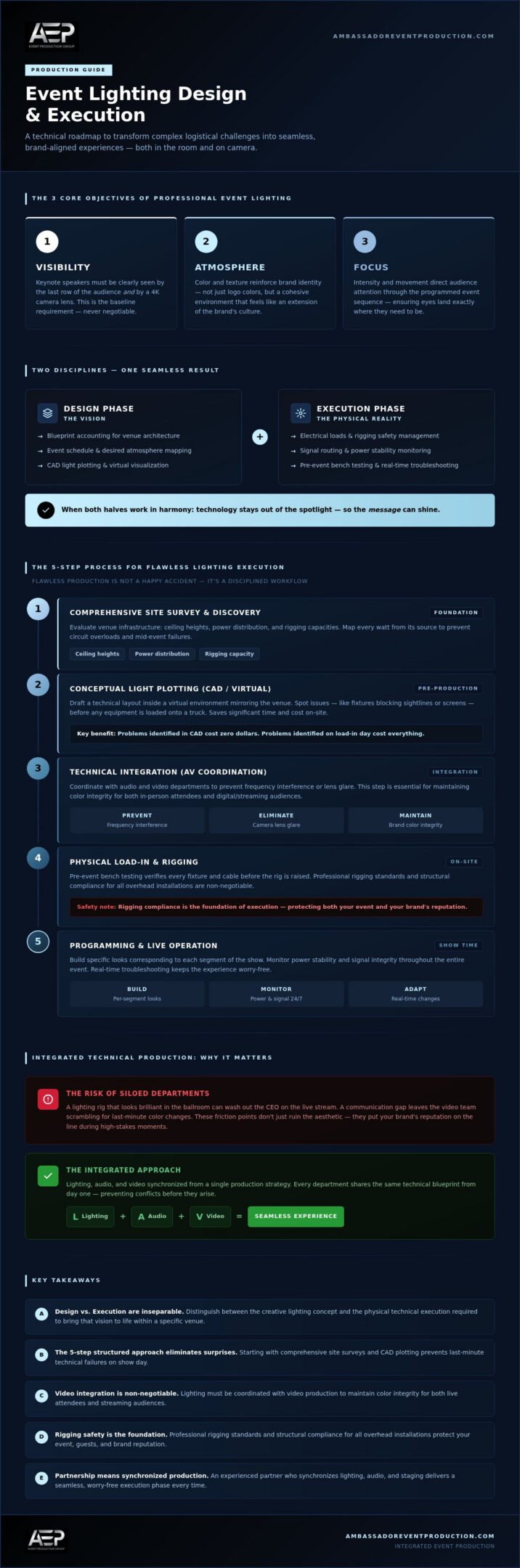
Professional event lighting design and execution is the strategic orchestration of illumination to enhance brand messaging while supporting every other technical layer of a production. It goes far beyond simply making a room bright. In a high-stakes corporate environment, lighting acts as the invisible thread that connects the audience’s emotional experience to the presenter’s message. Unlike theatrical lighting, which often prioritizes artistic mood, corporate lighting must meet rigorous technical standards to ensure that brand colors are rendered accurately and that every speaker is perfectly illuminated for high-definition video capture.
We view the process as two distinct but inseparable disciplines. The “Design” phase is the vision. It involves creating a blueprint that accounts for the venue’s architecture, the event’s schedule, and the desired atmosphere. The “Execution” phase is the physical reality of the build. It requires a deep understanding of electrical loads, rigging safety, and signal routing. When these two halves work in harmony, the result is a seamless environment where the technology stays out of the spotlight so the message can shine.
The Core Objectives of Event Lighting
Successful lighting serves three primary masters. First is visibility. This is the baseline requirement. Keynote speakers must be seen clearly by the last row of the audience and by the lens of a 4K camera. Second is atmosphere. We use color and texture to reinforce brand identity. This isn’t just about using a logo color; it’s about creating a cohesive environment that feels like an extension of the brand’s culture. Finally, there is focus. Lighting is the most effective tool for directing audience attention. By adjusting intensity and movement, we guide the eye through the programmed event sequence, ensuring the audience is looking exactly where they need to be.
Execution: Turning the Light Plot into Reality
The transition from a digital light plot to a physical rig is where technical mastery becomes essential. Execution starts long before the first truss is raised. It includes pre-event bench testing, where we verify that every fixture and cable is functioning correctly. Once on-site, the event lighting design and execution process shifts into programming and operation. This involves building the specific looks that correspond to each segment of the show and being ready for real-time troubleshooting. A professional execution team doesn’t just push buttons. They monitor power stability and signal integrity throughout the entire event to ensure a worry-free experience for the client.
The 5-Step Process for Flawless Lighting Execution
Flawless production isn’t a happy accident. It’s the result of a disciplined workflow that bridges the gap between a creative concept and a physical venue. Our approach to event lighting design and execution follows a methodical five-step path. This sequence ensures that every technical hurdle is cleared before the audience enters the room. We treat every step as a layer of insurance against the unexpected, keeping your brand’s reputation secure.
The journey starts with a comprehensive discovery phase and site survey. We evaluate the venue’s infrastructure, specifically looking at ceiling heights, power distribution, and rigging capacities. Once we have these metrics, we move into conceptual light plotting. Using modern CAD and visualization software, we draft a technical layout that mimics the venue in a virtual environment. This allows us to spot potential issues, like fixtures blocking a sightline or a screen, before any equipment is loaded onto a truck. This proactive approach to event lighting design and execution saves time and resources on-site. Technical integration follows, where we coordinate with audio and video teams to prevent frequency interference or lens glare. Finally, the physical load-in and rigging lead into the programming phase, where the run-of-show comes to life.
Venue Assessment and Logistics
Understanding the physical environment is the first step toward technical reliability. We analyze power distribution requirements to avoid circuit overloads that could lead to mid-event failures. It’s common for venues to have limited power zones, so we map out exactly where every watt is coming from. Identifying rigging constraints early allows us to adjust fixture placement without sacrificing the design’s integrity. Load-in efficiency is the cornerstone of on-time event starts. By planning the logistics of every truck and technician, we ensure the build stays on schedule and the venue’s rules are respected.
Programming for High-Stakes Moments
Programming is where the technical preparation meets the emotional arc of your event. While static washes provide essential visibility for speakers, dynamic intelligent lighting movements create the energy needed for awards or transitions. We synchronize these cues with walk-on music and video playback to create a unified experience that feels intentional. A skilled operator always keeps their hand on the Grand Master control for real-time adjustments as the room dynamics shift. This level of control is what separates a standard setup from a truly professional production. Working with an experienced technical partner ensures these complex transitions happen with total precision, giving you the freedom to focus on your guests.
Why Integrated Technical Production is the 2026 Standard
Hiring separate vendors for lighting, audio, and video often leads to a “silo problem” where technical requirements clash on-site. We’ve seen many instances where a lighting team prioritizes a dramatic aesthetic that looks great to the naked eye but causes the video team to struggle with high-contrast shadows or washed-out skin tones. Integrated event lighting design and execution eliminates this friction by ensuring that all departments collaborate from the initial site survey. When a single technical director oversees the entire production, they can balance the needs of the room with the requirements of the camera. This leadership ensures that your brand’s visual identity remains consistent across every medium, from the ballroom floor to the live stream.
This integrated approach also addresses the subtle technical conflicts that often derail a show. For instance, we coordinate power distribution to separate lighting loads from sensitive audio circuits, preventing the hum and buzz that can ruin a recording. By treating the production as a single ecosystem, we create a more reliable environment. You don’t have to worry about vendors pointing fingers at one another when a technical issue arises. Instead, you have a unified team focused on a single outcome: a flawless event that stays on schedule and on budget.
The Impact of Lighting on Video Quality
The quality of your digital record depends heavily on the technical specifications of your lighting rig. High-definition corporate event video production services require precise color rendering index (CRI) values to ensure skin tones look natural on screen. We prioritize high-frequency LED fixtures to avoid the “flicker effect” that often appears in video when using lower-grade equipment. By implementing professional 3-point lighting for every keynote speaker, we ensure they remain crisp and clear for both the in-person audience and the remote viewers. Managing shadows is equally critical, especially when working with large LED video walls. We carefully calculate angles to maintain clear visibility on the screens while keeping the presenters perfectly illuminated. For a deeper look at how to synchronize fixtures with modern camera sensors to achieve broadcast-quality results, our guide on event lighting for video production covers the latest 2026 standards in detail.
Integrated Staging and Lighting
Staging and lighting are physically tethered through the rigging infrastructure. The way staging and rigging for live events are configured directly dictates the available lighting angles and the overall safety of the installation. Our integrated approach allows us to use structural rigging as a creative asset, building immersive 360-degree lighting designs that wrap around the audience. This level of synchronization also streamlines the production timeline significantly. Instead of multiple vendors negotiating for space and power, a single team executes a unified plan. This synergy also helps in reducing electrical noise and signal interference between systems, ensuring that your audio remains pristine while your event lighting design and execution stays sharp.
Rigging Safety and Venue Compliance: The Foundation of Execution
Safety is the silent partner in every successful production. While the audience notices the color and movement, the technical team focuses on the structural integrity of every component suspended overhead. In high-stakes corporate environments, the weight of trusses, motors, and fixtures adds up quickly. This makes precision in load calculations essential. We ensure that every venue’s rigging points can support the proposed design before a single motor is ever engaged. This level of technical oversight is a core component of professional event lighting design and execution, protecting both the attendees and the venue’s infrastructure.
Compliance with national safety standards, such as those set by OSHA and ANSI, isn’t just a best practice; it’s a requirement for operational stability. We follow these guidelines to manage risk and ensure a secure environment. This includes rigorous inspections of all hardware and a commitment to using only rated equipment. By prioritizing these foundational elements, we create a worry-free execution phase that allows the creative vision to take center stage without compromise.
Expert Rigging Standards
Certified riggers play a vital role in ensuring the safety of a production. These professionals understand the physics of weight distribution and the specific requirements of different venue structures. We use secondary safety cables for every overhead fixture, providing a redundant layer of protection in the unlikely event of a primary clamp failure. Safety compliance is a non-negotiable insurance requirement for global brands operating in high-stakes environments. When you work with an experienced technical production partner, you gain the peace of mind that comes from decades of safety-first operation.
Power Distribution and Reliability
Reliable power is the lifeblood of any rig. We calculate total amperage needs during the planning phase to prevent mid-show power failures or circuit overloads. Designing safe electrical distribution for high-wattage systems requires a methodical approach to balancing loads across available circuits. We also prioritize the use of “clean power” for sensitive audio and video equipment, ensuring that the lighting system doesn’t introduce electrical noise into your live stream or recording. Emergency lighting protocols and backup power considerations are also integrated into our designs, providing a clear path forward if the venue experiences a primary power loss.
Choosing a Partner for Event Lighting Design and Execution
Selecting a technical partner is a decision that impacts every facet of your event’s success. It isn’t just about who has the newest fixtures; it’s about who has the experience to use them safely and effectively. When you evaluate a provider for event lighting design and execution, look for a legacy of reliability. Multi-generational experience in this industry isn’t just a point of pride. It’s a sign that the business has successfully navigated decades of technological shifts and high-stakes challenges. A partner with a proven track record brings a level of quiet confidence that only comes from years of on-site problem-solving.
Prioritize a ‘one-stop’ capability to ensure your production is cohesive. When one team handles video, audio, and lighting, the technical friction described in previous sections disappears. You should also demand total technical transparency. This includes seeing clear light plots, power distribution plans, and rigging schedules during the pre-production phase. Finally, ensure your partner has a national reach. Your brand needs consistent quality regardless of the event location, and a provider with national service coverage can deliver that stability across the United States.
The Ambassador Event Production Difference
We leverage over 70 years of technical mastery to ensure your execution is seamless. Founded in 1955 and family-owned for three generations, our business is built on the values of accountability and personal attention. We embrace the persona of the “Experienced Guide.” Our goal is to stay behind the scenes, handling the complex logistics and technical synchronization, so that you and your brand are the ones that shine. This integrated approach doesn’t just improve the visual outcome; it reduces the logistical burden on event managers by providing a single, dependable point of contact for all technical needs.
Ready to Execute Your Vision?
The most successful events start with early technical consultation. Bringing a partner into the conversation during the initial planning phase allows us to identify venue constraints and power requirements before they become expensive problems. We help you move beyond a basic RFP to create a comprehensive technical production plan that covers every detail of your event lighting design and execution. This proactive collaboration ensures that the final result is visually stunning and technically flawless. Partner with Ambassador for your next high-stakes event.
Elevate Your Brand Through Technical Mastery
Achieving a flawless production requires shifting from a siloed approach to a unified technical strategy. By prioritizing early site surveys and rigorous rigging standards, you eliminate the risks that often derail high-stakes gatherings. The most impactful visuals are those where the lighting, video, and audio work in perfect synchronization to support your brand’s message. Mastering event lighting design and execution isn’t just about the equipment; it’s about the decades of specialized experience required to anticipate and solve logistical hurdles before they ever reach the stage.
Since 1955, our team has provided national technical support for global brands, specializing in the integrated execution of video, audio, and lighting. We act as your experienced guide, handling every complex detail behind the scenes so your brand can take center stage. This heritage of reliability ensures your event is both visually stunning and technically sound. If you’re ready to transform your vision into a seamless reality, Partner with Ambassador for Integrated Technical Production. We look forward to supporting your team and helping your next event reach its full potential with total confidence.
Frequently Asked Questions
What is the difference between event lighting design and basic AV lighting?
Professional event lighting design and execution focuses on the strategic use of light to reinforce brand identity and support complex technical layers. Basic AV lighting often only addresses general visibility. In contrast, a designed approach includes custom light plots, programmed cues, and intentional color rendering. This ensures that the visual experience feels cohesive and professional rather than just functional, providing a higher level of technical sophistication for high-stakes corporate environments.
How much power does a professional lighting rig typically require?
A professional lighting rig typically requires dedicated three-phase power distribution rather than standard wall outlets. The total amperage depends on the number of fixtures and the type of technology used. We perform precise load calculations during the pre-production phase to ensure the venue’s electrical infrastructure can safely handle the demand. This prevents circuit overloads and ensures that your lighting system operates with total stability throughout the entire programmed event sequence.
Can you provide lighting design if I already have a video production team?
Yes, we frequently serve as a collaborative partner alongside existing video production teams. Our role is to ensure that the event lighting design and execution supports their specific capture needs. We coordinate on color temperatures and light placement to eliminate glare or shadows that could compromise the video quality. This partnership ensures a seamless result where the technical departments work in harmony rather than in isolation, keeping your brand’s image sharp.
What are the most important safety standards for event rigging in 2026?
The most critical standards involve compliance with OSHA and ANSI rigging regulations. These standards dictate how weight must be distributed and secured when suspending equipment overhead. We prioritize using only rated hardware and ensuring that every fixture has a secondary safety cable. By following these national safety protocols, we maintain structural integrity and provide a secure environment for your attendees, which is a foundational requirement for any large-scale professional production.
How does lighting affect the quality of a live-streamed event?
Lighting is the most significant factor in determining the visual clarity of a live-streamed event. Professional fixtures with high color rendering index (CRI) values ensure that skin tones look natural on camera. Additionally, using high-frequency LED technology prevents the distracting flicker effect often seen in digital recordings. Proper event lighting for video production creates depth and separation between the speaker and the background, ensuring that your remote audience receives the same high-quality experience as those in the room.
What kind of lighting is best for corporate keynote speakers?
Corporate keynote speakers require a professional 3-point lighting setup to ensure they look three-dimensional and clear on camera. This includes a key light for primary illumination, a fill light to soften shadows, and a back light to create separation from the background. We use fixtures with adjustable color temperatures to match the specific needs of the venue and the video team, ensuring that every presenter appears confident and perfectly illuminated for both the live audience and the recording.
Do you provide equipment rentals without technical staff?
We don’t provide equipment-only dry hire services. Our focus is on providing a comprehensive, integrated service that includes design, physical implementation, and real-time operation. This approach allows us to maintain our high standards of technical excellence and ensures that every piece of equipment is handled by an expert team. By providing full-service execution, we take the logistical burden off your shoulders and guarantee a seamless, worry-free experience from load-in to load-out.
How early should I involve a lighting designer in my event planning?
You should involve a lighting designer as early as possible, ideally during the venue selection or initial site survey phase. Early involvement allows us to identify potential rigging constraints or power limitations before they impact your budget or design vision. By consulting with us during the early stages of event planning, we can help you choose the right venue and develop a technical roadmap that ensures your event is both visually stunning and technically flawless. If your event includes a recognition program, exploring professional awards ceremony lighting techniques during this early planning phase ensures that cinematic stage moments are built into the production design from the start.