
How to Calculate Stage Rigging Loads and Assess Capacity
A rigging system’s capacity depends on the loads on its components and the conditions of the setup. For load-bearing calculations for stage rigging, multiply the material’s weight per unit volume by the object’s total volume, then add the weight of hoists, hardware, and rope. Compare the complete load with each component’s working load limit, accounting for how the weight is distributed and how movement can change the forces.
It’s easy to focus on the suspended object and overlook the rest of the system or the load at each point. This guide explains how to estimate weight from volume and material density, understand capacity and load limits, and identify qualified professionals to assess and approve a rigging plan. Calculations are a starting point, not a substitute for evaluating the actual setup, equipment condition, and loading conditions.
Key Takeaways
- Account for temperature, humidity, wear, and movement because conditions can affect rigging materials and safe capacity.
- Understand how sling type, hitch configuration, and bridle angle change the forces carried by each part of a lift.
- Know when an ETCP-certified rigging professional and a licensed mechanical or structural engineer should review a plan.
- Use a professional assessment to evaluate the specific equipment, load distribution, and production setup before lifting.
What Is Rigging Weight Capacity and Why Does It Matter?
Capacity is the maximum weight equipment can bear before failing, while the working load limit (WLL) is its normal operating limit. Assess the complete system, since movement, sling angles, equipment condition, and environmental exposure can all affect loads.
-
Account for Dynamic and Lateral Forces
Account for movement, acceleration, shifting weight, impact, and bridle angles when assessing a lift. These dynamic forces can change the load at individual points, while lateral forces add demands beyond a straight vertical lift. Temperature and humidity can weaken rigging materials and reduce safe working loads. A static weight estimate is not a complete load calculation.
-
Apply Rigging Safety Factors
Compare each component’s working load limit with its minimum breaking strength. The safety factor expresses their ratio; rigging recommendations include 5:1, 8:1, or 10:1, depending on the component. Safe working load also accounts for operating conditions that affect equipment. Don’t treat a safety factor as permission to exceed the WLL during normal operation.
-
Check Load Ratings and Limits
Read the rated capacity for every truss, motor, sling, shackle, and anchor point, then compare it with the force that component carries. Truss-grid averages range from 440 lbs to 2,204 lbs, depending on construction material; actual capacity depends on equipment and setup. Overloads are prohibited under OSHA and ASME B30 standards. Common errors include overlooking a component or assuming equal load distribution.
-
Consult Load Factor Charts
Use a load factor chart to find the factor for the sling angle, then account for the increased force as bridle angles decrease. Confirm that the selected sling and hitch can carry the resulting load. Record the load estimate, component ratings, configuration, and inspection findings in the load schedule and inspection record. Note any wear or damage, since repeated use can reduce capacity.
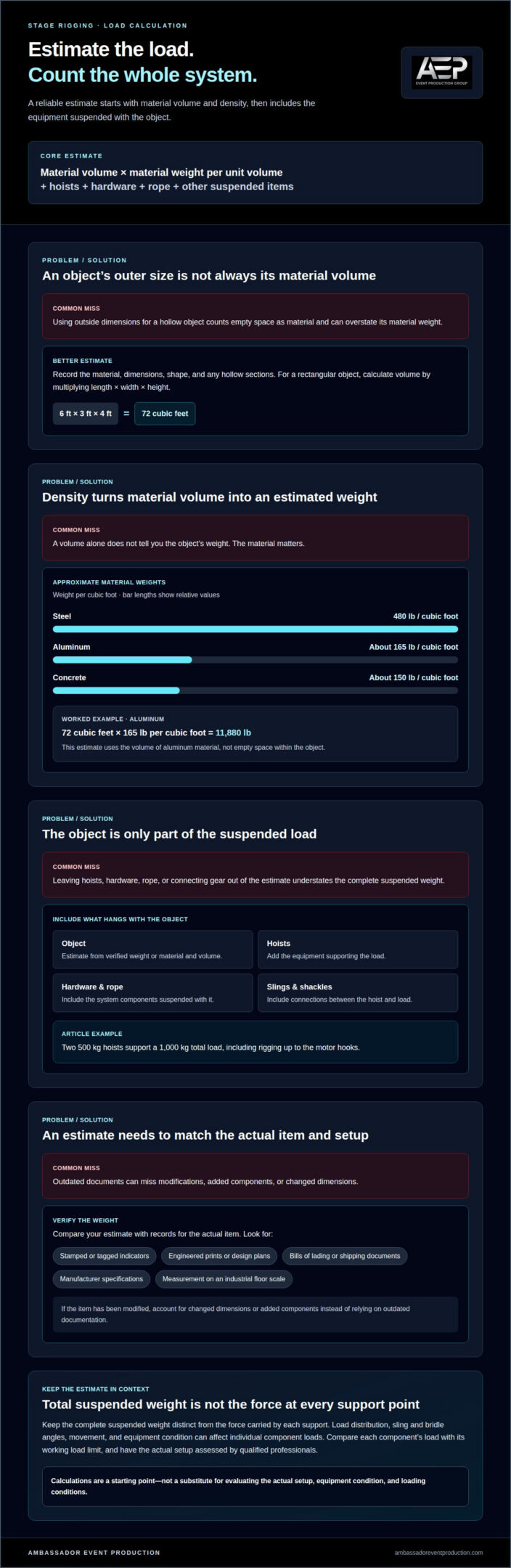
Calculating load weight from volume and material density
Accurate load-bearing calculations for stage rigging start with the object’s dimensions, material, and verified weight information. Include all equipment suspended with the object, since the object’s weight alone does not represent the full suspended load.
-
Gather Load Calculation Information
Record the material, dimensions, shape, and every item suspended in the system. For a rectangular object, multiply length, width, and height: a block measuring 6 feet by 3 feet by 4 feet has a volume of 72 cubic feet. Identify hollow sections and gather weights or manufacturer specifications for hardware, hoists, rope, slings, and shackles.
-
Estimate Total Suspended Weight
Calculate the object’s weight, then add hoists, hardware, and rope included in the system. Include slings and shackles connecting the hoist to the load. For example, two 500 kg hoists support a 1,000 kg total load, including rigging up to the motor hooks. Keep the complete suspended weight distinct from the force carried by each support point when completing load-bearing calculations for stage rigging.
-
Verify the Load Weight
Compare your estimate with weight records for the actual item. Check stamped or tagged indicators, engineered prints or design plans, bills of lading, shipping documents, manufacturer specifications, or a measurement on an industrial floor scale. If the item has been modified, account for changed dimensions or added components instead of relying on outdated documentation.
-
Compare Material Weight Examples
Multiply material volume by its approximate weight per cubic foot. Aluminum is about 165 pounds per cubic foot, steel 480, and concrete 150. A 72-cubic-foot aluminum block weighs 11,880 pounds using that density. For load-bearing calculations for stage rigging, use the volume of material itself: a hollow object’s outer dimensions include empty space and can overstate its material weight.
Who Is Qualified to Assess and Approve Rigging Loads?
Rigging approval depends on both the load path and the venue structure. Review the sling configuration and angles, as well as the qualifications of the professionals assessing the setup.
- Match sling type and hitch to the lift. Identify how each sling connects to the load, then assess the hitch and the force on each leg. Check that each sling is suitable for the forces it will carry. Don’t assume every leg shares the load equally: the hitch arrangement and load geometry affect how forces travel through the rigging.
- Calculate the effect of sling angles. As bridle angles decrease, force on the rigging increases. Use a load factor chart to find the factor for the sling angle, then account for it when assessing each leg. A vertical-load estimate alone can miss the additional force created by angled legs.
- Check the venue’s approved load points. Compare proposed rigging loads with the venue’s certified point-load drawings. A structural engineer should review and approve the loads against those drawings. This connects the planned hang to the building’s documented capacity, rather than treating a truss, motor, or sling rating as approval for the venue structure.
- Use qualified rigging and engineering review. The Entertainment Services and Technology Association (ESTA) runs the Entertainment Technician Certification Program (ETCP), which certifies individuals in technical disciplines, including rigging. Have a professional inspect and approve the system. A recommended review includes an ETCP-certified expert and a licensed mechanical or structural engineer, particularly when load distribution and bridle geometry affect point forces.
Professional rigging assessment
- Base calculations on the actual setup. Add the dead load and dynamic load to determine the load acting on a rigging point. Include the production configuration, equipment, and expected movement. Known weights from regularly lifted loads can inform estimates, but repeated use may degrade materials and reduce capacity. Assess equipment condition as well as its listed rating.
- Calculate force at each point, not just total weight. For a symmetrical two-point hang carrying a uniformly distributed load, each hoist carries half the total. In a three-point hang, the centre hoist carries approximately 62%, while each outer hoist carries approximately 19%. These distributions show why the heaviest-loaded point can govern the assessment.
- Test each point against its working load limit. With 500 kg WLL hoists in a three-point hang, the maximum allowable uniformly distributed total is 806 kg using a 62% maximum point load. Multi-point calculations are theoretical, so use load monitoring equipment to assess actual distribution. An uneven load can shift force and overload a point despite an acceptable total.
- Review connections before the full lift. A professional assessment considers the specific setup and production needs, then checks load security, connections, swing, and centre of gravity. Raise the load a few inches off the ground for this check before continuing. If the system moves unexpectedly or connections are insecure, lower the load and reassess the rigging.
For a coordinated rigging assessment, discuss your stage rigging requirements.
Ambassador Event Production: Video Production Services
Ambassador Event Production supports event delivery with video production and coordinated audio-visual technical support. Once qualified professionals have assessed and approved the rigging plan, the production team can integrate the event’s visual and sound requirements into the broader technical setup.
For a corporate presentation, video production, audio production, and lighting design and execution all contribute to how content reaches the audience. Ambassador Event Production’s audio-visual technical support brings these elements together as part of event production. Turn to the team when your approved rigging plan needs to fit into a coordinated production approach, rather than treating sound, lighting, and video as separate tasks.
Contact Ambassador Event Production to discuss your event’s production needs.
Make Each Rigging Decision Part of the Production Plan
Treat load-bearing calculations for stage rigging as part of a working production plan, not a figure to set aside after approval. Keep the approved design in the event’s working documents, and record who owns each decision. If the design or production requirements change, route the revision through the same assessment process before proceeding with the affected setup.
This handoff helps technical teams work from a shared plan and keeps rigging decisions connected to the event as it develops. It also gives the production team a clear reference when coordinating equipment, schedules, and technical responsibilities. For complex events, that continuity matters as much as the initial calculation.
Ambassador Event Production can support the wider production through its event services. Contact Ambassador Event Production to discuss how your event’s technical requirements can come together. A clear plan gives your team a stronger starting point for a well-coordinated event.
Frequently Asked Questions
Do I need an engineer for stage rigging?
Have an engineer review venue loads and calculations when hoists will operate at or near maximum capacity. A licensed mechanical or structural engineer can assess whether proposed loads align with venue point-load drawings. An ETCP-certified rigging professional can also review the rigging system. The engineer’s review addresses structural approval, while the rigging assessment examines the equipment and configuration.
How much weight can a theater grid hold?
There isn’t one capacity that applies to every theater grid. Some theater grids can have load capacities exceeding 1,000 lbs, but the usable capacity depends on the specific grid and how the load is placed. Compare the planned hang with the venue’s certified point-load drawings. A grid’s overall capacity alone doesn’t establish that any individual point can carry a proposed load.
What is the difference between SWL and WLL in rigging?
WLL is the maximum load a piece of rigging equipment is designed to handle during normal operation. Safe working load, or SWL, accounts for real-world operating conditions that can affect the equipment. For example, a sling’s operating conditions and configuration matter alongside its marked rating. Assess the actual lift, and don’t treat the two terms as interchangeable without understanding their context.
How do you calculate total suspended load for stage rigging?
Add the suspended object’s weight to the weight of all rigging included in the lift. Count hoists, hardware, and rope, including connecting equipment below the hook. For an object with known dimensions, calculate its volume and multiply it by the material’s weight per unit volume. Then compare the total with the equipment and support points in the planned configuration.
How do you calculate point loads and load distribution on trusses?
Determine how the load is positioned and supported, then calculate the force carried by each point. Don’t assume multiple truss points share the weight equally, especially when the load is off-centre or uneven. A load-distribution chart applies only to uniformly distributed loads. For multi-point hangs, calculations are theoretical, so load monitoring helps reveal the actual distribution during the lift.
What safety factors and design factors apply to entertainment rigging?
Rigging safety factor is the ratio between a component’s minimum breaking strength and its working load limit. Recommendations include 5:1, 8:1, or 10:1, depending on the component. These ratios aren’t a substitute for checking the component’s WLL against its actual load. Account for the equipment, configuration, movement, and operating conditions when evaluating capacity for an entertainment rigging setup.