
How to Write a Technical Brief for an Event: A Practical Guide
What if the most useful technical brief isn’t the one packed with equipment jargon, but the one that clearly explains what your event needs to achieve? Knowing how to write a technical brief for an event can feel daunting when you’re unsure which details to include or worried that a missed requirement will cause problems onsite. The brief doesn’t need to solve every technical question. It needs to give your production team a clear starting point.
A strong brief connects your goals and creative ideas to practical production inputs, while leaving technical validation to the people who will deliver them. This guide will help you create a concise, production-ready document that gives technical partners enough context to assess your needs, spot gaps, and ask informed questions before setup begins.
We’ll cover the event overview, audience and venue details, schedules, contacts, and requirements for audio, video, lighting, staging, and rigging. You’ll also learn how to flag unknowns and dependencies, so your team and production partner can clarify them together and reduce avoidable confusion during planning and show delivery.
Key Takeaways
- Learn how to write a technical brief for an event by connecting its goals to clear, audience-focused production needs.
- Use a practical checklist to capture the event format, audience, venue conditions, schedule, key content, and contacts.
- Map show-critical moments to the experience you want attendees to have, rather than guessing at equipment specifications.
- Give your production team useful context and questions to resolve, even if you don’t know the technical terminology.
- Keep the brief reliable by reviewing decisions with your production partner and recording updates, owners, and approval dates.
What Is a Technical Brief for an Event, and What Should It Do?
A technical event brief is a production-focused document that translates an event’s purpose, program, and venue conditions into clear inputs for technical planning. It tells production partners what the event needs to achieve and what constraints or decisions they should consider. It doesn’t prescribe a complete system design. Instead, it gives the technical team a grounded starting point to assess feasibility, identify dependencies, and raise questions while there’s still time to resolve them.
For example, “remote presenters need to participate in a live session” is a useful production input. It describes the intended experience without assuming which connection method, equipment, or staffing will make it work. That assessment belongs with the technical team, which can consider how video, audio, lighting, staging, and rigging requirements may affect one another.
How a Technical Brief Differs from a General Event Brief
A general event brief typically covers the wider event: its goals, audience, format, and logistics. A technical brief focuses on the production implications of those decisions, such as what speakers, presentations, audience interaction, and venue conditions may require. It can relate to a technical rider, which documents technical needs for a performance, but an event brief can cover production considerations across a broader program.
It also serves a different purpose from supporting documents. A run of show lays out what happens and when; a production schedule coordinates preparation and delivery tasks. A technical specification records the detailed system and equipment requirements. The brief informs those documents, but it doesn’t replace them. As you consider how to write a technical brief for an event, aim to give the production team enough context to develop and confirm the specifications, rather than guessing at a complete equipment package yourself.
Who Uses the Brief and When Should You Write It?
Organizers usually coordinate the brief, with useful input from speakers, venue contacts, and technical production partners. Each contributor sees different details: a speaker may know about presentation content or participation needs, while a venue contact can clarify access and site conditions. The organizer brings those inputs together and remains responsible for event-wide decisions.
Start drafting once the event goals and basic details are known. Share the document early, even if some items are still undecided, and label open questions clearly. Early review gives production partners an opportunity to identify dependencies and ask informed questions. Update the brief as schedules, content, venue conditions, or requirements change, so everyone is working from the same current information.
What to Include in an Event Technical Brief: The Essential Inputs
A production team needs more than an event title and a list of equipment requests. It needs the context behind each request: what’s happening, when it happens, who’s responsible, and what attendees should see, hear, or experience. Useful production inputs include content, timing, venue conditions, and decision owners. This gives technical partners a practical basis for reviewing requirements without forcing you to choose equipment before they’ve assessed the event.
Event, Venue, and Program Details to Gather
Start with the event purpose and format, expected attendance, event dates, venue and room layout, access arrangements, setup windows, and any known site restrictions. Add key contacts for the organizer, venue, speakers, and other relevant suppliers. Attach an agenda or draft run of show that includes segment durations, transitions, and the person responsible for each part. Mark details that are provisional.
- Program content: Identify speakers, presentations, playback videos, remote participants, audience interaction, and any recording requests.
- Show-critical moments: Flag opening remarks, speaker entrances, key announcements, live demonstrations, or other moments where a delay or missed cue would affect the program.
- Content handling: Note who will provide presentation files or video content, who approves them, and any known delivery or playback requirements.
Specific, plain-language notes help the team act on what you know. Toastmasters International offers guidance on how to convey technical information clearly. Use that principle here: name the need, the relevant moment, and the person who can answer follow-up questions.
Technical Goals, Priorities, and Constraints
Describe the attendee experience you’re aiming for. For a panel, for instance, note that each speaker needs to be heard clearly and that audience questions are part of the session. Leave the technical approach open for production review. Separate confirmed requirements from preferences, assumptions, and open questions, so no one mistakes an idea for an approved decision.
Include known venue provisions and constraints, accessibility needs that affect the room or program, and any safety or approval considerations that need review with the appropriate venue or production contacts. Don’t guess at venue capabilities or prescribe specifications you can’t verify. A production partner can assess how the confirmed details interact across audio, video, lighting, staging, and rigging.
As you work through how to write a technical brief for an event, prioritize clarity over jargon. If you’re developing production requirements, reviewing them with a partner experienced in integrated event production services can help surface questions across related technical areas.
How to Write the Technical Brief: Turn Event Goals into Clear Production Requirements
A useful brief turns intentions into decisions a production team can assess. To learn how to write a technical brief for an event, work through the program in order, describe the experience each moment requires, then make ownership and unresolved details visible. Keep the organizer’s goals at the center and let technical partners validate the production approach.
Write Requirements Around the Audience Experience
For each important agenda moment, state what attendees need to see, hear, or experience. A keynote might require clear speech throughout the room and presentation content that’s easy to follow. A panel might need a smooth handoff between speakers and a way for audience questions to be heard. These are actionable outcomes, not premature equipment prescriptions.
Use this workflow to build the brief:
- Define the outcome: State what the event or segment should accomplish for attendees.
- Map the program: Identify key moments, presenters, transitions, and content sources.
- Record conditions: Capture relevant venue details, access, layout, and known constraints.
- State requirements: Describe the audience-facing result for each priority moment.
- Assign owners: Name who supplies content, confirms details, and approves decisions.
- Review together: Check priorities, dependencies, and open questions with the production team.
Mark each item as a must-have or an optional enhancement. This helps the team distinguish essential show needs from ideas to assess during planning. For broader context on how production elements work together, see this technical event production guide. Early, open collaboration also supports effective working with a technical production partner.
Make Ownership, Status, and Open Questions Visible
A requirement is easier to act on when the team knows who owns it and what still needs confirming. Use a simple tracking table. For example, “keynote slides visible to attendees” may be a confirmed priority, while the final file delivery date remains unresolved. Assign someone to follow up rather than leaving the question buried in meeting notes.
| Requirement | Event moment | Priority | Owner | Status | Open question |
|---|---|---|---|---|---|
| Slides visible to attendees | Keynote | Must-have | Speaker contact | Proposed | When will the final file be supplied? |
Use consistent status labels such as confirmed, proposed, and unresolved. Track dependencies too: a production decision may rely on venue information, approved content, or a speaker’s materials. Recording the owner and next decision alongside each item gives the team a clear path to resolution.
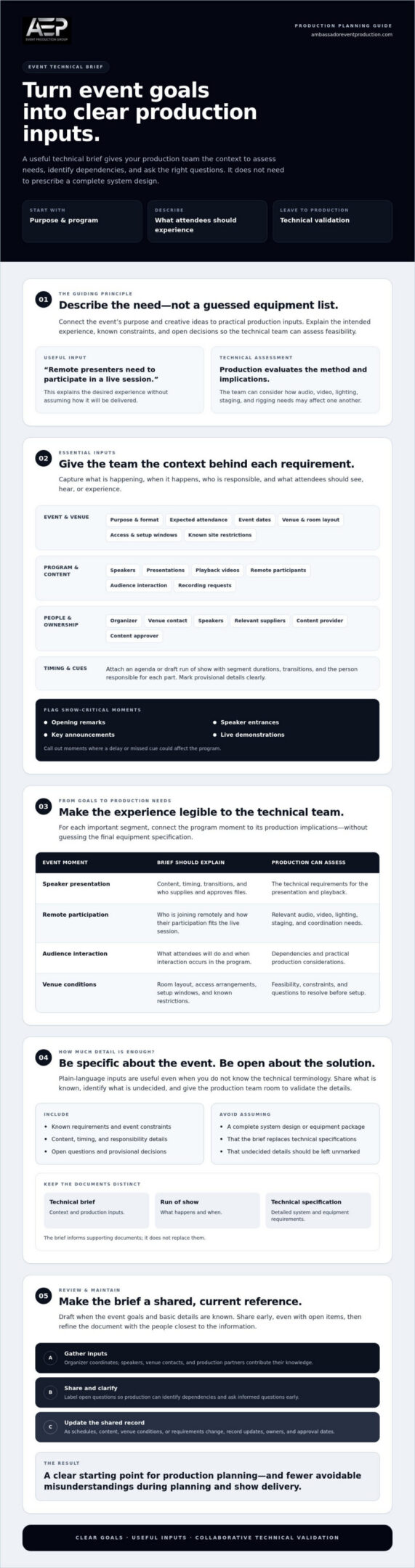
How Much Technical Detail Is Enough? Give the Production Team Useful Inputs
You don’t need to speak in technical jargon or design a complete equipment package. Your job is to explain the event, its content, audience needs, and known constraints. The production team can then assess feasibility, integration, staffing, and the appropriate technical approach. A useful rule: be precise about the experience you need, and flag technical details you’re unsure about for review.
What Organizers Can Define, and What Technical Teams Should Validate
Organizers can confirm the agenda, speaker formats, content, attendee needs, priorities, and decisions already made. For example, tell the team that a panel includes audience questions and that each panelist needs to be heard. Let production professionals assess how to meet that need across the room.
Share useful source material when it’s available, such as venue plans, room layouts, existing technical documents, content samples, and confirmed restrictions. If you don’t know whether a venue has a particular capability, label it “to confirm” rather than treating it as fact. That distinction helps prevent assumptions from turning into production requirements.
Make Audio, Video, Lighting, Staging, and Rigging Needs Legible
Describe what each part of the program calls for in everyday language. Note whether the session has one speaker or a panel, whether presentations or video will play, what needs to be visible from the audience area, and whether lighting should support a particular mood or activity. Describe how the stage will be used, and flag any rigging questions for technical assessment rather than specifying a solution. For deeper audio context, explore this event audio production guide. If video plans need further development, see the corporate event video production guide.
A short comparison table can show what’s known and what the production team should resolve:
| Event need | Source | Owner | Status | Production-team question |
|---|---|---|---|---|
| Panelists and audience questions need to be heard | Draft agenda | Program lead | Confirmed | What audio approach suits the room and format? |
| Presentation content must be visible | Speaker materials | Speaker contact | Proposed | What content format and display plan should be reviewed? |
| Stage use may involve overhead elements | Venue plan | Venue contact | Unresolved | What site details are needed to assess rigging? |
For help assessing connected audio, video, lighting, staging, and rigging needs, contact Ambassador Event Production about technical production support.
Review, Share, and Update the Technical Event Brief with Your Production Partner
A brief is useful only if the people delivering the event can trust that it reflects current decisions. Once you’ve gathered the details, review the document with key stakeholders and your technical production partner. This final pass turns how to write a technical brief for an event into a working process: check what’s confirmed, resolve what you can, and make remaining questions easy to track.
Run a Practical Technical Review Before the Event
Consolidate organizer, speaker, and venue input into one draft, then share it with the people responsible for confirming details. Ask them to check facts, responsibilities, deadlines, and unresolved decisions. Review show-critical transitions, content readiness, venue access, setup windows, and known site constraints with the technical leads. A change to a speaker’s format or presentation content, for example, may affect more than one production requirement.
Record decisions and follow-up actions in the brief or a linked change log. For each change, note what changed, who owns the next step, and the decision date. That creates a clear record when timing, content, venue conditions, or production needs shift.
Prepare a Clear Handoff for Production
After review, distribute one current document with a clear version identifier and update date. Include links to supporting materials such as venue plans, agendas, and content files, or state who will provide them and by when. Confirm who can approve changes and how urgent updates should reach the relevant people. This prevents teams from relying on different drafts or informal conversations.
A technical production partner can assess how audio, video, lighting, staging, and rigging requirements connect, then help clarify open production questions. The organizer remains responsible for event-wide decisions; the review is a way to make those decisions and their technical implications clear. Keep the document live as the event develops, and tell stakeholders when a new version replaces the previous one.
Ambassador Event Production is a family-owned, operated technical production company founded in 1955, with services spanning event video, audio-visual technical support, audio production, lighting design, staging, and rigging. If you’re ready to review production requirements with an experienced partner, contact Ambassador Event Production.
Build a Brief Your Production Team Can Put to Work
A strong technical brief doesn’t need to answer every technical question. It needs to connect event goals to clear audience needs, provide reliable details about the program and venue, and show what’s confirmed, who owns each decision, and what still needs review. That’s the practical heart of how to write a technical brief for an event.
Keep the document focused on outcomes rather than guessing at equipment or system designs. Share it early, review it with your production partner, and update it when content, timing, or venue conditions change. This gives technical teams a sound basis to assess connected audio, video, lighting, staging, and rigging requirements.
Ambassador Event Production is a family-owned and operated business founded in 1955, with integrated technical services across those production areas. If you’re ready to discuss your event’s requirements, discuss your event’s technical production needs.
A clear brief is a strong first step. With the right details and collaboration, your team can move forward with greater confidence and focus on delivering the event you envision.
Frequently Asked Questions
What is a technical brief for an event?
A technical brief for an event is a production-focused document that connects the event’s goals and program to information a technical team needs for planning. It describes what attendees should see, hear, or experience, along with relevant timing, venue conditions, content, and responsibilities. The brief isn’t a final equipment list or system design. It gives production professionals a clear starting point to assess requirements and identify questions.
How do you write a technical brief for an event?
To understand how to write a technical brief for an event, begin with the intended outcome, then map the program and note the venue conditions that may affect production. Describe the audience experience needed at important moments rather than prescribing equipment. Separate confirmed facts from preferences and unresolved questions, assign owners to decisions, and review the draft with technical partners. Update it as schedules, content, and requirements change.
What should an event technical brief include?
Include the event purpose and format, audience, dates, venue details, access arrangements, setup windows, and key contacts. Add a draft agenda with segment timing, speakers, transitions, presentations, playback video, remote participation, and show-critical moments. Describe relevant audio, video, lighting, staging, and rigging needs in terms of the desired attendee experience. Also identify known constraints, content owners, decision status, and questions that need production-team review.
Is an event brief the same as a run of show?
No. An event brief provides broader context, including goals, audience, format, logistics, and production needs. A run of show lays out the program sequence and timing, such as when speakers present or videos play. They work together: the brief helps the technical team understand why production support is needed, while the run of show shows when it’s needed. The technical brief informs detailed planning but doesn’t replace either document.
Do I need technical knowledge to write an event production brief?
No. You don’t need to know technical jargon or select a complete equipment package. Focus on what you know best: event goals, program, speakers, content, audience needs, and confirmed venue conditions. For example, explain that panelists and audience members need to be heard during questions. Let production professionals assess the technical approach, and label unknown venue or system details as questions rather than presenting guesses as facts.
When should I send the technical brief to an event production company?
Share a draft once the event goals and basic details are clear, even if some decisions are still open. Early review gives the production team time to assess dependencies, ask questions, and identify information that needs confirmation. Include available schedules, venue documents, and content details, and mark provisional items clearly. Then send updated versions as timing, materials, venue conditions, or requirements change, so the team can work from current information.