
Mastering Event Video and Audio Synchronization: A 2026 Technical Checklist
A split-second delay between a speaker’s voice and their image on a forty-foot LED wall can dismantle the credibility of an entire keynote in moments. When the audio and visuals don’t align, your audience stops listening to the message and starts focusing on the technical distraction. Achieving perfect event video and audio synchronization isn’t just about luck or basic settings; it’s a precise engineering requirement that demands a proactive approach to signal flow and latency management.
We understand the pressure of managing high-stakes productions where there’s no room for error. You want to feel confident that your technical crew has every millisecond under control without getting buried in vendor jargon that doesn’t actually solve the problem. This professional guide provides a comprehensive 2026 technical checklist to help you prevent and resolve AV sync issues before they reach the screen. We’ll explore how to manage complex signal processing paths, the essential requirements to discuss with your production partners, and the steps needed to deliver a seamless experience for both your in-room attendees and your global broadcast audience. By the end, you’ll have the technical roadmap necessary to lead your crew with total confidence.
Key Takeaways
- Understand how digital signal processing adds latency and why a unified signal path is essential for maintaining perfect event video and audio synchronization.
- Learn why even a two-frame delay is noticeable to audiences and how to establish a “Master Clock” to keep every device in rhythm.
- Discover the technical checklist for standardizing frame rates and resolutions across all cameras and playback decks to prevent signal drift.
- Gain practical techniques for adjusting audio delays on digital consoles and monitoring return feeds during live, high-stakes sessions.
- See how an integrated technical crew eliminates the “vendor gap” by managing the entire signal chain from a single point of accountability.
What is Event Video and Audio Synchronization?
At its core, audio-to-video synchronization is the precise alignment of sound and image in time. For any high-stakes production, this timing is both vital and fragile. Digital signals travel through various processors, switchers, and mixers, with each piece of hardware adding a tiny amount of delay. If the audio arrives before or after the video, the result is a jarring experience that pulls focus away from your speaker. Ensuring perfect event video and audio synchronization requires a technical team that understands the entire signal chain, not just their individual stations.
Industry standards show that even a two-frame mismatch is enough for an audience to perceive a problem. While it might seem like a negligible sliver of time, the human brain is highly sensitive to timing errors in speech. When a keynote speaker delivers a visionary message and their mouth doesn’t move in time with the PA system, their authority takes an immediate hit. It looks amateurish and suggests a lack of preparation, even if the content of the presentation is world-class. Our role as your technical partner is to maintain that signal integrity, keeping the focus on your message rather than the technology.
Key Terms for Event Planners
Understanding the language of production helps you communicate more effectively with your technical crew. Clear definitions prevent misunderstandings during the planning phase.
- Latency: This is the total time it takes for a signal to move from the input, such as a microphone or camera, to the final output on the speakers or screen.
- Drift: This occurs when audio and video slowly lose alignment over a long session. It’s often caused by slight differences in internal hardware clocks that compound over hours of use.
- Lip-Sync Error: This is the specific visual mismatch where the sound of a voice doesn’t match the speaker’s lip movements on screen.
Why Precision Matters in 2026
Modern events use massive LED walls and complex signal paths that demand more processing power than ever before. These high-resolution screens often introduce their own internal latency, which means the audio must be manually delayed to match the visual processing speed. Your event likely serves two distinct groups: those in the room and those watching a global live stream. Maintaining consistent event video and audio synchronization across both platforms is a non-negotiable standard for professional productions. We act as your experienced guide, managing these invisible logistics so your speaker shines and your audience stays engaged from the first word to the final applause.
For organizations seeking specialized support in high-quality video capture and production, you can learn more about SN Media Services LLC and their professional media solutions.
Common Causes of Audio-Visual Latency and Drift
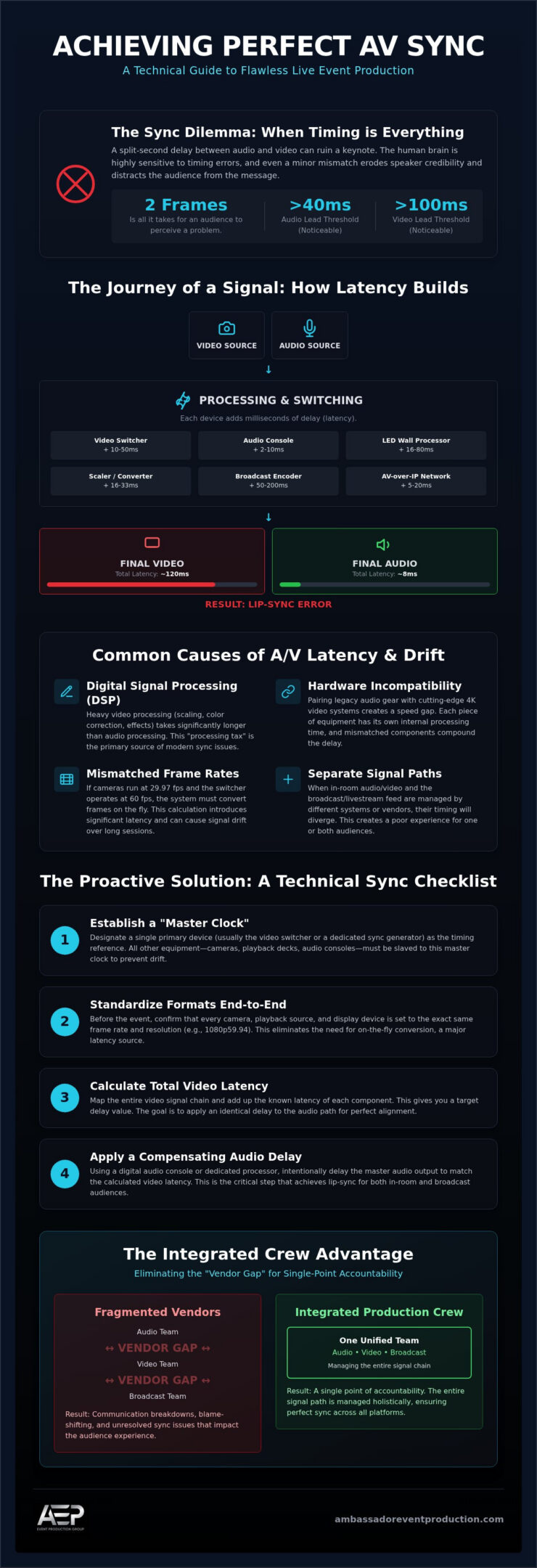
In a perfect world, sound and light would reach your audience at the exact same moment. In the digital environment of a modern convention center or ballroom, every piece of equipment adds a tiny “tax” in the form of milliseconds. These delays are cumulative. By the time a signal moves from a microphone through a mixer, into a processor, and out to the speakers, it has traveled a complex path. Understanding the technical aspects of A/V synchronization helps us identify exactly where these offsets begin to build up.
Hardware incompatibility is a frequent culprit in high-stakes environments. When legacy audio consoles are paired with cutting-edge 4K video processors, the speed gap becomes apparent. Modern video processors do an incredible amount of work, such as scaling images for massive displays or managing high-dynamic range colors, which naturally takes longer than processing a standard audio signal. Additionally, the process of encoding video for a live stream adds another layer of latency that doesn’t exist for the in-room PA system. If these two paths aren’t managed as a single ecosystem, your remote audience will see a completely different timing than your local attendees.
Digital Signal Processing (DSP) Bottlenecks
Heavy audio processing, such as multi-band compression or complex EQ, can subtly delay the sound feed. On the video side, frame-rate conversion is a major factor. If your cameras are set to 29.97 fps but your switcher is running at 60 fps, the hardware must calculate those extra frames, which adds processing time. DSP latency is the hidden cause of most modern sync issues.
The Network Latency Factor
AV-over-IP systems are now common in large venues, but they rely on network switches that can become congested if not managed correctly. Buffer settings in streaming software often cause audio to lead video because audio packets are significantly smaller and easier to transport than heavy video data. Even wireless microphone transmission adds a few milliseconds of “hop” time before the signal even reaches the mixer. If you’re concerned about these technical hurdles, a unified technical production partner can map your entire signal path to ensure every element remains in perfect alignment.
Transmission pathways also play a role in event video and audio synchronization. While fiber optic cables move data at near-instantaneous speeds, long copper SDI runs or wireless transmitters introduce physical delays. Our technical crew prioritizes signal path mapping during the load-in phase to account for these differences, ensuring that the final output is seamless and professional.
While live events focus on synchronization, professional recording environments also demand extreme precision; you can check out Starsound Studios to learn about the technical requirements of modern audio formats like Dolby Atmos.
The Pre-Event Technical Sync Checklist
Preparation is the foundation of a flawless performance. Before the first attendee enters the room, our technical team establishes a single “Master Clock” to serve as the heartbeat for the entire production environment. This synchronization ensures that every digital device operates on the exact same timeline. Without this shared reference, even high-end gear can begin to drift apart over the course of a multi-day conference. We prioritize a unified signal path where audio and video travel together as long as possible to minimize the risk of external offsets.
Standardizing frame rates and resolutions across all cameras and playback decks is a critical first step. Mixing a 24fps cinematic camera with a 60fps broadcast feed creates processing overhead that leads to lag. When planning video production for live conferences, we ensure every source matches the native resolution of the primary display. This consistency simplifies the signal path and reduces the risk of event video and audio synchronization issues during the live show. It’s a methodical approach that replaces guesswork with engineering precision.
Hardware Configuration Essentials
For high-stakes environments, we implement Genlock. This technical process forces every camera sensor to fire at the exact same microsecond, which eliminates “tearing” or frame-timing offsets during fast-paced movement. We also utilize SMPTE timecode to keep multi-camera setups perfectly aligned for both the live screen and the final recording. If the production layout requires it, we verify that the video switcher has “audio follow video” capabilities enabled to maintain a tight bond between the speaker’s image and their voice throughout the broadcast.
Testing and Verification Steps
Rehearsals are the time to find and fix errors. We conduct a traditional “Clap Test” or use a digital AV sync meter to measure exact millisecond offsets at various points in the room. It isn’t enough to check the monitors at the tech table; we test the sync at the furthest point in the venue, such as the back-of-house seating, to account for the physical speed of sound. Verification must happen across every output in the chain:
- Measure offsets for primary LED walls and side-fill monitors.
- Verify alignment on the primary record deck for post-event delivery.
- Confirm that the live stream encoder is receiving a perfectly timed feed from the switcher.
This thorough verification process ensures that once the keynote begins, the technical crew can focus on the creative execution of the show rather than reacting to avoidable timing errors.
On-Site Troubleshooting for Live Productions
Even with a rigorous pre-show checklist, the live environment introduces variables that can impact your signal. High-intensity lighting can increase hardware temperature, and heavy network traffic can slow down AV-over-IP paths. Our technical crew remains vigilant at the front-of-house position, constantly monitoring the return feeds to detect any drift before it becomes a distraction. Managing event video and audio synchronization during a live keynote requires a balance between high-end visual processing and the immediate need for zero-latency communication.
For complex setups involving multi camera video production for events, we establish secondary signal paths that can be activated instantly if a primary processor begins to lag. This behind-the-scenes mastery allows us to make adjustments without the audience ever realizing a technical hurdle existed.
Real-Time Delay Adjustments
The digital audio console is our primary tool for on-site correction. Since video processing is almost always slower than audio, we apply a specific millisecond delay to the PA system to match the screen’s output. We also factor in the physical speed of sound; in a large ballroom, attendees at the back will hear the speaker slightly later than those in the front row. Audio should never lead video; the human brain accepts a slight lag in sound, but an early audio signal feels unnatural and jarring.
Emergency Fallback Protocols
In high-stakes moments where latency threatens event video and audio synchronization, we may choose to bypass non-essential processors like complex color-grading LUTs or heavy up-scalers to reclaim lost milliseconds. If a sudden re-sync is required during a live broadcast, our team handles the transition during a camera cut or a slide change to keep the flow seamless. We believe in transparent partnership, so we communicate these adjustments to you with calm authority, ensuring you’re informed without being alarmed.
If you’re planning a high-stakes corporate gathering and need a team that handles these invisible logistics, you can partner with us for your next event.
The Advantage of Integrated Technical Production
One of the most common points of failure in complex setups is the “vendor gap.” When separate companies handle audio and video, they often operate on independent timelines with different hardware standards. This fragmentation makes achieving perfect event video and audio synchronization significantly harder because no single person owns the entire signal chain. If a delay occurs, vendors often spend valuable time diagnosing which side of the gap the problem lives on, rather than fixing it. It’s a stressful situation that can be avoided with a more cohesive strategy.
We take a different approach by providing comprehensive corporate event video production services alongside our audio and staging expertise. We eliminate those communication silos. Our technical crew manages the signal from the microphone to the speaker and from the camera to the LED wall as a single, unified ecosystem. This end-to-end accountability means we don’t just react to latency; we engineer it out of the system from the start. We act as your dependable ally, ensuring every technical element works in harmony.
Mastery Behind the Scenes
Seasoned technical teams know that latency isn’t just a digital issue; it’s often a physical one. Strategic staging and rigging play a vital role here, especially for the in-room experience where audiences are most sensitive to timing errors. By designing the room layout to minimize long cable runs and reducing the number of conversion points between devices, we protect the integrity of the signal. This one-stop integration of lighting, audio, and video allows us to anticipate bottlenecks before they reach the screen. It reduces your stress as an event planner because you have one trusted partner to hold accountable for every millisecond of the experience.
Planning for Technical Excellence
Success starts long before the load-in. We encourage our clients to involve us early in the event design phase to ensure that the rigging and staging infrastructure perfectly supports the technical requirements of the show. This early collaboration is the best way to maintain seamless event video and audio synchronization across every screen and speaker in the venue. We don’t just provide equipment; we act as your experienced guide, blending modern technical proficiency with old-school values of reliability and personal attention.
High-stakes productions require more than just hardware; they require a legacy of proven performance. With over 70 years of experience as a family-owned business, we’ve mastered the behind-the-scenes logistics that keep your production seamless. Trust your next keynote or conference to a partner that prioritizes consistency, thoroughness, and the perfect execution of every detail. Let’s work together to ensure your message remains the focus, perfectly synchronized and professionally delivered.
Securing Technical Excellence for Your Next Keynote
Perfect event video and audio synchronization is the result of meticulous planning and a unified technical vision. By establishing a master clock, standardizing hardware settings, and eliminating vendor gaps, you ensure that your production remains a seamless reflection of your brand’s authority. These invisible logistics are what allow a speaker’s message to resonate without the distraction of technical lag or signal drift. When every millisecond is accounted for, your audience stays fully immersed in the experience.
We’ve been technical production experts since 1955, providing integrated video, audio, and staging solutions that simplify complex environments. Our team offers national service coverage across the United States, bringing seasoned authority to high-stakes corporate gatherings. We handle the engineering and signal path management so you can focus on your attendees. Your vision deserves a production that is as precise as it is powerful.
Ready to elevate your next event? Partner with Ambassador Event Production for your next high-stakes production and experience the peace of mind that comes with decades of reliable mastery. Let’s work together to make your next project a resounding success.
Frequently Asked Questions
How much audio delay is considered acceptable for a live event?
Most industry standards suggest that audio should stay within a range of 45 milliseconds ahead to 125 milliseconds behind the video. However, in a professional ballroom setting, we aim for much tighter margins. Audiences usually notice a mismatch once it exceeds two frames. Keeping the offset as close to zero as possible ensures the speaker’s authority remains intact throughout the presentation.
Why does my audio get out of sync with my video over time?
This issue is called drift and it happens because different digital devices have internal clocks that don’t run at the exact same speed. While the difference is tiny, it adds up over several hours of a long session. Using a master clock or genlock to unify all equipment is the best way to prevent these micro-offsets from becoming a visible problem by the afternoon keynote.
Can I fix AV sync issues in a live stream without restarting the broadcast?
Yes, you can adjust audio offsets in real-time using your digital mixer or encoding software. Most professional streaming tools allow the technical crew to add millisecond delays to the audio feed on the fly. This allows us to correct any emerging drift during a live session without the remote audience ever knowing a technical adjustment was made. It’s a standard part of live troubleshooting.
What is the difference between latency and audio-video drift?
Latency is a constant delay introduced by digital processing, while drift is a cumulative timing error that grows over time. You’ll notice latency the moment a speaker starts talking because the signal takes time to move through the hardware. Drift is more deceptive; it might not be visible during the morning introductions but can become a major distraction after several hours of continuous operation.
Does using wireless microphones increase the chance of sync issues?
Wireless microphones add a small amount of processing latency, usually between 3 and 5 milliseconds, but they don’t typically cause major event video and audio synchronization issues on their own. The problem occurs when this wireless lag is combined with heavy video processing. Our crew calculates the total signal path delay during rehearsals to ensure the final output remains perfectly aligned for the audience.
What happens if the audio is ahead of the video during a presentation?
If audio leads the video, the experience feels unnatural and jarring because it contradicts the physical law that light travels faster than sound. It creates a “badly dubbed” effect that immediately pulls the audience’s attention away from the speaker’s message. We always prioritize delaying the audio to match the video because the human brain is much more forgiving of sound that arrives slightly late.
How do high-resolution LED walls affect audio synchronization?
High-resolution LED walls require intense processing to map and scale images, which often creates several frames of video lag. This processing time is a frequent cause of event video and audio synchronization errors in modern venues. To compensate, we apply a specific delay to the PA system so the sound reaches the audience’s ears at the exact same moment the image appears on the screens.
Should I use a hardware or software-based sync solution for my conference?
Hardware-based solutions like master clocks and Genlock are the gold standard for high-stakes environments because they offer superior stability. Software sync can work for simple webcasts, but it often lacks the reliability needed for 4K video or complex staging. For a professional corporate event, hardware provides the technical accountability required to ensure the production stays seamless from the first word to the final applause.