
Professional Audio Visual Support for Events: What to Expect from an Integrated Production Partner
What if the biggest technical risk at your event isn’t a piece of equipment, but a gap between the people responsible for it? When sound, video, lighting, and staging are managed separately, details can fall between teams, leaving no clear owner for coordination. Professional audio visual support brings those moving parts together around the event, particularly when the program is high visibility.
Professional audio visual support is more than supplying gear. It means coordinating technical disciplines around your event’s program, space, and production needs so the people and systems work together. This article explains what integrated support can cover, how to plan for it, and what to discuss when outlining your requirements. It looks at the roles of audio, video, lighting, staging, and rigging, and how they connect behind the scenes. Ambassador Event Production brings these capabilities together as a family-owned business founded in 1955, supporting events with integrated technical production.
Key Takeaways
- Map your event’s purpose, audience, agenda, presenters, and content needs before shaping the technical plan.
- Professional audio visual support coordinates sound, video, lighting, staging, and rigging around the event’s program and venue.
- Clarify who owns communication and live execution across technical disciplines to help prevent gaps between teams.
- Prepare playback requirements, speaker transitions, and audience interaction details to make production decisions more informed.
- Ambassador Event Production brings integrated technical production experience as a family-owned business founded in 1955.
What professional audio visual support covers at a high-stakes event
Professional audio visual support is the technical planning, coordination, and execution of an event’s production needs. It brings audio, video, lighting, staging, and rigging together to support the program and audience experience. It covers more than setting up equipment: the technical team considers how each element will work in the event space and throughout the live program.
At a high-stakes event, those decisions affect whether speakers can be heard, presentations can be followed, and transitions feel planned rather than improvised. The approach depends on the event’s goals, agenda, presenters, content, audience, and venue conditions. Technical production supports the event, but it does not replace event planning, catering, or venue management. Defining responsibilities helps each team focus on its role while keeping production requirements connected.
Which technical disciplines can AV support bring together?
Each discipline has a distinct role, but the audience experiences them together. Audiovisual technology and its applications span different settings; for live events, the technical approach is shaped by the program and the space.
- Audio production supports clear speech, playback, and live program elements. Microphone use and sound reinforcement need to suit the speakers, audience, and room.
- Video production supports presentations, camera feeds, and visual content, helping people see the information and activity that matter to the program.
- Lighting, staging, and rigging work together to shape the presentation environment. Lighting supports visibility and atmosphere, staging provides a platform for presenters and program elements, and rigging supports the planned production setup.
Coordinating these areas matters because one decision can affect another. For example, screen placement needs to work with audience sightlines, the stage layout, and lighting. Considering those dependencies together helps the production serve the event as a whole instead of treating each technical element as a separate task.
What does technical support mean beyond supplying equipment?
Equipment is only one part of production. Technical support also means understanding the event’s requirements, developing an appropriate technical plan, coordinating production disciplines, and executing the plan during the event. A collection of equipment on site does not, by itself, account for how presenters, content, cues, and transitions fit together.
A program with several speakers and presentation files, for instance, has different operational needs from one centered on a live performance. The run of show, content format, room conditions, and audience all inform the approach. Integrated technical event production connects those requirements to the people and systems delivering them, giving the event team a clearer picture of how production will support the program from setup through live execution.
How integrated audio visual support works from brief to live execution
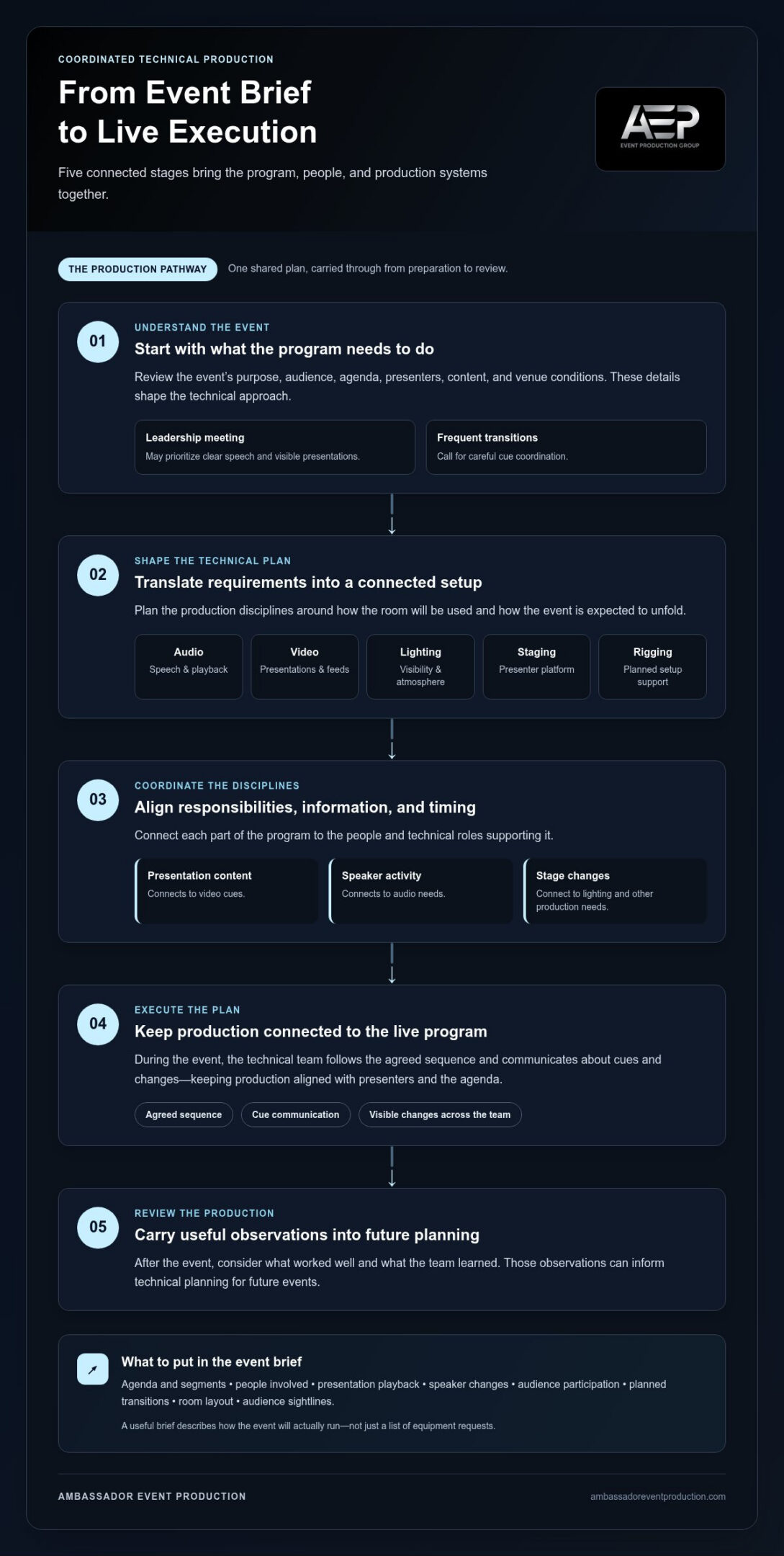
Coordinated production starts before the audience enters the room. The event brief gives the technical team a working picture of what must happen, when it must happen, and what the audience needs to see and hear. From there, each production discipline can work from the same plan rather than solving its tasks in isolation.
- Understand the event goals. Review the purpose, audience, agenda, presenters, content, and venue conditions. A leadership meeting, for example, may prioritize clear speech and visible presentations, while a program with frequent transitions calls for careful cue coordination.
- Shape the technical plan. Translate those requirements into an approach for audio, video, lighting, staging, and rigging. Account for how the room will be used and how the event is expected to unfold.
- Coordinate the disciplines. Align responsibilities, information, and timing across technical roles. This connects presentation content to video cues, speaker activity to audio, and stage changes to lighting and other production needs.
- Execute the plan. During the live program, the technical team follows the agreed sequence and communicates about cues and changes, keeping production connected to the presenters and agenda.
- Review the production. Afterward, consider what worked well and what the team learned. Those observations can inform technical planning for future events.
Turn event requirements into a coordinated production plan
Start with the agenda, then identify the content and people involved in each segment. Note presentation playback, speaker changes, audience participation, and planned transitions. These details help connect needs to the right disciplines without assuming one standard setup fits every event. AVIXA: The Audiovisual and Integrated Experience Association also provides resources for understanding the professional AV field.
Venue conditions matter, too. Room layout, audience sightlines, and the flow between program segments all inform technical decisions. A useful brief gives the production team enough context to plan for the event as it will actually run, not just as a list of equipment requests.
Coordinate the technical team through show execution
Before the program, technical roles need a shared understanding of the sequence, responsibilities, and cues. During the event, communication keeps changes visible across the team. If a presenter moves into a new segment, for instance, the transition may involve their position on stage, the next content item, audio, and lighting. Treating those elements as connected cues helps the team prepare for the handoff.
Video is part of that coordination, from presentation playback to camera feeds where the production calls for them. A focused look at corporate event video production services can help clarify how video supports a program’s content and audience experience.
Ambassador Event Production brings audio, video, lighting, staging, and rigging together through its integrated technical production approach.
Integrated AV support or separate equipment vendors: what changes?
The key difference is not simply how many vendors are involved. It is who connects the technical responsibilities, information, and decisions that shape the live program. Equipment can be part of a solution, but equipment alone does not coordinate cues, speaker transitions, or communication across production disciplines.
| Delivery model | Responsibility | Communication and coordination | Live-event execution |
|---|---|---|---|
| Equipment-only | Provides equipment for the agreed scope. | The event team coordinates how equipment and requirements connect. | Operation and cue coordination depend on the arrangements in place. |
| Separate vendors | Each vendor manages its assigned technical area. | Information passes between vendors and the event team, so roles and handoffs need to be clear. | Each discipline executes its part; cross-team coordination must be addressed. |
| Integrated technical production | A production partner coordinates the technical approach across disciplines. | Shared planning aligns responsibilities, content, timing, and cues. | Connected technical roles work from a coordinated plan during the program. |
No model suits every event. A straightforward program with a capable in-house technical team may need a narrower scope. A more involved agenda, multiple presenters, frequent transitions, or several production disciplines can increase the coordination work. Consider both the event’s complexity and the internal resources available to manage communication, decisions, and live execution.
When can equipment-only support leave coordination gaps?
Equipment does not manage cues or communicate changes to the run of show. If one team handles sound and another handles video, someone still needs to connect the presenter’s timing with playback and related production cues. Clear handoffs can address this, but they require ownership and preparation. Ambassador Event Production provides technical production services, coordinating production needs rather than offering equipment-only dry hire.
What value can an integrated production partner add?
An integrated approach brings audio, video, lighting, staging, and rigging into one technical plan. That makes it easier to define responsibilities, share relevant updates, and align production cues with the program. The practical value is that technical teams can work toward the same sequence instead of relying on assumptions between separate assignments. For a closer look at how sound supports speech and live program elements, explore a guide to high-fidelity event audio production.
Professional audio visual support can be useful when your team needs clear coordination across technical disciplines. The right delivery model depends on the event’s requirements and who will manage the details. Whichever approach you use, define responsibilities and communication before the live program, not during a transition.
How to prepare your event for professional audio visual support
A useful production conversation starts with a clear picture of the event, not a list of equipment. Share what the program needs to accomplish, who will be in the room, and how the audience will take part. Those basics help shape a technical approach around the event instead of asking the event to fit a generic setup.
What information belongs in an event technical brief?
Gather the details you already know, and label open decisions clearly. A concise brief gives the production team a practical starting point for connecting the schedule, content, presenters, and venue to the technical requirements.
- Purpose and format: Describe the event’s goal and format, such as a presentation-led meeting, conference session, or program with audience participation.
- Agenda and timing: Share the current schedule, including speaker changes, breaks, playback moments, and important transitions.
- Audience expectations: Note who will attend and what they need to see, hear, or do during the program.
- Presenters and content: Identify speakers, presentation materials, playback needs, and live program elements. Include expected content formats when known.
- Venue and event format: Provide the venue layout and relevant room details, along with whether the event is in person or includes a remote audience. These factors help guide decisions about sightlines, sound, staging, and video.
- Production priorities: Separate essential requirements from optional enhancements. This makes trade-offs clearer if the agenda or priorities change.
Be specific about audience interaction, too. A planned question-and-answer segment, for example, affects how the team thinks about microphones, timing, and transitions. A brief does not need to answer every technical question. It should give the production team enough context to identify what needs discussion and which decisions are still pending.
How can teams align stakeholders before production?
Clear ownership keeps information moving. Identify who approves the agenda and presentation content, who communicates venue details, and who makes production decisions. These roles may belong to different people, but each handoff needs a clear owner. Share approved schedules and presentation materials in a timely way, and flag changes so the production plan can reflect the current version.
Stage design also benefits from early alignment. The stage layout needs to support the presenters and program while working with the venue and production priorities. Considering custom stage design as part of the technical conversation can help connect the visual plan to staging, lighting, and audience sightlines.
Preparing these details gives your team a stronger foundation for professional audio visual support. Discuss your event’s technical needs with Ambassador Event Production to begin shaping a coordinated production approach.
Ambassador Event Production for coordinated AV support
For an important event, technical production needs to support the program as a whole. Ambassador Event Production brings video, audio, lighting, staging, and rigging into a coordinated technical approach, connecting the production details behind the scenes. Rather than treating each discipline as an isolated task, the team works from the event’s requirements to shape and execute the technical production.
A technical production partner with established roots
Ambassador is a family-owned and operated business founded in 1955. The company works with event teams to understand production requirements and deliver the technical work that supports the program. Its role is behind the scenes, helping presenters and attendees focus on the event itself.
Each event has its own agenda, content, venue, and production priorities. A coordinated approach connects those elements to the relevant technical disciplines. Video, audio production, lighting design and execution, staging, and rigging can be considered together as the technical plan takes shape. This helps keep responsibilities and event requirements in view as production moves from preparation to live execution.
The process starts with information from the event team, rather than a one-size-fits-all setup. The agenda informs timing and transitions. Presenter and content needs guide video and audio considerations. Venue details and production priorities help shape staging, lighting, and rigging decisions. As plans develop, clear communication gives the technical team and event stakeholders a shared reference for changes and decisions.
Start a conversation about your event’s technical needs
You do not need every production detail decided before beginning the discussion. A useful starting point is a working outline of what the event needs to accomplish and how the program will unfold. Sharing known details helps the production team understand the scope and identify areas that need closer discussion.
- Event purpose and format: Describe the intended outcome, audience, and whether the program is in person or includes a remote audience.
- Agenda and key moments: Note the schedule, presenters, transitions, and any parts of the program that need particular production attention.
- Content and interaction: Outline presentations, playback needs, live program elements, and planned audience participation.
- Venue and priorities: Share available room information and distinguish essential production needs from optional enhancements.
From there, Ambassador can discuss how its video, audio, lighting, staging, and rigging services relate to your event’s technical requirements. The conversation focuses on production scope and execution. Bring the details you have, including open questions, and work through the technical needs with the production team.
To discuss your event’s production requirements, connect with Ambassador Event Production and start the conversation about coordinated professional audio visual support.
Give your event production a confident starting point
Bring technical production into the conversation before every detail is locked in. Early collaboration gives your team room to connect the event’s ambitions with practical production decisions, identify dependencies, and make adjustments while the plan is still taking shape.
That is the value of professional audio visual support: a technical partner can help turn your priorities into a coordinated approach while your team stays focused on the purpose of the event. You do not need a perfect brief to begin. A clear idea of what you want the audience to experience is a useful first step.
Ambassador Event Production is ready to talk through your event and its technical requirements. Discuss your event’s technical production needs and take the next step with a production team by your side.
Frequently Asked Questions
What does professional audio visual support include?
Professional audio visual support can include technical planning and execution for event sound, video, lighting, staging, and rigging. A program with a keynote, presentation playback, and a panel discussion, for example, may need different technical considerations for each segment. The production scope is shaped by the agenda, audience, venue, and content. It focuses on technical delivery, while event planning and catering remain separate responsibilities.
Can one production partner coordinate audio, video, lighting, and staging?
Yes. One technical production partner can coordinate these disciplines around the event’s program. A shift from a speaker presentation to a panel may involve changing the stage arrangement, preparing the next visual content, and aligning sound and lighting cues. A shared plan helps make those connected responsibilities clear. The details should reflect the presenters, venue, content, and intended audience experience rather than follow a fixed template.
Is professional AV support the same as renting event equipment?
No. Equipment rental gives an event access to gear, while technical production addresses the work of coordinating and executing the event’s requirements. A projector or sound system alone does not determine who manages presentation playback, cues, or communication during a program. Consider who will oversee those live responsibilities. Ambassador Event Production provides technical production services, not equipment-only dry hire.
How early should we arrange audio visual support for an event?
Start the technical conversation as the event format, schedule, and core requirements take shape. You do not need to wait until every presentation is final. Sharing a draft agenda and identifying details still in progress lets the production discussion develop alongside the event. If a speaker or session order changes, for instance, flagging the update helps keep technical planning aligned with the current program.
Does professional AV support include event planning or catering?
No. Professional AV support addresses technical production, such as audio, video, lighting, staging, and rigging. Event planning and catering are separate from that technical scope. The event team can manage hospitality, registration, and the overall schedule while coordinating production requirements with the technical team. Agreeing on who owns each task helps keep nontechnical details distinct from production responsibilities.
Can technical production support work for different types of professional events?
Yes. Technical production can be tailored to professional meetings, conferences, and live programs. A presentation-focused session may prioritize clear speech and visible content, while a program with audience questions or multiple speakers may require attention to additional transitions. The format alone does not determine the plan. Share what attendees will see, hear, and participate in so the production approach reflects the experience you intend to create.
What should we include when requesting AV production support?
Share the event format, draft schedule, audience, venue information, presenter needs, and expected content. Note important transitions, playback moments, and audience interaction, such as a question-and-answer segment. It also helps to identify which requirements are essential and which are preferences. If some information is still being finalized, label it as tentative so the production discussion can distinguish confirmed details from open decisions.