
Technical Guide to Vocal Clarity for Keynote Speakers
Imagine a VIP speaker stepping onto a national stage, ready to deliver a career-defining message, only to have their first words lost to a piercing screech of feedback or a muffled, hollow echo. It’s a nightmare scenario for any event professional, yet it happens far too often when the technical nuances are overlooked. Achieving high quality audio for keynote speakers isn’t just about volume. It’s about creating a transparent, high-fidelity environment where the technology disappears so the message can resonate with every person in the room.
You’ve likely felt the tension in a venue when a speaker’s voice dips or becomes unintelligible, instantly pulling the audience’s focus away from the insights being shared. We understand that your reputation rests on these high-stakes moments. This guide explores how technical precision and high-fidelity audio engineering transform a standard keynote into a powerful, resonant message. We’ll walk through the essential signal chains, microphone techniques, and acoustic strategies our teams use to create a stress-free environment for the speaker. By the end, you’ll know exactly how to achieve professional recording quality and crystal-clear vocal intelligibility for your next event.
Key Takeaways
- Understand why vocal intelligibility, rather than just volume, is the true foundation of a successful and persuasive keynote delivery.
- Learn to select the correct microphone for different speaker styles, ensuring consistent clarity whether the presenter is stationary or roaming the stage.
- Identify common venue acoustic challenges, such as high ceilings and glass walls, and learn how to shape the sound to fit the room’s specific dimensions.
- Establish a technical soundcheck protocol that calibrates the gain structure to the speaker’s unique vocal projection style.
- See how integrated technical support provides high quality audio for keynote speakers by managing the complex logistics behind the scenes.
Why Audio Intelligibility is the Foundation of Keynote Success
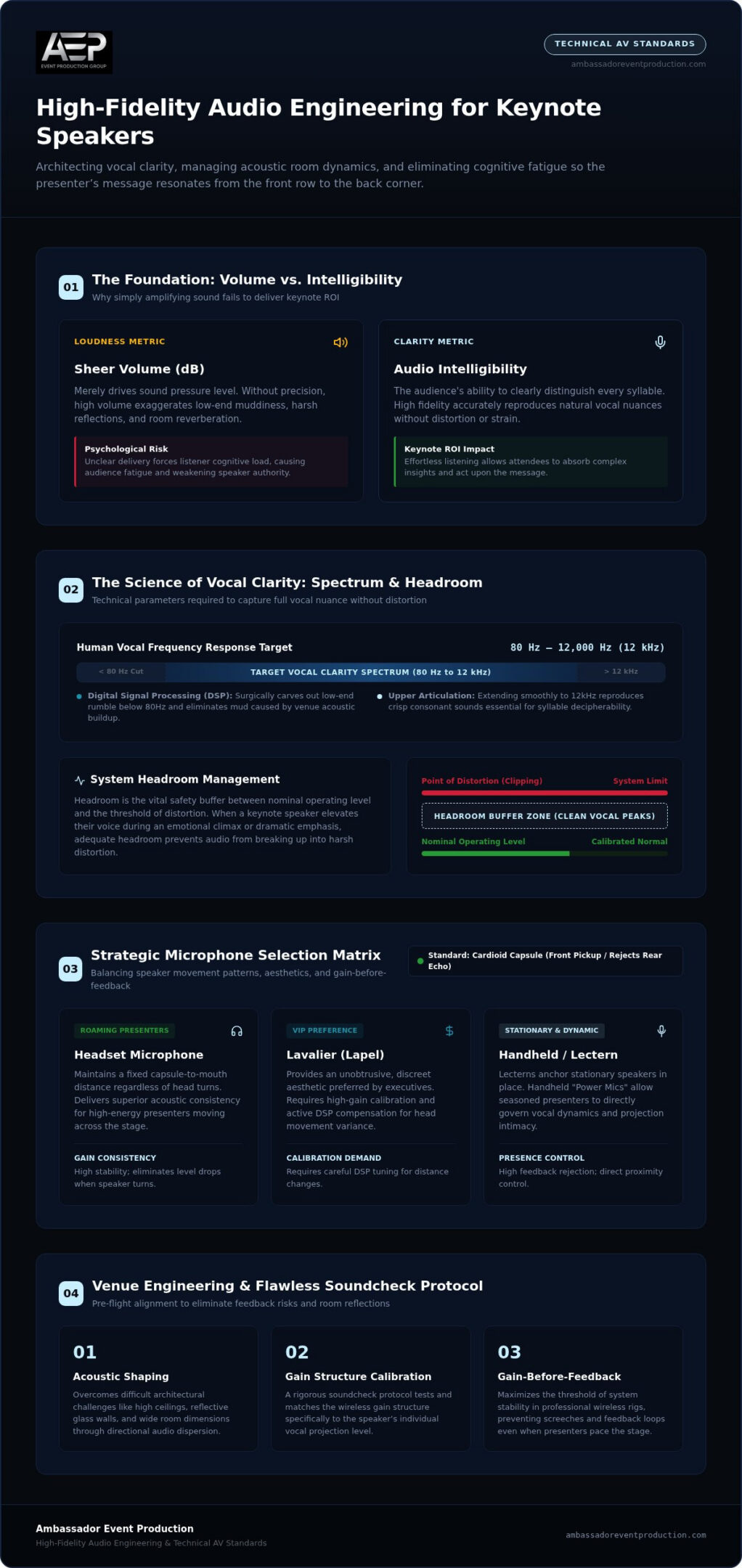
In the high-stakes environment of a corporate event, the difference between a message that inspires and one that falls flat often comes down to a single technical metric: audio intelligibility. While many event planners focus on the sheer volume of public address systems, volume is merely a measure of loudness. Intelligibility is the audience’s ability to distinguish every syllable clearly. Without it, even the most profound insights are lost in a sea of muddy frequencies.
Providing high quality audio for keynote speakers requires a shift from thinking about “making things loud” to “making things accurate.” Fidelity refers to the accuracy of sound reproduction. When a system lacks fidelity, the speaker’s voice may sound thin, harsh, or distorted. This has a direct psychological impact on the room. If an audience struggles to decode what’s being said, they subconsciously begin to question the speaker’s authority. A crisp, natural vocal tone reinforces a speaker’s professional image and ensures their personal brand remains untarnished by technical failure.
The Science of Vocal Clarity
To capture the full nuance of the human voice, a sound system must handle a specific frequency response, typically ranging from 80Hz to 12kHz. Our technical teams use digital signal processing (DSP) to surgically remove unwanted room noise and “muddiness” caused by low-end buildup. We also prioritize “headroom.” This is the buffer between the normal operating level and the point where the system begins to distort. When a speaker reaches an emotional peak or raises their voice for emphasis, adequate headroom ensures the sound remains clean rather than breaking up into harsh noise.
Combatting Audience Fatigue
When audio quality is low, the listener’s brain has to work significantly harder to fill in the gaps of missing information. This cognitive load leads to audience fatigue, where guests eventually disengage because the effort of listening becomes too great. High quality audio for keynote speakers solves this by ensuring consistent sound distribution across the entire venue. Whether someone is sitting in the front row or the very back corner, they should experience the same level of clarity and presence. Intelligibility is the critical metric for keynote ROI because a message that isn’t understood is a message that can’t be acted upon.
Choosing the Right Microphone for Every Keynote Style
Selecting a microphone is more than a technical checkbox; it’s a strategic decision that dictates how a speaker interacts with their audience. To provide high quality audio for keynote speakers, we first analyze their movement patterns. A speaker who remains anchored to a lectern requires a vastly different configuration than one who roams the stage to engage the crowd. This choice directly impacts the “gain-before-feedback” threshold. In professional wireless systems, maintaining a high threshold is non-negotiable. It ensures the voice remains loud and clear without the system reaching a point of instability or screeching.
The microphone’s capsule type also plays a vital role in managing ambient room noise. Cardioid capsules are the industry standard for keynotes because they pick up sound primarily from the front, effectively ignoring the speakers and echoes behind the mic. This precision helps in maintaining safe sound level standards while ensuring the voice remains the focal point of the recording. For a deeper dive into these technical benchmarks, you can explore our High-Fidelity Event Audio Production guide, which outlines the standards we use for national corporate events.
Lavalier vs. Headset: The Roaming Speaker Debate
Lavalier (lapel) microphones offer a discreet, professional look that many VIPs prefer. However, they can be temperamental because the distance between the mouth and the mic changes whenever the speaker turns their head. Headset mics solve this by keeping the capsule at a fixed distance, providing superior consistency. We typically recommend headsets for high-energy presenters who move their heads frequently. If a speaker’s attire doesn’t support a headset or they find it intrusive, we’ll opt for a high-gain lavalier and adjust our processing to compensate.
Handheld and Lectern Mics for Traditional Delivery
Some presenters rely on the “Power Mic” effect, using a handheld to control their own dynamics and physical presence. This is often the best choice for high quality audio for keynote speakers who are comfortable with mic technique. For those reading from notes, a lectern mic provides a stable “sweet spot” that allows them to focus on their delivery. Regardless of the primary choice, our protocol always includes a wired handheld mic in the wings. It’s a simple, fail-safe backup that ensures the message continues even if a wireless frequency faces interference. If you’re planning a high-stakes event, our audio production services team can help you map out the ideal configuration for your specific lineup.
Engineering the Room: Overcoming Venue Acoustic Challenges
Corporate venues often present architectural challenges that act as “sound killers.” Large glass walls reflect audio like mirrors, while cavernous ceilings create muddy reverberation that swallows a speaker’s message. Unlike some approaches that suggest a speaker can simply use their own energy to fill a room, we rely on the laws of physics and precise engineering. High quality audio for keynote speakers requires shaping the sound reinforcement to the specific dimensions of the hall. This involves strategically placing speakers to minimize echoes and ensure that the direct sound reaches the audience before the reflections do. Recent advances in audio technology allow us to map these environments digitally, predicting how sound waves will interact with hard surfaces before the first piece of equipment is even rigged.
Integrated technical production means we don’t look at audio in isolation. We consider how the staging and rigging affect the room’s acoustics. For example, a large scenic backdrop can actually help by absorbing sound that would otherwise bounce off a back wall. By treating the venue as a single, integrated organism, we can deploy techniques to minimize reverberation even in the most challenging convention halls, ensuring the speaker’s voice remains the dominant sound source at all times.
Point Source vs. Line Array Systems
The choice between speaker configurations depends on the room’s depth and the event’s intimacy. Point source speakers are ideal for smaller rooms or fireside chats where the audience is close to the stage. For deep convention halls, line arrays are essential. They project sound in a controlled, cylindrical pattern that maintains consistent volume from the front row to the back. In massive venues, we use digital delay speakers. These secondary units are timed to fire exactly when the sound from the main stage arrives, eliminating the “ghosting” effect where the back row hears a distracting double-tap of audio.
Managing Ambient Noise and RF Interference
Beyond the physical room, the invisible environment of radio frequencies (RF) requires careful management. We perform rigorous frequency coordination to ensure wireless microphones don’t compete with local TV or radio signals, which can cause dropouts. We also consider the impact of the lighting rig on audio signal integrity. It’s vital that expert stage lighting design is coordinated with audio cabling to ensure power lines and data cables are shielded and separated, preventing the dreaded 60-cycle hum. This integrated approach ensures that the high quality audio for keynote speakers remains pristine, regardless of the venue’s electrical or acoustic limitations.
The Flawless Soundcheck: A Technical Protocol for Speakers
A successful keynote begins long before the house lights dim. The relationship between the front-of-house (FOH) engineer and the speaker is a partnership built on trust and technical precision. During a soundcheck, our engineers don’t just listen for volume; they calibrate the “gain structure” to match your specific vocal projection style. Whether you’re a dynamic presenter who moves from a whisper to a shout or a steady, methodical speaker, the system must be tuned to capture every nuance without distortion. This personalized calibration is essential for delivering high quality audio for keynote speakers in high-stakes environments.
For speakers who require additional support, we often suggest an In-Ear Monitor (IEM) option. This allows you to hear your own voice clearly, even in large, reverberant halls, without the risk of feedback from floor wedges. We also establish a dedicated “talkback” channel. This provides a private line of communication between you and the technical crew, allowing for seamless adjustments or cues that the audience never hears. If you’re looking for this level of detail, our audio-visual technical support team ensures every minute of your preparation is maximized.
The 15-Minute Technical Rehearsal
We treat the technical rehearsal as a choreography of sound. During this time, we ask you to walk the entire stage. This helps us identify “cold spots” where the acoustics might change or “feedback zones” where the microphone might interact with the house speakers. We also test your audio cues, videos, and walk-on music to ensure the timing is perfect. Finally, we confirm the comfort and placement of your wireless belt pack. It’s a small detail, but a secure, well-placed pack prevents distractions and allows you to focus entirely on your delivery.
Fail-safes and Redundancy
In a live environment, hope is not a strategy. We employ a rigorous “A/B” wireless setup for every critical microphone, running two separate receivers simultaneously. If one frequency experiences a sudden burst of interference, the audio engineer uses an emergency “instant-switch” protocol to move to the backup signal in milliseconds. This level of redundancy is how a reliable event technology partner protects your keynote investment. We handle the complex logistics and potential technical hurdles behind the scenes so you can step onto the stage with total confidence, knowing your voice will be heard exactly as intended.
Partnering for Technical Excellence: The Ambassador Approach
Ambassador Event Production has been a cornerstone of the industry since 1955. We bring over 70 years of technical mastery to every stage we build. Our goal is to protect your keynote investment by ensuring every technical detail is handled with precision. High quality audio for keynote speakers is a priority, but we don’t view it in a vacuum. We operate as your “Experienced Guide,” managing the complex logistics so you can focus on the message. Our national service coverage ensures that whether you’re hosting an event in a large ballroom or a massive convention center, you receive the same boutique level of personal attention and accountability.
When audio, video, and lighting work as a single organism, the result is a seamless experience for the audience. We believe that technical execution should be invisible. If the audience is thinking about the sound system, we haven’t done our job. By integrating our services, we eliminate the friction that often occurs when multiple vendors try to coordinate on a single stage. This “behind-the-scenes” mastery is what allows the speaker to remain the focal point of the event.
Integrated Technical Direction
Our audio engineers work side-by-side with our video teams to ensure perfect synchronization. This is especially critical for high quality audio for keynote speakers who rely on video playback or live-streamed elements. Having a single point of contact for all technical production needs reduces stress and ensures a cohesive aesthetic and technical standard across the entire event. For a deeper look at how we manage these complex environments, explore our guide to Technical Event Production.
Your Trusted Partner in High-Stakes Production
We move beyond the traditional “vendor” mindset to act as your strategic ally. Our family-owned heritage drives a higher standard of service because our reputation is built on long-term reliability rather than short-term transactions. This stability is vital in high-stakes corporate environments where there’s no room for error. We’re here to ensure you shine, providing the steady, expert hand needed to navigate the pressures of live events. If you’re ready to elevate your next event, Contact Ambassador Event Production to discuss your upcoming keynote audio requirements and discover the difference that 70 years of integrated mastery makes.
Elevating Your Message Through Technical Precision
A successful keynote is built on the foundation of vocal clarity. It’s the difference between an audience that struggles to listen and one that is fully captivated by your message. We’ve explored how intelligibility, strategic microphone selection, and room engineering work together to create a seamless environment for the presenter. Achieving high quality audio for keynote speakers requires more than just high-end equipment; it demands a dedicated technical crew that understands the nuances of high-stakes corporate environments. When the technology disappears, your message takes center stage.
With over 70 years of technical event production experience, Ambassador Event Production provides the integrated mastery of audio, video, and lighting needed to protect your investment. We handle the complex logistics behind the scenes so you can focus on the stage. Our dedicated technical crew is ready to serve as your trusted partner for any national event. Partner with Ambassador for your next high-stakes keynote and ensure your message resonates with every person in the room. We look forward to helping you shine.
Frequently Asked Questions
What is the best microphone for a keynote speaker who moves around a lot?
A headset or earset microphone is the best choice for speakers who move frequently because it maintains a fixed distance between the mouth and the capsule. This consistency is vital for delivering high quality audio for keynote speakers, as it prevents the volume fluctuations common with lavalier mics when a presenter turns their head. Our technical teams prioritize these systems for roaming presenters to ensure the vocal signal remains steady and clear throughout the entire performance.
How do you prevent audio feedback during a live corporate event?
Preventing feedback requires a combination of precise microphone placement, proper gain structure, and surgical equalization. We ensure that microphones are always positioned behind the main house speakers to minimize the loop of sound. Additionally, our engineers use digital signal processing to identify and attenuate the specific frequencies prone to ringing. This proactive approach creates a stable environment where the speaker can project naturally without the risk of piercing technical interruptions.
Why does the sound quality in the back of the room often differ from the front?
Sound quality varies because high frequencies lose energy faster than low frequencies as they travel through the air. In large rooms, the back row often hears a muddier version of the speech compared to the front. We solve this by using delay speakers and advanced sound reinforcement techniques. These systems ensure that every seat in the venue receives the same level of clarity and high quality audio for keynote speakers, regardless of the room’s depth.
What is a “line array” and do I need one for my keynote?
A line array is a vertical cluster of specialized speaker cabinets designed to project sound in a controlled, cylindrical pattern. You need one for your keynote if you are presenting in a deep or large venue where even volume distribution is critical. Unlike traditional speakers that scatter sound, line arrays allow us to steer the audio directly toward the audience, significantly reducing unwanted reflections from the ceiling and walls that cause vocal blurring.
Can we use the venue’s built-in ceiling speakers for a professional keynote?
Built-in ceiling speakers are generally unsuitable for professional keynotes because they are designed for background music and paging rather than high-fidelity vocal reproduction. These systems often lack the frequency range and power needed to provide a commanding presence on stage. For a high-stakes event, we deploy professional-grade point source or line array systems that are specifically engineered to handle the nuances and emotional peaks of a live keynote presentation.
How much time should we allocate for a keynote speaker’s soundcheck?
You should allocate at least 15 to 30 minutes for a dedicated technical soundcheck. This time allows the audio engineer to calibrate the system to the speaker’s unique vocal dynamics and verify the integrity of the wireless signal. It also provides an opportunity for the speaker to get comfortable with the stage monitors and confirm that all audio cues, such as videos or walk-on music, are triggering perfectly within the integrated production environment.
What happens if a wireless microphone fails during a live presentation?
If a wireless microphone fails, our engineers immediately trigger an emergency instant-switch protocol to a backup system. We provide redundancy by running an A/B setup with two separate receivers for every critical channel. Additionally, we always keep a wired handheld microphone in the wings as a final fail-safe. This multi-layered approach ensures that the presentation continues without interruption, protecting both the speaker’s authority and the client’s investment in the event.
Should I provide a teleprompter and how does it affect the audio setup?
You can certainly provide a teleprompter, and while it doesn’t directly produce sound, its placement must be coordinated with the audio setup. We ensure that the prompter glass is positioned to avoid blocking the line of sight for any lectern microphones. Our integrated technical teams manage both the prompter and the audio-visual support as a single organism, ensuring that the technology assists the speaker without creating physical or acoustic obstructions on the stage.